
The $60,000 US Estate Tax Exemption Is a $13,000 Credit
Most explainers say non-residents get a $60,000 exemption from US estate tax. The law gives a $13,000 credit instead, and that changes how much your heirs owe.

Abhighyan Sinha
Almost every article on US estate tax for Indian investors carries one of two claims. Either non-residents get a $60,000 exemption and everything above it is taxed at 40%, or the first $60,000 is not taxed at all and the tax only starts after that. I have read both on broker blogs, in news reports and on personal finance sites, and whenever either is used to work out a bill, the number comes out wrong.
The law gives non-residents no exemption. It taxes the full value of your US assets at graduated rates from 18% to 40%, and then takes $13,000 off the bill as a credit. That credit equals the tax on the first $60,000, which is where the familiar figure comes from.
The difference sounds like a technicality until you run the numbers, so that is where I will start.
One estate, three different answers
To see how much the wording matters, I ran one portfolio through the three methods I kept coming across. I took the case of an Indian resident who holds $500,000 of US stocks and US-listed ETFs at the time of death, with no debts or expenses to deduct.
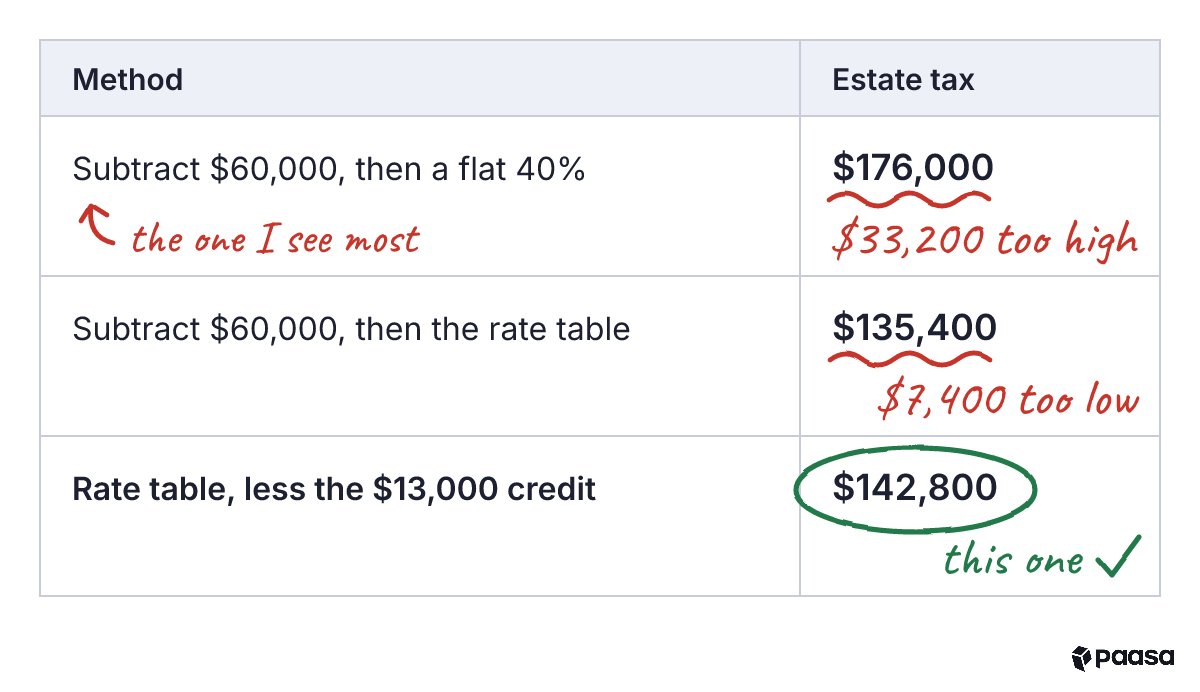
The law arrives at $142,800. The flat 40% method gives $176,000, which overstates the bill by $33,200, and the subtract-first method gives $135,400, which understates it by $7,400.
The flat 40% method is the one I see most often, and it distorts the picture most at smaller portfolio sizes. On $100,000 of US assets it gives $16,000, while the actual bill is $10,800. The 40% rate applies only to the part of an estate above $1 million, so a holding just over $60,000 is taxed at 26% on the margin.
The subtract-first method looks more careful because it uses the real rate table, but it starts the table in the wrong place. Taking $60,000 out of the estate removes it from the highest bracket the estate reaches, which at $500,000 saves $20,400. The credit is only ever worth $13,000.
What does the law say about the $60,000?
The statute contains no $60,000 exemption for non-residents. Section 2102(b)(1) of the US Internal Revenue Code allows a credit of $13,000 against the estate tax, and that is the only relief it gives.
The calculation therefore runs in two steps:
- Tentative tax: the rate schedule in Section 2001(c) is applied to the whole taxable estate, starting from the first dollar. On $500,000, this comes to $155,800.
- Credit: $13,000 is subtracted from that figure, which leaves $142,800.
The tax on an estate of exactly $60,000 works out to $13,000, so the credit cancels it in full and nothing is owed. This is the only sense in which the first $60,000 is exempt.
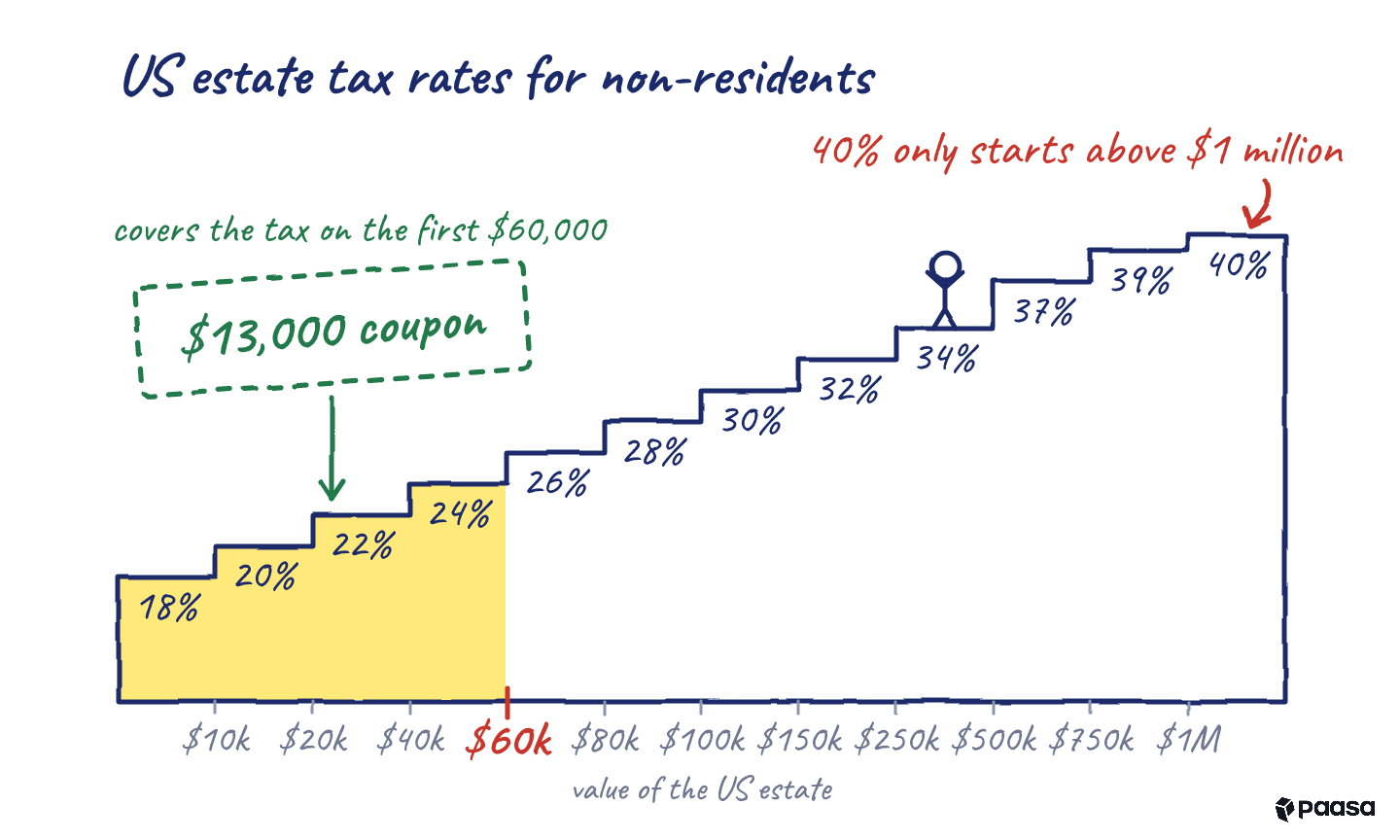
Once the estate is larger, the credit stays at $13,000 while the tax keeps rising, and the first $60,000 is taxed like every other dollar. The credit is a fixed amount and is not adjusted for inflation.
Where does $60,000 appear in the rules?
The figure is real, but it belongs to the filing requirement and has no part in the calculation. The executor has to file Form 706-NA when a non-resident's US-situated assets are worth more than $60,000 at the date of death.
Brokers use the same line to decide when they need an IRS transfer certificate before releasing US assets to heirs. Our guide on how estate transfers work on Paasa walks through that process.
So $60,000 correctly answers one question, which is whether an estate has to go through the IRS at all. The errors begin when the same number is carried into a second question, how much is owed, where the law uses the $13,000 credit instead.
What this changes if you hold US stocks
If your US holdings are modest, your exposure is real but smaller than the 40% headline suggests. The bill is $10,800 on $100,000 and $41,800 on $200,000, which is about 11% and 21% of the holding.
If your US holdings are large, the whole amount is taxed, including the first $60,000, and you still get the $13,000 credit against the bill. On $1 million the bill is $332,800 after the credit, or about a third of the portfolio, and the share keeps climbing towards 40% as the estate grows.
In both cases the figure you plan around should come from the two steps above. How US estate tax is calculated has the full rate schedule, and the US estate tax calculator gives the figure for your own holdings.
The quickest test of any estate tax number you are shown is to ask where the $13,000 went. If the working never subtracts a credit, the result is not the one the IRS would arrive at.
About Paasa
Paasa is a global investing platform that gives you direct access to stocks on their home exchanges in the US, Canada, the UK, Germany, France, Switzerland, the Netherlands, South Korea, Japan, Hong Kong and Singapore, along with ETFs and UCITS funds.
- UCITS funds outside US estate tax: invest in Ireland- and Luxembourg-domiciled UCITS ETFs and mutual funds, which give you exposure to US companies but are not US-situs assets.
- An account in your own name: your investments sit in an account held in your own name, with Interactive Brokers as custodian, so your heirs inherit a clearly identifiable account.
- Tax reports in one place: capital gains, dividends and Schedule FA workings, ready for your return in India.
Frequently Asked Questions
Is the first $60,000 of US assets exempt from US estate tax for non-residents?
Not as an exemption. Non-residents receive a $13,000 credit against US estate tax, which equals the tax on the first $60,000 of US assets. An estate worth $60,000 or less therefore owes nothing, but a larger estate is taxed on its full value and only $13,000 is taken off the bill.
Is US estate tax a flat 40% above $60,000?
No. US estate tax uses graduated rates from 18% to 40%, and the 40% rate applies only to the part of a taxable estate above $1 million. On $500,000 of US assets, a non-resident's estate owes $142,800, which is about 28.6% of the holding.
When does Form 706-NA have to be filed?
Form 706-NA has to be filed when a non-resident's US-situated assets are worth more than $60,000 at the date of death. This filing threshold is where $60,000 appears in the rules, and it is separate from the calculation of the tax.


Invest in global markets from India

Discussion
Disclaimer
The information provided in this post is for general informational purposes only. It is not intended as professional advice or to replace consultation with qualified professionals. While we strive to ensure the accuracy and reliability of the information presented, we make no representations or warranties of any kind, express or implied, about the completeness, accuracy, reliability, suitability, or availability with respect to the content contained herein. Any reliance you place on such information is therefore strictly at your own risk. We disclaim any liability for any loss or damage, including, without limitation, indirect or consequential loss or damage, or any loss or damage whatsoever arising from loss of data or profits arising out of, or in connection with, the use of this post. Always seek the advice of professionals or relevant authorities regarding your specific situation or circumstances.