
Tax Planning & FEMA
What Is DTAA? India's Tax Treaties Explained
What a DTAA is, how India's tax treaties work, treaty rates for nine markets, and how Indian residents claim foreign tax credit.

Abhighyan Sinha

A Double Taxation Avoidance Agreement (DTAA) is a tax treaty between two countries. It decides which country can tax each type of income, caps the tax the country where the income arises can charge, and makes sure you get credit for tax already paid in the other country. If you are an Indian resident investing abroad, a DTAA usually lowers the tax the foreign country withholds on your dividends and interest. India then taxes that income and gives you credit for the foreign tax.
This guide explains how India's DTAAs work, with treaty rates for nine markets Indian investors use most, and how to claim the credit in India.

What is double taxation?
When you live in India and earn income from another country, both countries may try to tax it. The country where the income arises (the source country) taxes it first. India, as your country of residence, taxes your global income too. Taxing the same income twice is double taxation.
Example. Suppose you are an Indian resident in the 30% slab and your US stocks pay $5,000 in dividends. The US withholds 30% by default, but under the India-US DTAA the rate drops to 25% once you file Form W-8BEN with your broker.
| Item | Without a DTAA | With the DTAA |
|---|---|---|
| Gross dividend | $5,000 | $5,000 |
| US tax withheld | $1,500 (30%) | $1,250 (25%) |
| Indian tax at 30% on the gross dividend | $1,500 | $1,500 |
| Credit for US tax | None | $1,250 |
| Tax still payable in India | $1,500 | $250 |
| Total tax paid | $3,000 (60%) | $1,500 (30%) |
The result: with the DTAA, you pay tax once, at your Indian rate
This example ignores surcharge and cess.
How do India's DTAAs work?
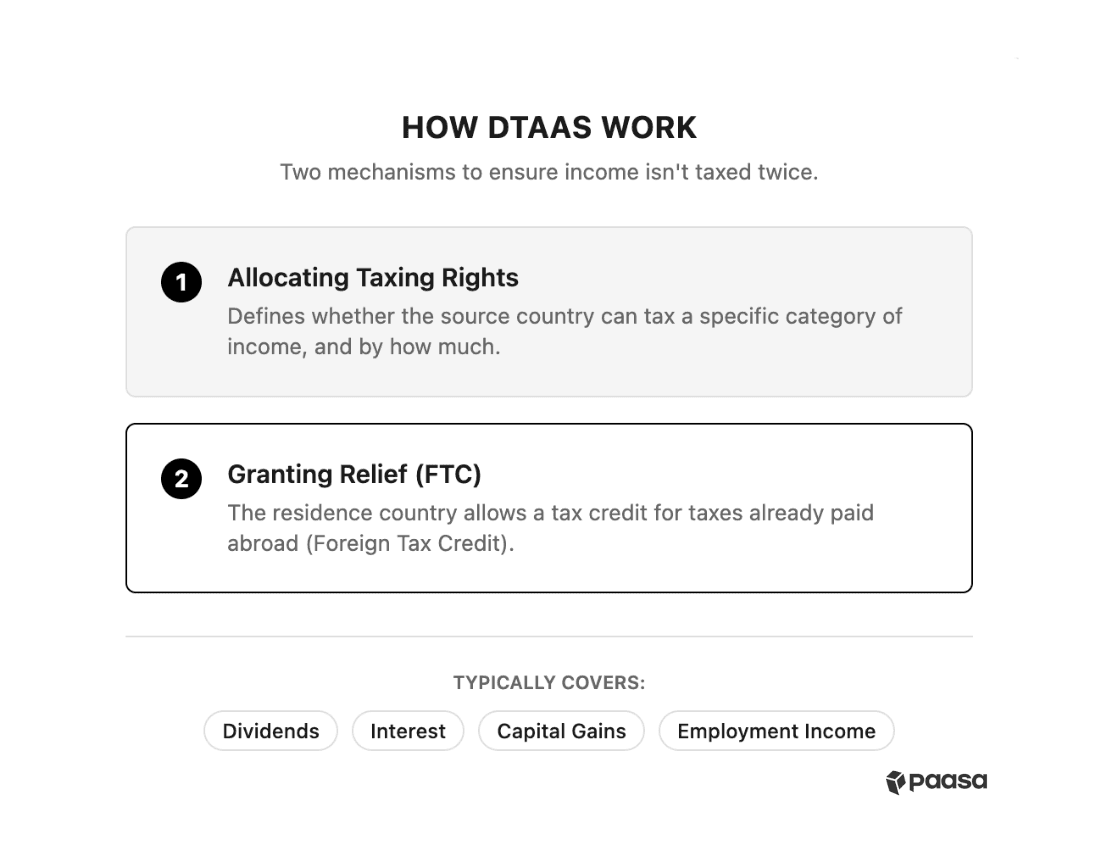
India's tax treaties work in two ways:
- Allocating taxing rights: the treaty sets which country can tax each type of income, and caps how much the source country can charge.
- Granting relief: if both countries tax the same income, the country you live in gives credit for the tax paid abroad.
They usually cover employment income (including stock awards), dividends, interest and capital gains.
Note: Treaty benefits are not applied on their own. You claim the lower foreign rate through your broker, and the credit in India through your tax return.
What are the treaty rates for each country?
This table shows the most a source country can charge an Indian resident on dividends and interest under each DTAA, as listed by the Income Tax Department.
| Country | Dividends (treaty cap) | Interest (treaty cap) | Country guide |
|---|---|---|---|
| US | 25% (15% for a company owning at least 10% of the voting stock) | 15% (10% on bank loans) | India-US DTAA |
| UK | 10% (15% for certain property investment vehicles) | 15% (10% to banks) | India-UK DTAA |
| Singapore | 15% (10% for a company owning at least 25%) | 15% (10% on bank loans) | India-Singapore DTAA |
| Switzerland | 10% | 10% | India-Switzerland DTAA |
| Ireland | 10% | 10% | India-Ireland DTAA |
| Japan | 10% | 10% | India-Japan DTAA |
| Germany | 10% | 10% | India-Germany DTAA |
| Poland | 10% | 10% | India-Poland DTAA |
| China | 10% | 10% | India-China DTAA |
Note: A treaty rate is a cap, not the rate you always pay. Some countries charge less under their own law, or nothing at all on certain income. Others withhold a higher rate at source and refund the difference when you apply. Each country guide explains what is actually withheld and how to claim the treaty rate.
Who counts as a tax resident?
Which treaty applies to you depends on where you are tax resident. Under section 6 of the Income-tax Act 2025, you are resident in India for a tax year if:
- you are in India for 182 days or more in the tax year, or
- you are in India for 60 days or more in the tax year and 365 days or more in the four years before it.
Note: Two exceptions apply to Indian citizens and persons of Indian origin. If you visit India from abroad and your Indian income (excluding foreign income) is above ₹15 lakh, the 60-day test becomes 120 days. An Indian citizen with Indian income above ₹15 lakh who is not liable to tax in any other country is deemed resident.
Depending on your travel and income, two countries can treat you as resident in the same year.
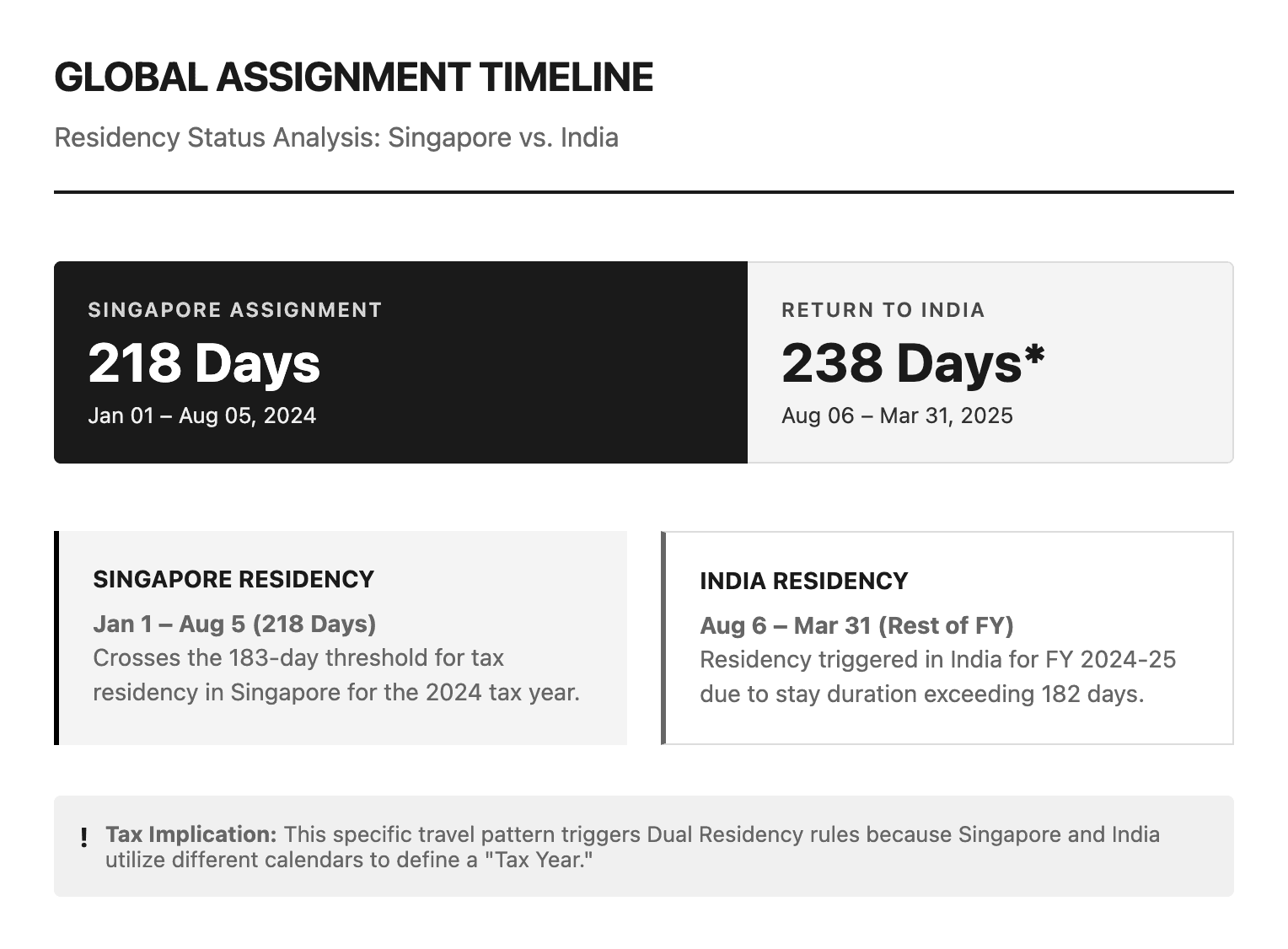
Example. Suppose you are a software engineer on an assignment in Singapore. You stay in Singapore from 1 January to 5 August 2024 (218 days), then return to India on 6 August 2024 and stay until 31 March 2025.
1. The Singapore view (calendar year)
Singapore taxes by calendar year. A foreigner is a tax resident of Singapore for a year if they:
- stayed or worked in Singapore for at least 183 days in the calendar year, or
- stayed or worked in Singapore continuously for 3 consecutive years, or
- worked in Singapore for a continuous period straddling 2 calendar years, with a total stay of at least 183 days.
You were in Singapore for 218 days in 2024, so you are a Singapore tax resident for 2024.
2. The India view (tax year)
India taxes by financial year, from 1 April to 31 March (called the tax year under the Income-tax Act 2025). You were in India from 6 August 2024 to 31 March 2025, about 238 days, which meets the 182-day test. You are an Indian tax resident for 2024-25.
The result: both countries treat you as resident from April to December 2024
Income you earned in that overlap is at risk of being taxed by both. In such cases, the treaty's tie-breaker rule decides which country treats you as resident, in this order:
- Permanent home: where you have a home available to you.
- Centre of vital interests: where your personal and economic ties are closer.
- Habitual abode: where you usually live.
- Nationality: the country you are a citizen of.
- Mutual agreement: if none of these settles it, the two tax authorities decide.
Which country taxes what?
The treaty splits taxing rights between the source country and the country of residence. As an Indian resident, India taxes all of your income under its own rules. If the source country has taxed it too, you claim that tax as a credit in India.
Dividends
India taxes foreign dividends at your slab rate. The source country withholds tax first, up to the treaty cap.
Example. Suppose you own Apple shares and receive a $100 dividend. Under the India-US DTAA, the US withholds 25%, so $75 reaches your account. You report $100 in India and claim credit for the $25.
Interest
Interest from foreign bonds, bond funds or cash is taxed in India at your slab rate. The source country may withhold tax first, up to the treaty cap.
Example. Suppose you hold bonds issued by a Swiss company and earn CHF 1,000 in interest. Under the India-Switzerland DTAA, Swiss tax on that interest is capped at 10%, or CHF 100. Switzerland withholds more at source and refunds the excess when you apply, as Paasa's India-Switzerland DTAA guide explains.
Capital gains
Whether the source country taxes your gain on shares depends on the treaty and that country's own law. The US, for example, generally doesn't if you were there for less than 183 days in the year (IRS Publication 519).
India taxes the full gain:
- Long-term (held for more than 24 months): 12.5% without indexation, under section 197 of the Income-tax Act 2025.
- Short-term (held for 24 months or less): at your slab rate.
Example. Suppose you bought Tesla shares for $1,000 and sold them for $1,500. The US does not tax the $500 gain, so you receive the full $1,500. You pay capital gains tax on the $500 in India.
How do you claim foreign tax credit in India?
India gives credit for foreign tax under section 159 of the Income-tax Act 2025 where a treaty applies, and under section 160 where there is no treaty. These replaced sections 90 and 91 of the 1961 Act from 1 April 2026. To claim the credit:
- Report the gross income in your return, before foreign tax, and list your foreign assets in Schedule FA.
- File Form 44 for foreign income earned from 1 April 2026, or Form 67 for income earned up to 31 March 2026. Form 44 is due within 12 months of the end of the tax year, if your return is filed on time (CBDT's Form 44 FAQs).
- Keep proof of the foreign tax, such as a broker statement showing the income and tax withheld. If the foreign tax paid in a year is ₹1 lakh or more, Form 44 must be verified by an accountant.
The credit cannot be more than the Indian tax on the same income. Paasa's guide to Form 44, which replaced Form 67, and the Schedule FA guide walk through each step. For the full list of renumbered sections, see the old-to-new section mapping.
The source country has its own paperwork too, such as Form W-8BEN for the US. Each country guide in the treaty rates table covers it.
Conclusion
DTAAs make sure Indian residents earning abroad pay tax once on that income, not twice. The source country's tax is capped by the treaty, and India gives credit for it against your own tax. To get both, claim the treaty rate with your broker and file Form 44 (or Form 67) with your Indian return.
About Paasa
Paasa is a global investing platform built for Indian and Asian investors, giving anyone direct access to stocks and ETFs across the US, UK, Europe and Asia.
- Treaty rates applied: Paasa handles your Form W-8BEN, so US dividends are withheld at the treaty rate.
- Credit-ready reports: India-ready tax reports show the foreign tax withheld, for Form 44 (or Form 67) and Schedule FA, across all the markets you hold, with a dedicated relationship manager to help you file correctly.
- One account, many treaty countries: invest in the US, UK, Europe and Asia, including UCITS ETFs, from one account.
Frequently Asked Questions
What is DTAA?
A Double Taxation Avoidance Agreement (DTAA) is a tax treaty between two countries. It decides which country can tax each type of income, caps the tax the source country can charge, and makes sure the country you live in gives credit for tax already paid in the other.
Can I be a tax resident of India if I am not a citizen?
Yes. Tax residency in India depends on how long you are in India, not on citizenship. You are resident if you are in India for 182 days or more in the tax year, or for 60 days or more in the tax year and 365 days or more in the four years before it.
Do I need to file taxes in India if all my investments are abroad?
Yes, if you are resident and ordinarily resident. You must file a return and disclose all foreign assets, such as shares, bank accounts and property, in Schedule FA, even if they earned no income during the year.
What do I need to claim foreign tax credit in India?
You file Form 44 for foreign income earned from 1 April 2026, or Form 67 for income earned up to 31 March 2026, and keep proof of the foreign tax, such as a broker statement showing the income and tax withheld. Form 44 is due within 12 months of the end of the tax year if your return is filed on time.
Are overseas capital gains taxed in India?
Yes. Indian residents are taxed on their global income. Long-term gains on assets held for more than 24 months are taxed at 12.5% without indexation. Short-term gains on assets held for 24 months or less are added to your income and taxed at your slab rate.
Does a DTAA reduce tax on capital gains?
Usually not directly. Under the India-US DTAA, for example, each country taxes capital gains under its own law. India taxes your full gain, and some countries, such as the US for most investors, do not tax non-residents on gains from listed shares, so there is often no foreign tax to claim credit for.
Can I claim credit in India for US state taxes?
The India-US DTAA covers only US federal income tax. Credit for US state taxes falls under the unilateral relief section, section 160 of the Income-tax Act 2025 (section 91 of the old Act), and has been allowed in tribunal rulings, but it is a disputed area, so take advice from a chartered accountant before claiming it.
What happens if I do not file Form 44 or Form 67?
The foreign tax credit is not applied automatically. If you do not file the form within the time allowed, you can lose the credit even though you have already paid tax in the other country.
Is US estate tax covered by the India-US DTAA?
No. The treaty covers income tax only. US estate tax can apply on death to non-residents who hold more than 60,000 dollars of US-situs assets, such as US shares and ETFs, and the treaty gives no relief from it.


Invest in global markets from India

Discussion
Disclaimer
The information provided in this post is for general informational purposes only. It is not intended as professional advice or to replace consultation with qualified professionals. While we strive to ensure the accuracy and reliability of the information presented, we make no representations or warranties of any kind, express or implied, about the completeness, accuracy, reliability, suitability, or availability with respect to the content contained herein. Any reliance you place on such information is therefore strictly at your own risk. We disclaim any liability for any loss or damage, including, without limitation, indirect or consequential loss or damage, or any loss or damage whatsoever arising from loss of data or profits arising out of, or in connection with, the use of this post. Always seek the advice of professionals or relevant authorities regarding your specific situation or circumstances.