



The silver market is currently defined by a severe structural imbalance, entering its sixth consecutive year of supply deficit. As demand from green infrastructure accelerates against inelastic mine supply, the fundamental floor for prices is rising.
This blog covers how Indian investors can access the best silver ETFs globally for superior liquidity and cost efficiency.
Table of contents
Why are investors looking at silver exposure?
Here’s why investors are looking to add silver to their portfolios:
1. Solar Energy Explosion
- Silver is the most conductive metal on earth, making it irreplaceable in Solar Photovoltaic (PV) cells.
- The solar industry's appetite for silver has exploded. By 2027, solar panel manufacturing is projected to consume nearly 20% of the entire global annual supply of silver.
- As the world races to meet 2030 renewable energy targets, the "solar load" on the silver market is becoming a permanent floor for demand.
2. A Structural Supply Deficit
- The silver market is currently in its sixth consecutive year of a supply deficit.
- Most silver is not mined directly; it is a byproduct of mining copper, lead, and zinc. This means supply cannot simply "ramp up" when silver prices rise.
3. "High Beta" Asset
- Silver typically acts as a "leveraged" version of Gold. When precious metals rally, Silver tends to outperform Gold due to its smaller market size and higher volatility.
- While Gold rallied ~67%, Silver surged roughly 150%, rewarding investors who could stomach the volatility.
How can Indian investors buy silver?
Indian investors essentially have three paths for adding silver to their portfolio:
- Physical Silver: Bars and coins from jewelers or banks.
- Indian Silver ETFs: Domestic funds listed on the NSE/BSE.
- Global Markets: Buying institutional-grade Silver ETCs on international exchanges (LSE/NYSE).
1. Problem with Physical Silver
Buying silver bars in India is inefficient for investment purposes.
- Storage & Oxidation: Unlike gold, silver is bulky (less dense) and tarnishes (oxidizes) over time.
- Making Charges: You often pay a premium over the spot price when buying, and lose value when selling back to a jeweler.
2. Limits of Domestic ETFs
While Indian Silver ETFs (like those from Nippon or ICICI) are an improvement over physical metal, they have limitations.
- Tracking Error: These funds often struggle to track the global spot price perfectly due to import duties, currency hedging costs, and cash management issues. The tracking error can be around 0.50% to 1.0% annually.
- Expense Ratios: Domestic funds typically charge 0.40% - 0.60% per year.
3. Global Market Advantage
Global Silver ETCs (Exchange Traded Commodities) offer a more direct and efficient route.
- Pure Price Tracking: Funds listed in London or New York track the spot price with extreme precision.
- Lower Cost: Global ETCs have expense ratios as low as 0.20%, roughly half the cost of Indian alternatives.
Types of global funds that provide silver exposure
Here is a breakdown of the silver investment options available on global markets:
1. Physical Silver Funds
These funds hold allocated silver bars in secure vaults (London, Zurich, or Singapore).
- Structure: They are usually structured as ETCs (Exchange Traded Commodities).
- Security: The metal is "Allocated," meaning it is legally owned by the investors.
- Best For: Investors who want direct exposure to the metal price without corporate risk.
2. Silver Miners
Buying shares in companies that mine silver (e.g., Pan American Silver, Hecla Mining).
- Leverage: Mining stocks are "High Beta." If the price of silver rises 10%, a miner's profits might rise 30%. This often leads to their stock price rising faster than the metal itself.
- Risk: You are exposed to operational risks (e.g., a strike at a mine in Mexico or Peru).
Top silver funds you can invest in
Here are the top silver funds you can invest in, segmented by the type of exposure they offer.
1. Physical Silver Funds
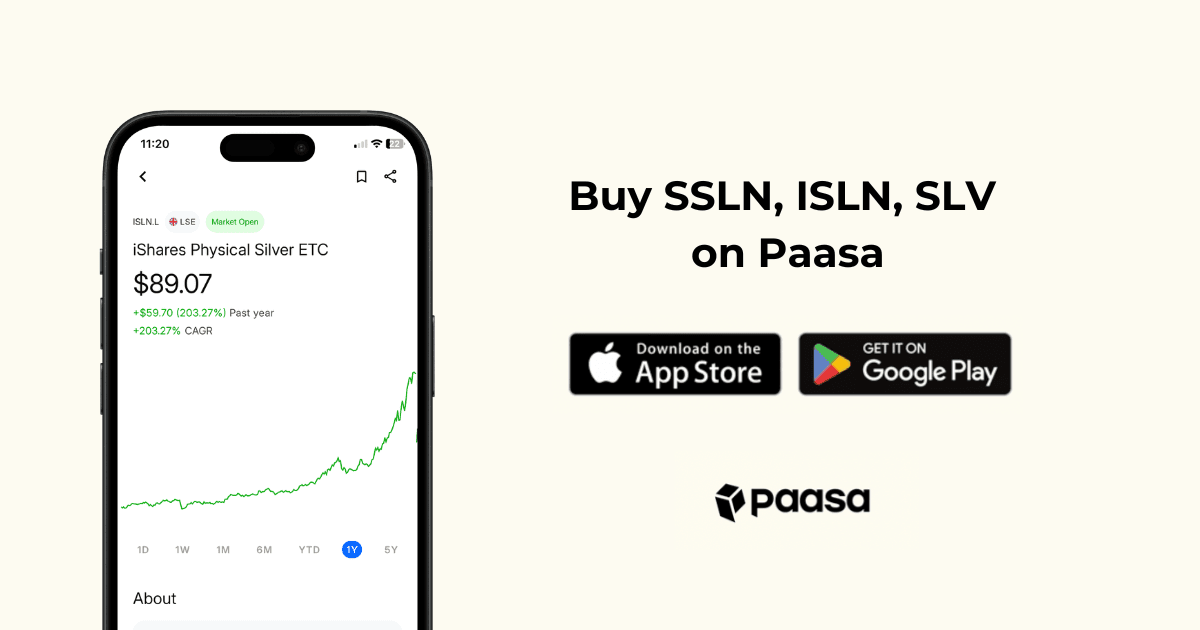
- European Fund : iShares Physical Silver ETC
- Ticker: SSLN (GBP) or ISLN (USD)
- Exchange: London Stock Exchange (LSE)
- Expense Ratio: 0.20% (One of the cheapest globally).
- Why: Deep liquidity, physically backed, and No US Estate Tax risk.
- US Fund (The Giant): iShares Silver Trust
- Ticker: SLV
- Exchange: NYSE Arca
- Expense Ratio: 0.50%
- Note: The most liquid silver fund in the world, but carries US Tax risk.
2. Silver Mining Leaders
- The "Blue Chip" Miner: Pan American Silver
- Ticker: PAAS
- Exchange: NYSE
- Profile: One of the world's largest primary silver producers with diversified assets across the Americas.
- You can invest in this stock using Paasa
- The US Giant: Hecla Mining
- Ticker: HL
- Exchange: NYSE
- Profile: The oldest precious metals miner listed on the NYSE. It is the largest silver producer in the US, producing ~40% of all US silver.
- You can invest in this stock using Paasa
- The ETF Play: Global X Silver Miners ETF
- Ticker: SIL
- Exchange: NYSE Arca
- Profile: A basket of the top 30+ global silver miners, giving you diversified industry exposure.

Which route is right for you?
| Physical Silver ETCs | Silver Mining Stocks | Domestic Indian ETFs |
Primary Goal | Direct price exposure. | Aggressive growth via business leverage. | Rupee-denominated exposure. |
Dividend Income | None. | Yes (Variable). | None. |
Key Risk | Volatility: Price swings. | Operational: Mine strikes/politics. | Tracking Error: Divergence from spot. |
Leverage | None (1:1 with metal). | High: Profits explode as price rises. | None. |
Best For | Strategic long-term allocation. | Risk-tolerant growth seekers. | Small, tactical allocations. |
Why Indian investors should choose non-US silver funds
For Indians investing globally, where a fund is located should be an important consideration, as US-domiciled funds and stocks come with a significant taxation risk.
The United States enforces a strict Estate Tax on non-residents. If you hold US-domiciled assets (such as the SLV or SIVR ETFs) and pass away, the US government levies a 40% tax on the value of those assets above $60,000.
This means that in the event of an untoward incident, your heirs could lose nearly half of your US-based portfolio to the IRS before the money is even repatriated to India.
For more information on how the Estate tax can affect your investments, read How the US Estate Tax Works for Indians and NRIs.
The Solution: Non-US Funds
Funds not domiciled in the US, like those listed on the London Stock Exchange (LSE) do not carry this risk.
By choosing the iShares Physical Silver ETC (SSLN) on the LSE, you get the exact same silver exposure as the US funds, often at a lower cost (0.20%), but completely eliminate the risk of a 40% tax wipeout.
For Indian investors focused on long-term wealth preservation, this structural safety makes London-listed funds the superior choice.
Invest in silver ETFs with Paasa
Paasa is a truly global platform designed for the modern Indian investor. We provide direct access to over 10 global exchanges, including the United States, United Kingdom, Switzerland, Hong Kong, Germany, France, Canada, Netherlands, Japan, and Singapore.
This means you are not restricted to just US funds; you can buy tax-efficient Silver ETCs listed in London from a single interface.
The Compliance Advantage
Global investing usually comes with a heavy compliance burden. Paasa removes this friction with a specialized layer built specifically for Indian residents:
- Schedule FA Reporting: We generate the exact reports you need for your Indian tax returns, eliminating the need for manual calculations.
- Tax Filing & Advice: Get access to expert tax advice and seamless filing support.
- FEMA & LRS Integration: We provide guidance on FEMA regulations and LRS limits to ensure compliance.
Whether you are buying silver miners in New York or physical silver in London, Paasa provides the global access you need with the India-specific compliance you require.
What other commodities can I invest in with Paasa?
Paasa provides access to all commodities and stocks listed on global stock exchanges across US, Europe and Asia.

