



If you are an Indian investor holding US stocks and ETFs (including RSUs), the US Estate Tax should be your top financial planning concern as it can wipe off up to 40% of your US-situs assets in the case of your death.
This blog talks about how the US Estate Tax is calculated and how you can find out your exact US Estate Tax liability using our Estate Tax Calculator.
Table of contents
- What is the US Estate Tax?
- Who needs to pay US Estate Tax?
- Who is considered non-domiciled?
- What assets are considered for calculating Estate Tax?
- How is the Estate Tax calculated?
- Estate Tax liability calculator
- What does your family need to do?
- How to reduce Estate Tax exposure to zero?
- More tools from Paasa
- About Paasa
What is the US Estate Tax?
The US Estate Tax is a federal tax levied on the transfer of a deceased person's assets to their heirs. It is essentially a tax on the right to transfer property upon death.
It is levied at progressive rates ranging from 18% to 40% on the total market value of your US-situs assets. Non-residents then receive a fixed credit of $13,000 against the tax, which is what protects the first $60,000 of estate value.
Who needs to pay the US Estate Tax?
Anyone whose US-situs assets are worth more than $60,000 at the time of death needs to pay the US estate tax.
If you are not domiciled in the US, only your US-situs assets are counted, and the tax applies once their value crosses the $60,000 limit. US citizens and domiciliaries, by contrast, are taxed on their worldwide estate, but with a far larger exemption of $15 million.
Who is considered non-domiciled for US Estate Tax calculation?
US domiciliary status is based on intent. To be domiciled in the US, you must be physically present there with the definite intention to remain indefinitely.
If you are not based in the US and do not have the intention (and means) to remain there permanently, you are considered non-domiciled for estate tax purposes.
If you are an Indian professional working in India, or on a visa (like H-1B or L-1) with the intent to return home eventually, the IRS will usually treat you as non-domiciled. This means you are subject to the strict $60,000 limit on your US holdings. Note that a visa category alone does not settle the question. The IRS weighs the full set of facts, including where your family, home, and business ties sit.
Note: India does not have an estate tax treaty with the US. If you are an NRI living in one of the 15 countries that do, such as the UK, Canada, or Japan, the treaty may give you a higher exemption or limit which of your assets count as US-situs. Check the treaty for your country.
What assets are considered for calculating the US Estate Tax?
US-situs assets owned at the decedent’s death that are subject to US estate tax include:
- US real estate: Any land or property located in the US.
- Tangible personal property: Items physically located in the US, such as automobiles, furnishings, art, and jewelry. Note that cash and currency are considered tangible personal property and will be taxable if located in the United States (e.g., in a safe deposit box).
- US stocks: Shares of corporations organized in or under US law (e.g., Apple, Microsoft), even if the share certificates or brokerage account are held outside the US.
- Some US debt obligations: Debt issued by US companies or US persons whose interest does not qualify for the portfolio interest exemption. Most bonds held by investors do qualify, so they are not counted (see below).
- Retirement plans: Qualified retirement plans (like 401(k)s) held in the United States.
- Business assets: Assets connected to a US trade or business, including bank accounts used for that business.
For estate tax purposes, the value of your US holdings is determined by their Fair Market Value (FMV) on the date of death
What is not counted?
These assets are not treated as US-situs, so they are not subject to US Estate Tax (IRS):
- UCITS ETFs and other non-US funds: Funds domiciled outside the US, such as Irish UCITS ETFs, are not US-situs assets, even if they hold US stocks.
- Most US bonds: Bonds whose interest qualifies for the portfolio interest exemption. This covers most US Treasury and corporate bonds held by investors.
- US bank deposits: Money in US bank accounts, as long as it is not connected with a US business.
- Life insurance: The proceeds of a life insurance policy on your life.
How can I calculate the total Estate Tax Liability?
The US estate tax is progressive, meaning the rate increases as the value of the estate rises. The rates range from 18% to 40%.
For non-residents, the calculation runs in two steps. The rate schedule is applied to the full value of your US-situs assets to arrive at a tentative tax. A flat unified credit of $13,000 is then subtracted from that figure.
This is why $60,000 is the threshold that matters. At that estate size the credit exactly cancels out the tax due, so nothing is payable. Above it, the credit stays fixed at $13,000 while the tax keeps climbing.
Example
Suppose you are an Indian businessperson with a globally diversified portfolio consisting of direct US stocks and US ETFs. The total value of your US assets (stocks and ETFs) is $800,000.
In case you pass away, the rate schedule is applied to the full $800,000:
| Tax Rate | Tax Due |
First $10,000 | 18% | $1,800 |
Next $10,000 | 20% | $2,000 |
Next $20,000 | 22% | $4,400 |
Next $20,000 | 24% | $4,800 |
Next $20,000 | 26% | $5,200 |
Next $20,000 | 28% | $5,600 |
Next $50,000 | 30% | $15,000 |
Next $100,000 | 32% | $32,000 |
Next $250,000 | 34% | $85,000 |
Next $250,000 | 37% | $92,500 |
Remaining $50,000 | 39% | $19,500 |
Tentative tax |
| $267,800 |
Less unified credit |
| -$13,000 |
Total Estate Tax Liability | Effective rate 31.9% | $254,800 |
In this scenario, out of your $800,000 hard-earned wealth, the IRS would take $254,800 (nearly 32% of your total portfolio) before your family receives anything.
Note: Strictly, the rate schedule applies to your taxable estate, not the full value of your assets. For a non-resident, three terms matter:
- Gross estate: The total value of your US-situs assets at death.
- Taxable estate: Your gross estate minus allowed deductions, such as debts and funeral or administration expenses. This is the figure the tax is calculated on.
- Worldwide estate: Everything you own, in India and elsewhere. It is not taxed, but it limits your deductions. You can deduct only the share of your total debts and expenses that matches the share of your worldwide estate held in the US, and only if your worldwide estate is disclosed on the estate tax return (Section 2106).
For example, if your US assets make up 20% of your worldwide estate, only 20% of your total debts and expenses can be deducted. For most Indian investors, US holdings are a small part of their total wealth, so this deduction is small. The example above assumes no deductions, which makes it a close estimate of what your heirs would pay.
Calculate the US Estate Tax liability using our Estate Tax Calculator
You can use Paasa’s Estate Tax calculator to instantly find out your total estate tax liability based on the value of your US assets.
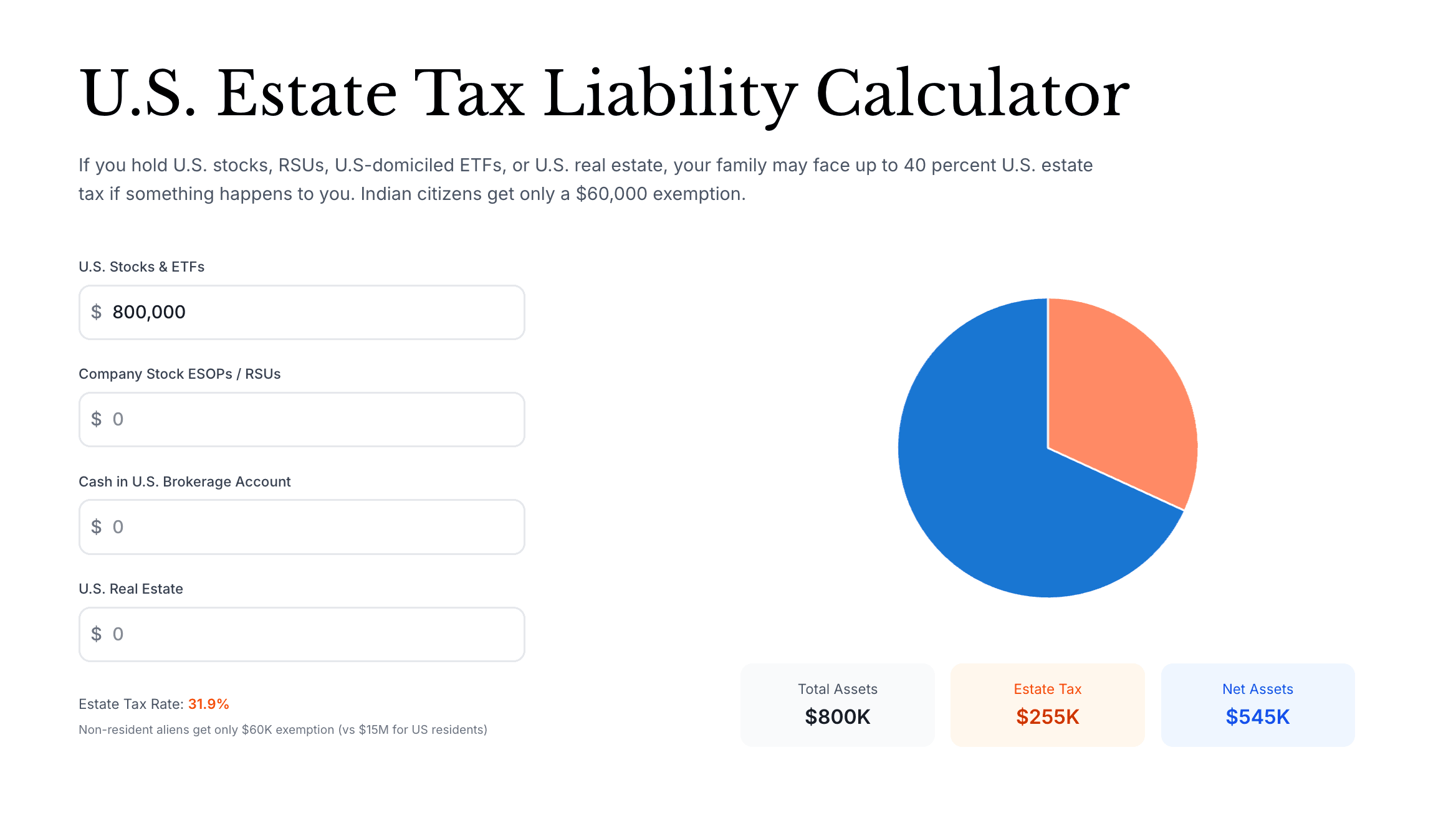
Simply put the value of your US assets here and our calculator will give you the exact tax liability and tax rate.
Use our Estate Tax Calculator to find your exact liability.
What does your family need to do?
If your US-situs assets are worth more than $60,000 at the time of your death, your family has to deal with the IRS before they can access them.
1. File Form 706-NA
The executor of your estate must file Form 706-NA within 9 months of your death and pay any tax due. A 6-month extension to file is available through Form 4768.
2. Get a transfer certificate
US brokers and custodians usually will not release your assets to your heirs until they receive a transfer certificate from the IRS. It confirms that the estate tax has been paid or is not due.
It usually takes the IRS 12 to 18 months to issue a transfer certificate after it receives all the documents. This means your family may not be able to access your US holdings for a year or more, even after paying the tax.
How to reduce Estate Tax exposure to zero?
You can eliminate US estate-tax risk by moving from US-domiciled assets to UCITS ETFs, which are Europe-domiciled and not treated as US-situs.
What do UCITS ETFs offer?
For Indian professionals who hold significant RSUs or US equity exposure, UCITS ETFs offer a safe and compliant alternative that avoids estate tax altogether.
Here are the key advantages of the UCITS ETFs:
- 100% Estate Tax Protection: Because UCITS ETFs are domiciled in Europe (typically Ireland or Luxembourg), they are not considered US-situs assets. This means your heirs face zero US estate tax liability on these holdings, regardless of the amount.
- Direct Exposure to US Giants: UCITS ETFs hold the exact same underlying assets as their US counterparts. You can get full exposure to companies like Apple, Nvidia, Microsoft, and Amazon through an Ireland-domiciled S&P 500 or Nasdaq-100 equivalent UCITS ETF.
- Lower Withholding at the Fund Level: Ireland-domiciled UCITS ETFs benefit from the US-Ireland tax treaty, which reduces the internal withholding tax on US dividends to 15%, against the 25% withheld directly when you hold US-listed stocks. Note that the 25% withheld on direct holdings is creditable in India, while the 15% is borne inside the fund and cannot be claimed as a foreign tax credit, so the real gain comes from pairing this with an accumulating share class.
- Tax-Efficient Compounding: By selecting "Accumulating" share classes, dividends are automatically reinvested within the fund. This defers Indian income tax (ordinarily taxed at your slab rate) until you sell, allowing your wealth to compound much faster.
- Institutional-Grade Safety: UCITS funds are subject to strict European regulatory oversight. A key requirement is asset segregation, where your investments are held by an independent depository, ensuring they are protected even if the fund manager faces financial issues.
- Liquidity & Transparency: UCITS ETFs must be open-ended and deal at least twice a month, though in practice they deal daily, so you can redeem your investment on any trading day. They must also provide standardized disclosure documents (the KID under PRIIPs, which replaced the older KIID) so you always know exactly what you own and what it costs.
UCITS vs US ETFs
Here is a comparison showing the main differences between US ETFs and UCITS ETFs.
| US-listed ETF | UCITS ETF |
Domicile | United States | Ireland or Luxembourg |
Estate-tax exposure | Subject to up to 40% US estate tax once holdings exceed USD 60,000 | No estate-tax exposure as the fund is non-US domiciled |
Dividend withholding | 25% withheld from you, creditable in India | 15% at fund level for Irish-domiciled ETFs, borne inside the fund |
Dividend handling | Mostly distribution share classes that pay out cash dividends | Option of accumulating share classes that automatically reinvest dividends |
Compounding efficiency | Interrupted each year by dividend payout and taxation | Continuous compounding due to internal reinvestment |
Regulatory oversight | US SEC | European UCITS framework focused on investor protection |
Currency options | Primarily USD | Available in USD, EUR, and GBP listings |
More tools from Paasa
- UCITS Screener: You can use Paasa’s UCITS Screener to discover and compare UCITS-compliant investment instruments.
- Brokerage Calculator: You can calculate your brokerage costs by Paasa’s Global Brokerage Calculator.
About Paasa
Paasa is a global investing platform, designed specifically for Indian HNIs, family offices, and professionals with international wealth.
With Paasa, investors can go far beyond US equities. We enable access to UCITS ETFs, managed strategies, and access to global markets including China, Japan, Germany, Switzerland, Europe, and emerging economies. This makes it simple to build a portfolio that is globally diversified, tax-efficient, and fully compliant with Indian regulations.
Whether you are de-risking RSUs, planning estate tax protection, or building long-term cross-border allocations, Paasa provides the structure and support to secure your global wealth.

