
Tax Planning & FEMA
Tax on Repatriation of Foreign Income to India
A complete guide on bringing foreign income back to India. Learn FEMA rules, tax implications, and how to avoid wealth erosion during repatriation.

Abhighyan Sinha

For Indians with global investment portfolios, repatriation is an important but oft-ignored topic.
Whether you are bringing money back to India for investments, personal expenses, or because of FEMA regulations, clarity around the rules is a must.
Understanding the regulations around repatriation and foreign remittance can help you stay compliant in India, avoid surprises from the Income Tax Department, and get better returns from your investments in the long term.
If you are moving back to India, start with our guide for NRIs returning to India.
Table of contents
- What is repatriation?
- How can I bring back money from abroad?
- How is the repatriated income taxed in India
- Can I keep my income abroad in USD without repatriating back to India?
- What exchange rate is applicable when converting money back to INR?
- Tax compliance and documentation in India
- Types of bank account for repatriation
- What happens to unrepatriated foreign assets in case of death?
- Should you keep your investments abroad or bring the money to India after moving back?
- How Paasa helps in repatriation
What is repatriation?
Repatriation is the process of bringing money back to your home country from overseas.
For Indian investors with global portfolios, this means transferring funds from an external source, such as a US brokerage account or a foreign bank, into an Indian bank account.
It is important to note that repatriation itself is not a taxable event. The tax liability arises the moment you earn the income (e.g., when you sell a stock for a profit or receive a dividend), regardless of where the money sits.
Once you have settled the tax on that income, the money is yours, and you are free to transfer it back to India without incurring any additional tax.
Here is how repatriation fits into the investment cycle:
Action | Is this Repatriation? | Tax Implication | |
Step 1: Investment | You send money from India to a US Brokerage to buy Apple stocks. | No. This is Outward Remittance (LRS). | None. You are just moving capital. |
Step 2: Selling | You sell the stocks for a profit. The cash sits in your US brokerage wallet. | No. The money is still abroad. | Tax Triggered. You have realized a gain. You must pay tax on this. |
Step 3: Transfer | You wire the cash from your US brokerage to your Indian bank account. | Yes. This is Repatriation. | None. You are simply moving your own tax-paid money home. |
Your tax liability occurs in Step 2 when you sell the stock and make a profit. Step 3 is purely a banking transaction. You are simply moving your own money from the US to India.
How can I bring back money from abroad?
Bringing money back to India is a standard banking process that typically does not require any extra steps.
You can simply initiate a wire transfer or SWIFT transaction from your overseas bank to your Indian bank.
While the backend compliance is handled by the banks, you should keep proofs of income, such as salary slips or investment statements, handy in case your bank requests them to verify the source of funds.
When the funds hit your Indian account, you must request a FIRC (Foreign Inward Remittance Certificate) or a "Remittance Advice" from your bank.
Without a FIRC, the Income Tax Department may treat unexplained high-value credits as "unexplained cash credits" or "black money," leading to severe penalties.
Always archive your FIRC for at least 8-10 years.
How is the repatriated income taxed in India
In India, tax is levied on the accrual of income (when you earn it), not on the receipt of funds (when you bring it back).
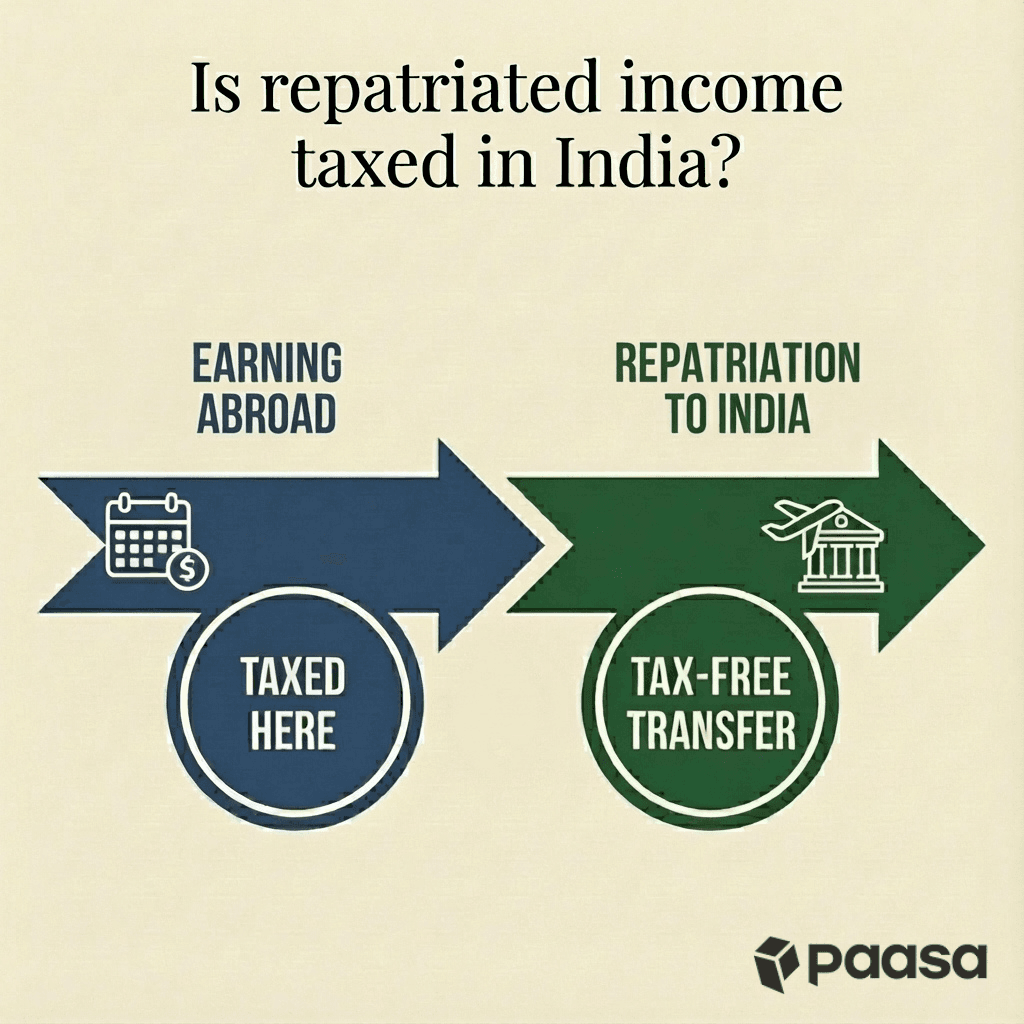
If you have already declared your foreign income in your annual IT Return and paid the applicable tax, the actual transfer of funds to your Indian bank account is tax-neutral.
Note: The tax regulation applicable will depend on your residential status at the time when you earned the income, not on your tax residential status at the time of repatriation.
Example
Suppose you are a software professional who lived and worked in the US for 5 years, invested in stocks, and later moved back to India.
- 2018 – 2023 (US resident): You lived in the US, earned salary, and invested $200,000 in US stocks.
- 2023 (Move to India): You return to India permanently.
- 2025 (Indian resident, ROR): You sell $50,000 worth of US stocks and repatriate the money to an Indian bank account.
Here is how the taxation applies at each stage:
Tax Residency Status | Tax Implication | |
Earning Salary (2018–2023) | US Tax Resident | Taxed in the US. You pay US taxes on your salary when you earn it. India does not tax this because you were an NRI/US resident during this period. |
Selling Stocks (2025) | Indian Tax Resident | Taxed in India. Since you are now resident and ordinarily resident (ROR) in India, the profit (Capital Gains) from this sale is taxable in India in the current financial year. |
Repatriating Funds (2025) | Indian Tax Resident | No Tax. The act of transferring the $50,000 to your Indian bank account is not taxable. |
You are taxed based on when you earn the money (or realize the gain) and where you live at that moment. The movement of money back to India (repatriation) creates no extra tax liability, provided you have settled the taxes on the income itself.
For detailed information on how foreign investments are taxed, visit our guide on How Global Stocks and ETFs Are Taxed for Indian Investors.
How repatriated capital gains are taxed?
Capital gains are taxed in the year you sell the asset, regardless of whether you bring the money back or keep it abroad. The rate of tax depends on your tax residency status.
If you are an Indian tax resident with a global portfolio, capital gains from foreign stocks and ETFs are taxed at these rates:
Holding Period | Capital Gain Classification | Tax Rate |
≤ 24 Months | Short-Term (STCG) | Slab Rate (Added to your income) |
> 24 Months | Long-Term (LTCG) | 12.5% (Flat rate without indexation) |
Example
Suppose you are a C-suite executive in an India-based company with a globally diversified portfolio.
You decide to sell $70,000 worth of UCITS ETFs that you have held for over 3 years. From this sale, you make a profit (Long-Term Capital Gain) of $10,000.
You then repatriate the entire $70,000 proceeds to your Indian bank account.
Here is how the taxation applies:
Amount | Tax Implication | |
Capital Gain | $10,000 | Taxed in India. Since you held the asset for >24 months, this profit is taxed at 12.5% (LTCG). |
Principal Amount | $60,000 | No Tax. This is your original invested capital. |
Repatriation | $70,000 | No Tax. The act of transferring the full $70,000 to India is not a taxable event. You only pay tax on the $10,000 profit. |
Your tax bill is calculated on the $10,000 gain. The remaining $60,000 is your own principal coming back, and the movement of the total funds (repatriation) creates no extra tax liability.
For an in-depth explanation (with examples) of how foreign capital gains are taxed, visit our guide on Capital Gains Tax on Foreign Stocks and ETFs.
How repatriated dividend income is taxed?
For Indian tax residents, dividend income is taxed in the year it is credited to your foreign account. Again, your dividend income is not taxed when you repatriate it, rather it is taxed when you actually earn the income.
India classifies dividend income as income (income from other sources to be specific) and taxes it according to your income tax slab.
Example
Suppose you are a businessperson based in India with a globally diversified investment portfolio. You receive $15,000 as dividend income from your US stocks.
You decide to use $10,000 of this amount to buy more stocks, and you send the remaining $5,000 back to India because you are approaching the 180-day FEMA deadline for holding idle foreign cash.
- Income event: You receive $15,000 as dividend income from your US stocks.
- Usage: You use $10,000 of this cash to buy more stocks immediately.
- Repatriation: Since you cannot hold the remaining idle cash indefinitely, you send the balance $5,000 back to your Indian bank account to meet the 180-day FEMA deadline.
Here is how the taxation applies:
Action | Tax Implication | |
Dividend Income | You earn $15,000 in dividends. | Taxed in India (as you are an Indian tax resident). You must pay tax on the full $15,000 in India (under 'Income from Other Sources') according to your slab rate. |
Reinvestment | You use $10,000 to buy new stocks. | No Tax. Reinvesting the cash is a valid usage of funds. It does not trigger a new tax, nor does it reduce your tax liability on the original dividend. |
Repatriation | You transfer $5,000 to India. | No Tax. The act of transferring this $5,000 to your Indian bank account is not taxable. You have already paid tax on the income itself; bringing the cash home is tax-free. |
You are taxed on the total income you earned ($15,000), not on the amount you brought back ($5,000). Whether you reinvest the money abroad or bring it home, the tax liability remains the same because it is based on earning, not moving.
For an in-depth explanation (with examples) of how dividend income is taxed in India and abroad, visit our guide on How Foreign Dividend Income is Taxed for Indian Investors.
Can I keep my income abroad in USD without repatriating back to India?
Not indefinitely if you are an Indian tax resident.
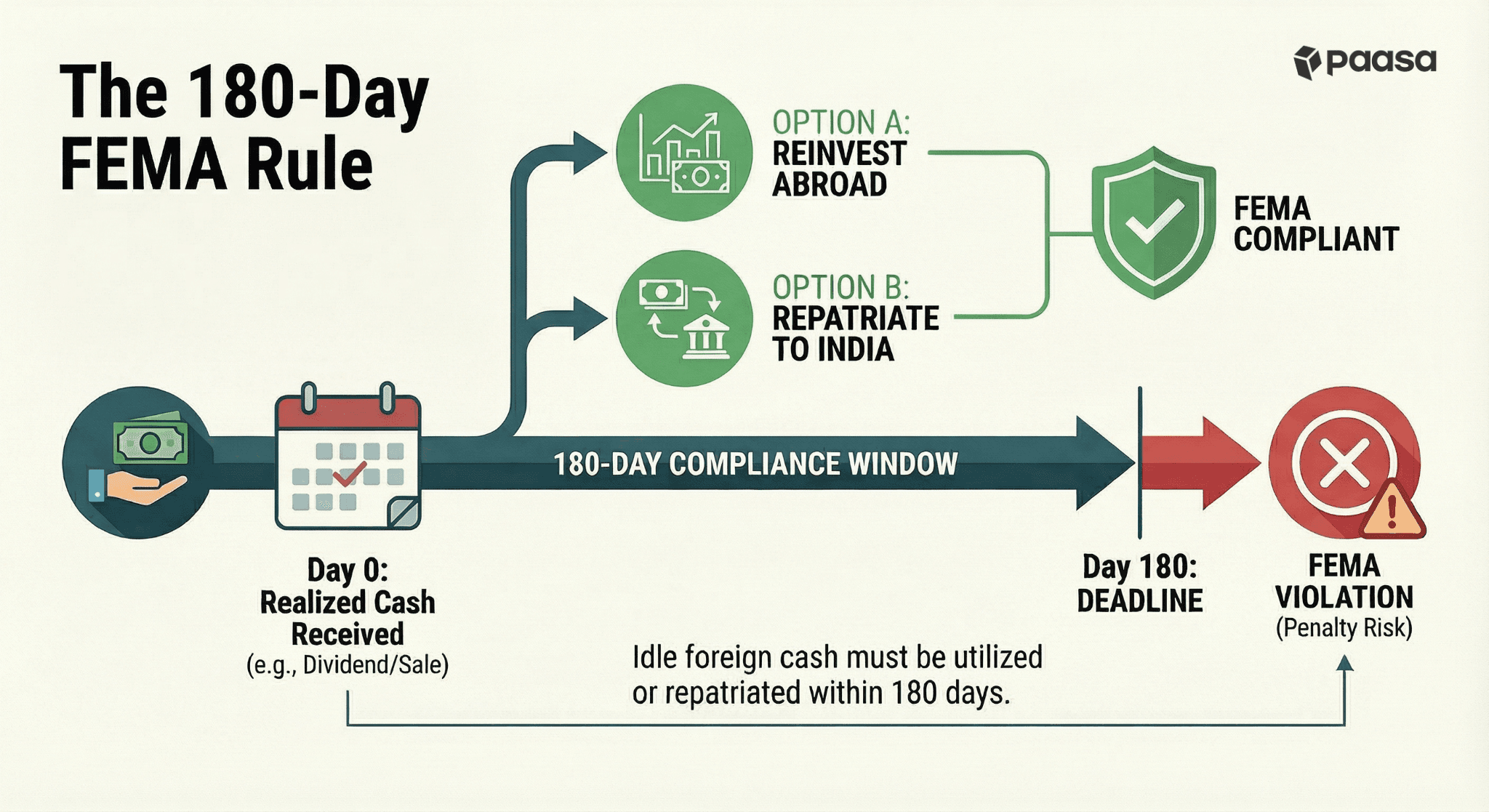
If an Indian tax resident receives foreign currency their overseas account (like salary, dividends, interest, or money from selling a stock), they have 180 days from the date of receipt to do one of two things:
- Reinvest or spend it: Invest or spend it (use it for a purpose permissible under LRS).
- Repatriate it: Send the money back to your Indian bank account.
If you do neither and let the cash sit there for Day 181, you are technically in violation of FEMA laws.
When Is It Triggered?
The 180-day countdown starts the moment "Realized Cash" hits your account.
Event | Status | Compliance Clock |
Stock Price Goes Up | Unrealized Gain | Not Triggered. (You can hold indefinitely). |
Dividend Payment | Realized Income | Triggered. |
Selling a Stock | Realized Cash | Triggered. |
Salary Credit | Realized Income | Triggered. |
Example
- Jan 1: You receive a $1,000 dividend in your Paasa/US Broker account.
- Jan 1 – June 29: The cash sits in your wallet. You are safe.
- June 30 (Day 180): You must effectively "use" this cash.
- Option A: Buy $1,000 worth of shares.
- Option B: Wire $1,000 back to your bank account in India. (Perfectly legal; the clock stops).
- July 1 (Day 181): The cash is still sitting idle in the wallet.
- Result: You are now in violation of FEMA regulations.
Note: This rule is for foreign exchange you earn or send abroad as a resident. If you have moved back to India, the assets you acquired while you lived abroad fall under Section 6(4) of FEMA, and the RBI has clarified that the income and sale proceeds from them can be kept and used abroad.
Is there any limit on the amount I can repatriate?
No, there is no limit on the amount of money you can bring back to India.
Whether it is salary income, business profits, or capital gains from your investments, you can repatriate the entire amount freely.
While you can bring in as much as you want, sending it back abroad later is restricted. Under the Liberalised Remittance Scheme (LRS), a resident individual can only remit up to $250,000 per financial year (April to March) per PAN card.
What exchange rate is applicable when converting money back to INR?
The exchange rate for bringing money back (inward remittance) is decided entirely by your receiving bank in India, not the sending bank.
Most banks default to applying their "Card Rate," which often includes a high profit margin (spread).
If you are transferring a significant amount, do not accept the default rate.
Instead, call your Relationship Manager (RM) before the transfer hits your account and negotiate for a "Live Deal Rate" or "Treasury Rate."
This is usually much closer to the actual market rate and can save you a significant amount in conversion fees.
Tax compliance and documentation in India
When you repatriate funds to India, the burden of proof lies on you to establish the source and nature of the money.
To stay compliant, you must obtain and preserve the Foreign Inward Remittance Certificate (FIRC) or a formal "Remittance Advice" for every single transaction.
While banks automatically generate these for business transactions, individual accounts often just receive a credit notification. You must proactively request a specific advice slip or certificate that details the sender's name, the foreign currency amount, and the purpose of the transfer.
This document acts as your primary shield if your transaction is ever flagged for scrutiny by the Income Tax Department. High-value international transfers often trigger the Statement of Financial Transactions (SFT) reporting logic.
If the tax officer questions a sudden credit of ₹50 Lakhs in your account, the FIRC serves as conclusive legal proof that the funds are legitimate, tax-paid capital or income from abroad, rather than unexplained "black money" or taxable domestic income.
Types of bank account for repatriation
The type of account you use to bring money back depends entirely on your residential status at the time of the transfer. Choosing the wrong account type can lead to compliance issues with FEMA or unnecessary tax complications.
1. For Resident Indians
If you are an Indian Tax Resident, you do not need any special "foreign" account to receive funds.
- Standard Savings/Current Account: You can wire funds directly to your regular savings account. The bank will automatically convert the foreign currency (USD/GBP) into INR at the prevailing exchange rate upon credit.
- The Better Option (RFC Account): If you are a returning NRI or have significant foreign earnings, you should consider opening a Resident Foreign Currency (RFC) account. This allows you to hold the money in foreign currency (like USD or GBP) within India without converting it to INR immediately, saving you from exchange rate fluctuations until you are ready to use the funds.
2. For Non-Resident Indians (NRIs)
NRIs (Indian citizens living abroad >182 days/year) strictly cannot hold regular resident savings accounts. For repatriation, you must use specific NRI accounts:
- NRE (Non-Resident External) Account: Best for repatriating foreign earnings.
- Benefits: Principal and interest are fully repatriable (you can send it back abroad anytime). Interest earned is tax-free in India.
- FCNR (Foreign Currency Non-Resident) Account: Ideally suited for HNIs who want to hold money in foreign currency (USD, Euro, etc.) to avoid exchange rate risk.
- Benefits: Fully repatriable and tax-free interest.
- NRO (Non-Resident Ordinary) Account: Primarily used for income earned within India (like rent or dividends).
- Limitations: Repatriation is capped at $1 Million per financial year. Interest earned is taxable in India.
3. For PIOs and OCIs
Persons of Indian Origin (PIOs) and Overseas Citizens of India (OCIs) follow the exact same banking regulations as NRIs. You are eligible to open NRE, NRO, and FCNR accounts.
- Repatriation Rules: Funds in NRE/FCNR accounts remain fully repatriable. Funds in NRO accounts are subject to the same $1 Million/year limit and require a 15CA/CB certificate for repatriation.
What happens to unrepatriated foreign assets in case of death?
Claiming foreign investments is procedurally similar to claiming Indian assets. Your heirs simply need to contact the broker and provide standard documents, like a death certificate, to start the transfer process.
However, while the process is simple, there is a major financial risk that most investors overlook: the US estate tax.
While India does not charge inheritance tax, the US applies a tax on the transfer of US assets owned by non-residents.
US estate tax on assets over $60,000
For non-US residents (like Indian investors), this tax applies if your US assets, such as stocks or ETFs, exceed $60,000.
- The tax rate: The US government charges a tax of up to 40% on the value of assets above $60,000.
- No treaty protection: This tax is not covered by the Double Taxation Avoidance Agreement (DTAA) between India and the US.
For example, if you hold US stocks worth $200,000, you will have to pay $36,000 (17.9%) in estate tax.
Use our US Estate Tax Calculator to find the exact tax you will have to pay.
How the estate tax is collected
The IRS does not automatically deduct the tax from your account. Instead, the process is manual and can lock your funds for a long time.
- Account freeze: As soon as the broker is notified of the death, they freeze the account. Your heirs cannot sell stocks or withdraw money.
- Payment from own pocket: Your heirs must calculate the tax and pay it to the IRS using their own funds. They cannot use the money inside the frozen brokerage account to pay this tax.
- Waiting period: After payment, the IRS takes about 18 to 24 months to issue a transfer certificate.
- Release of assets: The broker will unfreeze the account and transfer the assets to your heirs only after they receive this certificate.
Repatriation of inherited funds
Once the process is complete and your heirs receive the assets, the rules for bringing the money back are straightforward:
- Capital gains tax: If your heirs decide to sell the stocks, they must pay capital gains tax in India. This is calculated based on the price you originally paid for the stocks.
- Tax-free repatriation: The act of transferring the money back to India is not taxed. Since the estate tax and capital gains tax cover the liability, bringing the funds home is tax-free.
Recommendation: Avoid this risk with UCITS ETFs
The most efficient way to invest in US markets while avoiding the US estate tax is to use UCITS ETFs.
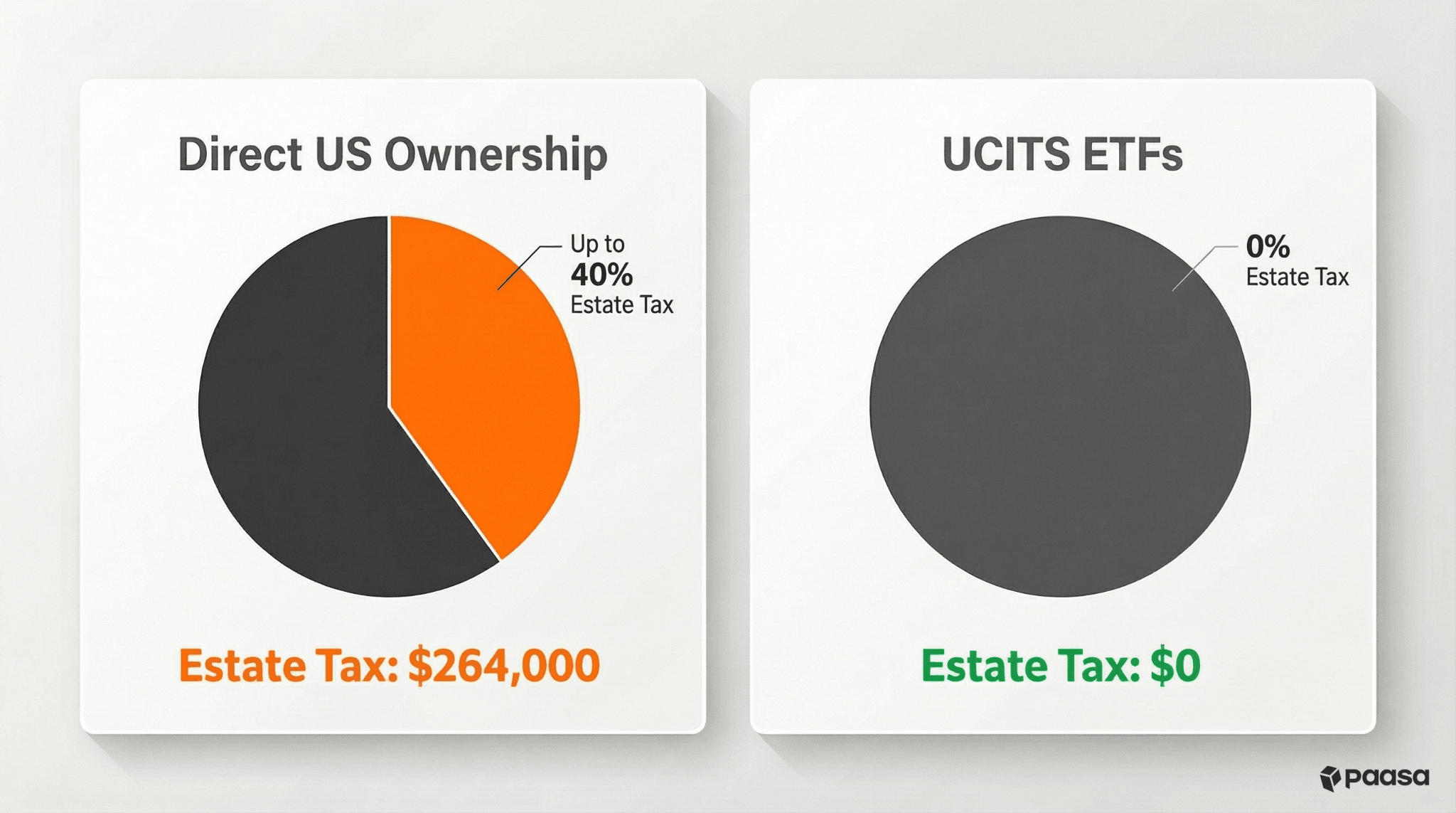
Since UCITS ETFs are legally domiciled in Europe (typically Ireland), not the US, they are not classified as "US-situated assets."
Even if the ETF holds Apple, Microsoft, or the S&P 500, your investment is legally in Ireland. This completely exempts your portfolio from the 40% US Estate Tax.
Use our UCITS Screener to discover and compare UCITS-compliant investment instruments.
Should you keep your investments abroad or bring the money to India after moving back?
You can do either. FEMA lets you keep the foreign shares, funds, bank accounts and property you acquired while you lived abroad for as long as you like, and the income and sale proceeds from them do not have to be brought back. The decision comes down to tax, currency and what you need the money for.
| Keep it abroad | Bring it to India | |
|---|---|---|
| Tax on the transfer | None | None. Moving your own money to India is not income |
| Tax on selling | Due only when you choose to sell | Due on the sale that funds the transfer, unless you sell while RNOR |
| Currency | Stays in USD, GBP or EUR | Converted to rupees at that day's rate, unless you hold it in an RFC account |
| Sending money abroad again | Not needed | Limited to $250,000 a financial year under the LRS, with 20% TCS on investment remittances above ₹10 lakh |
| US estate tax | Applies to US shares and US-domiciled ETFs above $60,000 | Stops applying once the US assets are sold |
| Reporting once you are ROR | Schedule FA every year | None for money held in India |
When does keeping it abroad make sense?
Keeping the portfolio abroad suits money you will not need in India for years, and money you may spend abroad later, for example on a child's education or a second move. You pay tax only when you sell, and the portfolio stays in the currency you may need it in.
If most of it is in US stocks and US-domiciled ETFs, read US estate tax after you move back to India before you decide to leave it untouched.
When does bringing it to India make sense?
Bringing money home suits near-term needs in rupees, such as buying a home or funding a business. If you plan to move a large amount, the timing of the sale matters more than the transfer. While you are RNOR, a sale abroad with the proceeds received abroad is not taxed in India, so the cash can then be moved to India with no Indian tax at either step.
Once you are ROR, the gain is taxed in India whether or not you move the money. Read should you sell US investments after returning to India for how the timing changes the tax.
What does it cost to bring everything back and send it out again?
The expensive outcome is bringing everything to India and later needing it abroad again.
Example
Suppose you moved back in 2020 with $1 million and brought it all to India. Five years later, in 2025, you want to send it back to the US.
- Step 1: Inflow (2020)
- You convert $1,000,000 at ₹74 (Average 2020 rate).
- Value in India: ₹7.4 Crores.
- Step 2: The idle period (2020-2025)
- While you held ₹7.4 Cr in India, the USD strengthened from ₹74 to ~₹86.
- Step 3: Outflow (2025)
- You now want to convert that ₹7.4 Cr back to USD.
- Exchange Rate: ₹86 + Bank Spread (1%) = ₹86.86.
- Regulatory Friction: You cannot send it all at once. The $250k LRS limit forces you to split this over 4 years (or use 4 family members' PAN cards).
- TCS Impact: On top of the transfer, you must pay 20% TCS upfront (approx ₹1.48 Cr blocked until you claim a refund).
- Final result:
- ₹7.4 Cr / 86.86 = ~$851,945.
- Net Loss: You lost ~$148,000 (nearly 15% of your wealth) purely due to currency depreciation and exchange spreads.
Can you keep the portfolio without keeping your old broker?
Yes. If your overseas broker will not keep you as a client once you live in India, you can move the holdings to another account in kind, which is not a sale. Paasa accepts in-kind transfers from overseas brokers, so you can hold the same portfolio as an Indian resident.
How Paasa helps in repatriation
Paasa is the platform used by global Indian Investors, HNIs, family offices to diversify their wealth across global markets like US, UK, China, Singapore, Switzerland, and beyond.
Paasa offers a comprehensive advisory layer that keeps your portfolio compliant and makes tax filing hassle free with:
- Support in the app, where you can message the team
- Ongoing remittance, FEMA and tax advisory
- Ongoing tax loss harvesting and rebalancing
- End of year tax documents
What type of documents does Paasa provide to file taxes?
At the end of the financial year, Paasa provides a ready-to-file tax package containing:
- Capital Gains Report: A clear breakdown of Short-Term vs. Long-Term capital gains, calculated specifically according to the 24-month holding rule for unlisted shares.
- Dividend & Interest Reports: Consolidated statements showing exactly how much income you earned and the tax withheld abroad, making it easy to fill Schedule FSI.
- Schedule FA Report: This is typically the hardest part of the ITR. We provide a report with the Peak Value and Closing Value of your assets in INR, calculated using the mandatory SBI TT Buying Rates, so you can simply copy-paste the numbers into your tax return.
If you are an Indian tax resident or NRI who wants to understand how to repatriate larger sums while keeping your future goals like investments, global travel, or your children's education in focus, feel free to reach out to our team of experts.
Disclaimer
This article is intended solely for information and does not constitute investment, tax, or legal advice. The material is based on public sources and our interpretation of prevailing regulations, which are subject to change. Global investments carry certain risks, including currency risk, political risk, and market volatility. Past performance does not predict future outcomes. Please seek advice from qualified financial, tax, and legal professionals before acting.
Frequently Asked Questions
Can I send money back to India to my parents? Are there any limits on it?
Yes, you can send money back to India to your parents without any restrictions. Under Indian tax laws, gifts to "relatives" (which includes parents, spouse, and siblings) are not taxed in the hands of the receiver. There is no upper limit on how much you can send.
How can Non-Resident Indian (NRI) citizens send money to India?
NRIs should ideally use an NRE (Non-Resident External) Account to send foreign earnings to India. Funds in an NRE account are fully repatriable (you can move them back abroad freely), and the interest earned is tax-free in India. You can also use an NRO (Non-Resident Ordinary) Account, but that is generally better suited for income earned within India (like rent).
How can non-citizen Persons of Indian Origin (PIOs/OCIs) send money to India?
PIOs and OCIs follow the same banking rules as NRIs. You can open an NRE or NRO account to receive funds. Just like with NRIs, using an NRE account is more efficient as the funds remain fully repatriable and tax-free.
Can I send the money repatriated to India abroad again?
Yes, but it is much harder to send it out than to bring it in. Once the money is in India, sending it back abroad falls under the Liberalised Remittance Scheme (LRS). This limits you to sending $250,000 per financial year and currently attracts a 20% TCS (Tax Collected at Source).
If I bring my US stock profits back to India, will I be taxed again on the transfer?
No. The act of transferring money (remittance) is not a taxable event. You are taxed on the income (capital gains or dividends) in the year it was earned. Bringing that post-tax money to India triggers no new tax.
Do I need to declare the repatriation amount in my ITR?
No. You do not declare the transfer itself. You must declare the foreign income and assets in Schedule FA and Schedule FSI of your Income Tax Return. However, you must keep the FIRC (bank certificate) safe, as the Income Tax Department may ask for proof of the source of funds later.
Can I keep my dividends in my US brokerage account to buy more stocks later?
Yes, but you have a strict deadline. You must reinvest that cash within 180 days of receiving it. If the cash sits idle in your brokerage wallet beyond 180 days, you are in violation of FEMA regulations.
Can I use my foreign earnings to pay for my hotel/travel abroad instead of bringing it back?
Yes. Using your foreign earnings for legitimate expenses abroad like hotel bills, travel, or education counts as "utilizing" the funds. As long as the money is used within 180 days, you do not need to bring it back to India.
What document must I ask my bank for when money arrives?
You must explicitly ask for a Foreign Inward Remittance Certificate (FIRC) or an Inward Remittance Advice. Most banks do not send this automatically for personal accounts. This document is your only legal proof that the money is legitimate investment proceeds and not taxable income or "black money."
If I sell my stocks at a loss, do I still need to bring the remaining money back?
Yes. The FEMA 180-day rule applies to "realized foreign exchange," regardless of whether you made a profit or a loss. If you have cash sitting in your account from a sale, you must either reinvest it or repatriate it within the 180-day window.
How repatriation works for RSUs sold through US brokers?
Once RSUs vest, they are treated exactly like normal stocks in your brokerage account. While you are liable for taxes when they vest (as salary) and when you sell them (as capital gains), the actual act of bringing those sale proceeds back to India is completely tax-free.


Invest in global markets from India

Discussion
Disclaimer
The information provided in this post is for general informational purposes only. It is not intended as professional advice or to replace consultation with qualified professionals. While we strive to ensure the accuracy and reliability of the information presented, we make no representations or warranties of any kind, express or implied, about the completeness, accuracy, reliability, suitability, or availability with respect to the content contained herein. Any reliance you place on such information is therefore strictly at your own risk. We disclaim any liability for any loss or damage, including, without limitation, indirect or consequential loss or damage, or any loss or damage whatsoever arising from loss of data or profits arising out of, or in connection with, the use of this post. Always seek the advice of professionals or relevant authorities regarding your specific situation or circumstances.