
Tax Planning & FEMA
How to Adjust TCS Against Advance Tax Liability (2026 Guide)
Learn how to offset the TCS paid on foreign remittances against your advance tax installments or monthly salary TDS to prevent your capital from being locked up until refund season.

Abhighyan Sinha

When you are remitting funds overseas under the Liberalised Remittance Scheme (LRS), the Tax Collected at Source (TCS) temporarily locks up a significant portion of your capital.
For example, if you have remitted ₹20 lakhs abroad for investments in this financial year, you have paid a TCS of ₹4 lakhs on this transaction, over and above the transaction value (the first ₹10 lakhs is exempt, TCS of 20% is applicable after that).
Waiting until you file your annual income tax return to claim this refund creates an inefficient drag on your cash flow.
However, you do not have to wait for a refund to free up this capital. You can adjust the TCS you have already paid against your advance tax liability.
Here is how you can use your TCS credits to reduce your advance tax and prevent your capital from getting stuck.
Table of contents
- What is advance tax?
- Who is liable to pay advance tax?
- How is advance tax collected?
- Offsetting advance tax with TCS
- TCS rates for foreign remittances
- How to offset advance tax using TCS
- How Paasa helps with tax
What is advance tax?
In India, income tax operates on a "pay as you earn" principle. Instead of paying your entire tax bill as a single lump sum at the end of the financial year, the Income Tax Department requires you to pay it in installments throughout the year as you earn the income.
Who is liable to pay advance tax?
You are legally required to pay advance tax if your estimated total tax liability for the financial year is ₹10,000 or more after deducting any Tax Deducted at Source (TDS).
This applies to all categories of taxpayers (salaried individuals with additional income, freelancers, and businesses) with one specific exception:
- Exempted Category: Resident senior citizens (aged 60 years or older) who do not have any income categorized under "Profits and Gains of Business or Profession" (PGBP) are exempt. They do not have to pay advance tax even if their tax liability from other sources (like pension or interest) exceeds ₹10,000.
How is advance tax collected?
Advance tax is paid online through the Income Tax Department’s e-filing portal using Challan 280 (selecting '100 - Advance Tax' as the type of payment). The collection mechanism depends on your primary source of income.
For salaried employees
Your employer deducts tax directly from your salary (TDS). While TDS serves a similar purpose to advance tax, your employer only calculates this based on your salary.
If you have additional income sources (such as capital gains from stocks or rental income), you have two options:
- Pay it directly: Calculate the tax on the extra income and pay it online via the tax portal.
- Declare it: Disclose your "other income" to your HR department. They will recalculate your tax and increase your monthly TDS deductions to cover the liability, saving you the administrative hassle of paying advance tax separately.
For people engaged in business
If you run a business or work as an independent contractor, you are responsible for calculating and paying the entire tax bill yourself.
The payment schedule depends on your taxation scheme:
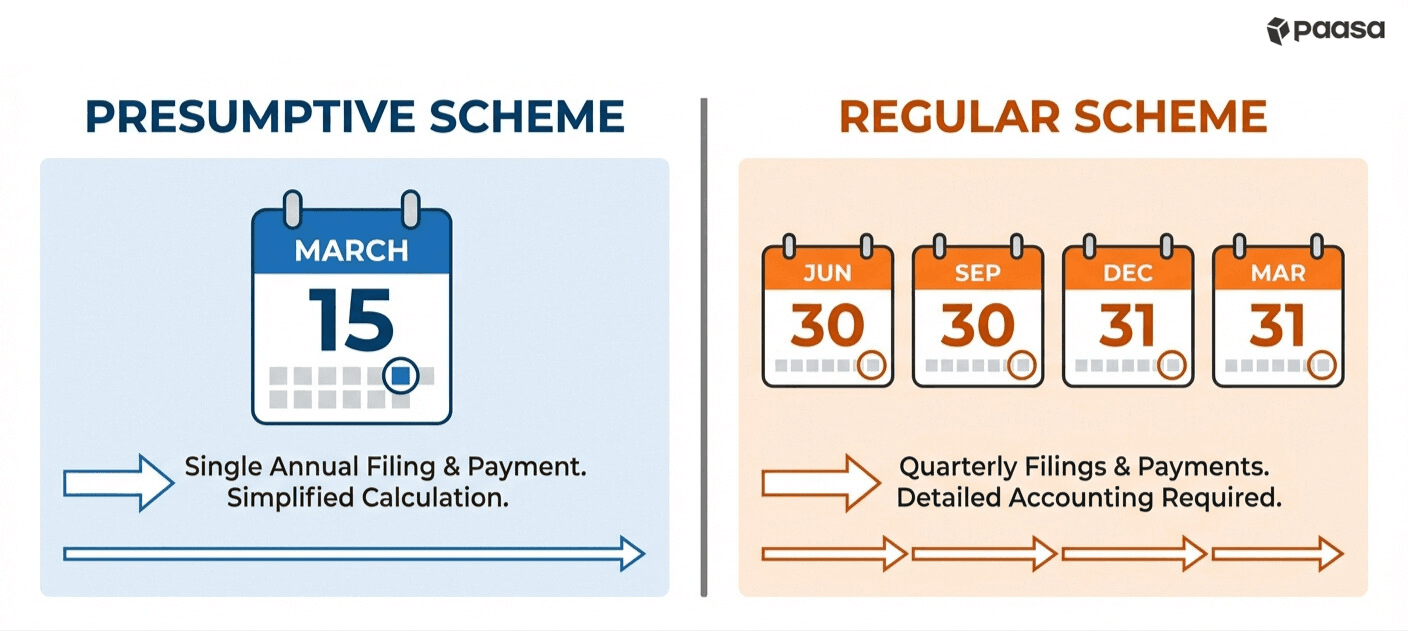
- The Presumptive Scheme (Section 44AD/44ADA): If you opt to declare a fixed percentage of your turnover as presumed profit, you enjoy a simplified schedule. You only need to pay your advance tax in a single installment by March 15th.
- The Regular Scheme: If you declare actual profits by deducting business expenses from your revenue, you must estimate your annual income and pay the advance tax in four quarterly installments (June, September, December, and March).
Can I offset my advance tax liability using the TCS I have already paid?
Yes. You can directly reduce your calculated advance tax liability by the exact amount of TCS you have already paid on foreign remittances.
For global investors, this is the most efficient way to solve the "stuck capital" problem. Instead of letting your TCS sit with the government until you process a refund the following year, you utilize that credit immediately to reduce the tax you owe on your current income (like salary or business profits).
TCS rates for foreign remittances (2026)
| Type of Remittance | Exemption Threshold (Per FY, Per PAN) | TCS Rate (Above Threshold) |
|---|---|---|
| Education (Funded via Loan u/s 80E) | Nil (Fully Exempt) | 0% |
| Education (Self-Funded / Others) | ₹10 Lakhs | 2% |
| Medical Treatment Abroad | ₹10 Lakhs | 2% |
| Overseas Tour Packages | No Exemption | 2% |
| Other Purposes (Investments Gifts etc.) | ₹10 Lakhs | 20% |
To learn more about LRS limits and TCS slabs, read our Complete LRS Guide for Indians (2026).
How to offset advance tax using TCS
The exact mechanics of claiming this offset depend on whether you are employed or running a business.
For salaried employees
Earlier, salaried individuals had to wait to claim TCS as a refund. Now, you can adjust it directly against your monthly salary TDS, instantly increasing your monthly take-home pay.
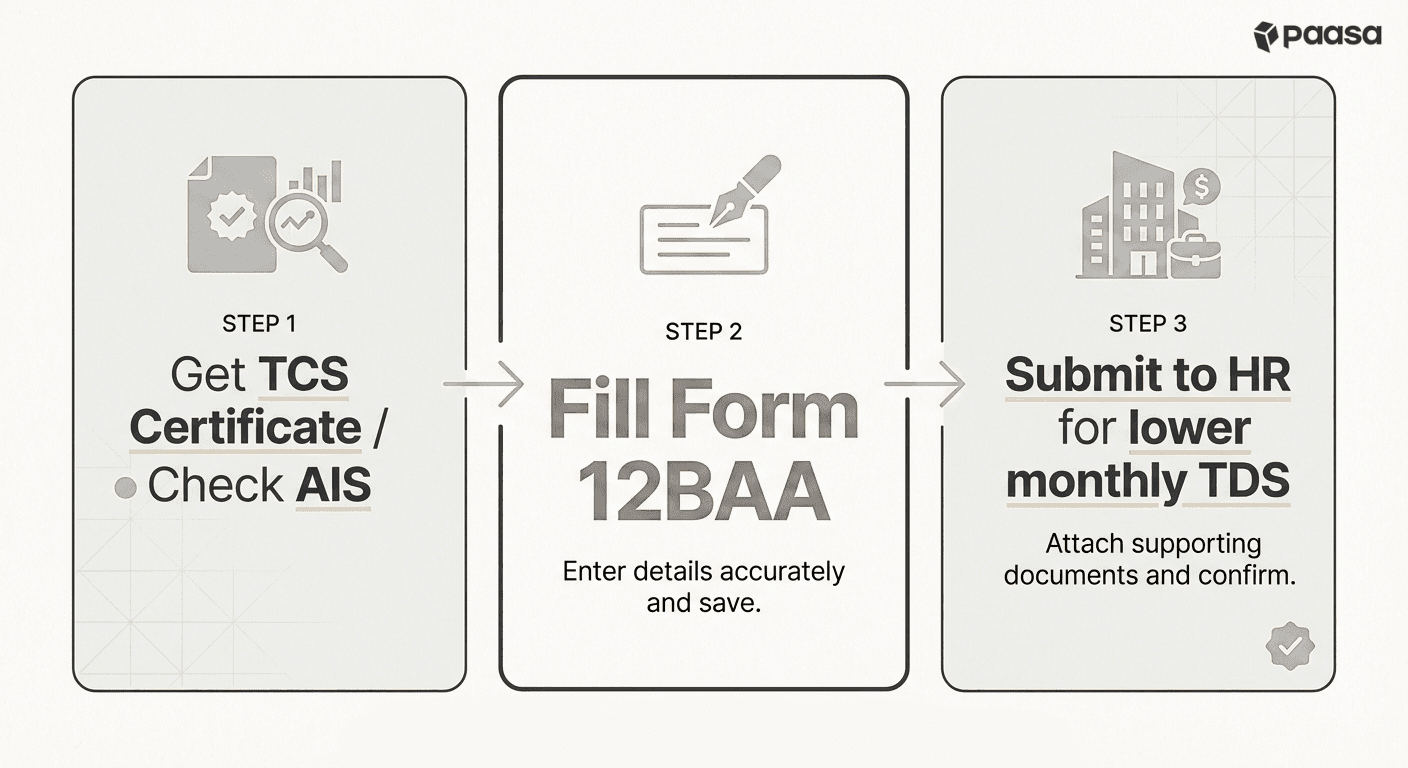
- Obtain your TCS Certificate (Form 27D) from your bank/broker, or verify the TCS amount reflected in your Annual Information Statement (AIS) on the tax portal.
- Fill out Form 12BAA. This is a specific declaration form used to report "other taxes paid," including TCS on foreign remittances.
- Submit this form to your HR or payroll department. Your employer is legally obligated to subtract the reported TCS amount from your total annual tax liability and proportionally reduce your remaining monthly TDS deductions.
Example
Suppose your total annual tax liability on your salary is ₹20,00,000. Without any adjustments, your employer deducts approximately ₹1,66,667 per month as TDS.
During the year, you remit ₹35 Lakhs to your global brokerage account. The first ₹10 Lakhs is exempt, and you pay a 20% TCS on the remaining ₹25 Lakhs, which equals ₹5,00,000 in TCS.
You submit Form 12BAA to your employer showing this ₹5,00,000 TCS credit. Your employer adjusts your annual tax liability down to ₹15,00,000. Your new monthly TDS becomes ₹1,25,000 or lower (depending on when you made the transaction and updated your employer). By doing this, you instantly free up at least ₹41,600 every month in your take-home pay instead of waiting for a refund next year.
For people engaged in business
Since you do not have an employer managing your tax deductions, you must execute this offset yourself during your standard quarterly advance tax calculations.
- Calculate your projected tax liability for the entire year based on your estimated business profits and other income.
- Deduct any tax that has already been withheld by your clients or customers.
- Deduct the total TCS you have paid on foreign investments, business software subscriptions, or international travel.
- The final resulting figure is your actual advance tax liability. You only pay this remaining balance in your scheduled installments.
Example
Suppose you are an independent contractor or freelancer and your estimated income tax liability for the year is ₹6,00,000.
You decide to invest heavily in global markets and remit ₹20 Lakhs. After the ₹10 Lakh exemption, you pay 20% TCS on the remaining ₹10 Lakhs, resulting in a TCS payment of ₹2,00,000.
When calculating your advance tax installments, you simply subtract the ₹2,00,000 TCS credit from your ₹6,00,000 liability. Your new net tax liability for the year is ₹4,00,000. You base your quarterly payments on this lower amount, immediately keeping ₹2,00,000 of working capital inside your business instead of locking it up with the government.
How Paasa helps with tax
Paasa is the platform used by global Indian Investors, NRIs, and family offices to diversify their wealth across global markets like US, UK, China, Singapore, Switzerland, and beyond.
Paasa offers a comprehensive advisory layer that keeps your portfolio compliant and makes tax filing hassle free with:
- Dedicated relationship manager
- Ongoing remittance, FEMA and tax advisory
- Ongoing tax loss harvesting and rebalancing
- End of year tax documents
Frequently Asked Questions
Can I adjust the TCS on foreign remittance against my regular salary TDS?
Yes. Salaried individuals can now submit Form 12BAA to their employer to declare the TCS paid on foreign remittances under the LRS. Once submitted, your employer will factor this accumulated TCS credit into your annual tax calculation and proportionally reduce the monthly TDS deducted from your salary, immediately freeing up your capital and increasing your take-home pay.
What happens if the TCS I paid is more than my total tax liability for the year?
If the total Tax Collected at Source (TCS) on your foreign investments exceeds your actual total tax liability for the financial year, you cannot adjust it against advance tax because your liability is already zero. In this scenario, your capital will remain locked until the end of the year, and you must file your Income Tax Return (ITR) to claim the surplus amount as a direct tax refund to your bank account.
Do I need a physical certificate from my bank to claim the TCS adjustment?
While your authorized dealer bank or broker will issue Form 27D as an official certificate for the TCS collected, you do not strictly need the physical document to claim the credit. The most reliable method to verify your available TCS credit is to check your Annual Information Statement (AIS) or Form 26AS on the Income Tax e-filing portal, as these dynamically reflect all taxes successfully deposited against your PAN.
Do business owners need to file a specific form to adjust TCS against advance tax?
No, business owners and freelancers do not need to file a specific declaration form like Form 12BAA during the financial year. When it is time to pay your quarterly advance tax installments, you simply calculate your total estimated tax, manually subtract the TCS that is already reflected in your Form 26AS or AIS, and pay only the remaining balance via the tax portal.
Is there a deadline to submit Form 12BAA to my employer?
There is no strict statutory deadline for submitting Form 12BAA, but it is highly advantageous to submit it as early in the financial year as possible. The sooner your payroll department receives the declaration, the quicker they can recalibrate your tax calculations, allowing you to benefit from lower monthly TDS deductions across a larger number of pay cycles.
Who gets the TCS credit if I remit funds from a joint bank account?
The TCS credit is strictly mapped to the Permanent Account Number (PAN) used to authorize the Liberalised Remittance Scheme (LRS) transaction. Even if the funds are debited from a joint bank account, the TCS credit will only reflect in the Form 26AS or Annual Information Statement (AIS) of the specific individual whose PAN was submitted for the foreign remittance.
What if I forget to submit Form 12BAA to my employer before the financial year ends?
If you miss the final payroll processing cutoff for the financial year, your employer cannot adjust your TDS retroactively. You will have to wait until you file your annual Income Tax Return (ITR) to claim the accumulated TCS as a standard tax refund from the government.
Can I use current TCS credits to offset past tax demands?
No. TCS collected during a specific financial year can only be used to offset your advance tax or TDS liability for that exact same financial year. You cannot legally apply a current-year TCS credit to settle an outstanding tax demand, dispute, or penalty from a previous assessment year.
I have remitted ₹50 Lakhs for my kid's education abroad. Can I offset that against my TDS with my employer?
Yes. Under the 2026 rules, self-funded education remittances attract a 2% TCS on amounts exceeding the ₹10 Lakh threshold. For a ₹50 Lakh remittance, the taxable amount is ₹40 Lakhs. At 2%, you will pay ₹80,000 in TCS. You can submit Form 12BAA to your employer along with the TCS certificate from your bank. Your HR department will then reduce your annual tax liability by ₹80,000, which will lower your monthly TDS deductions and effectively refund the money through your paycheck over the rest of the year.
I am an RNOR and my foreign income is tax-free. Can I still use the TCS I paid on a foreign investment to reduce the tax on my Indian salary or get a refund?
Yes. Even if the transaction that triggered the TCS (like a global stock purchase) does not result in taxable income in India due to your RNOR status, the tax credit itself remains entirely valid. You can legally use that credit to offset the tax liability arising from your Indian salary, rental income, or any other domestic source, and get a refund if your tax liability is lower than the advance tax paid.
I received my annual bonus in February and immediately remitted ₹30 Lakhs abroad for investments. But my employer has already deducted most of my tax for the year. What happens to my TCS credit?
If you submit Form 12BAA in late February or March, your employer can only adjust your TDS against your remaining salary payouts for that financial year. If your tax liability for March is only ₹50,000, but your TCS credit is ₹4,00,000 (20% on the ₹20 Lakhs above the threshold), your employer will bring your March TDS down to zero. The remaining ₹3,50,000 cannot be carried backward or adjusted by your employer. You will have to claim that unadjusted balance as a standard tax refund when you file your ITR.
My wife and I both work and file taxes separately. Can we split the TCS credit if the funds were sent from our joint bank account?
No. The Income Tax Department does not recognize joint ownership of a TCS credit. The TCS is strictly deposited against the single PAN that was used to authorize the LRS transaction with the bank. If your PAN was used for the remittance, 100% of the TCS credit belongs to you, and only you can adjust it against your advance tax or salary TDS.


Invest in global markets from India

Discussion
Disclaimer
The information provided in this post is for general informational purposes only. It is not intended as professional advice or to replace consultation with qualified professionals. While we strive to ensure the accuracy and reliability of the information presented, we make no representations or warranties of any kind, express or implied, about the completeness, accuracy, reliability, suitability, or availability with respect to the content contained herein. Any reliance you place on such information is therefore strictly at your own risk. We disclaim any liability for any loss or damage, including, without limitation, indirect or consequential loss or damage, or any loss or damage whatsoever arising from loss of data or profits arising out of, or in connection with, the use of this post. Always seek the advice of professionals or relevant authorities regarding your specific situation or circumstances.