


Indian investors have no options for investing in platinum domestically. Physical bars come with high premiums, and there are no local ETFs.
This blog covers the economics of the metal, and how Indian investors can actually buy the best platinum ETFs on global markets.
Table of contents
Why are investors looking at platinum exposure?
Investors are adding Platinum to their portfolios for four reasons: a historic valuation gap, a resurgence in auto demand, future green energy tech, and a supply chain that is hanging by a thread.
1. The Valuation Gap
- Historically, Platinum was more expensive than Gold (trading at ~$2,200/oz in 2008). Today, it trades at a historic discount to Gold.
- Value investors view this ratio as unsustainable. If Platinum merely reverts to its historical mean relative to Gold, the price upside is significant, regardless of what the broader market does.
- The metal has already started moving up, with a ~50% gain noted in the first half of 2025.
2. Auto Demand
- For years, automakers used Palladium for catalytic converters because it was cheaper. When Palladium prices spiked, they spent billions retooling factories to switch back to Platinum.
- That retooling is now complete. Demand from the auto sector is sticky and rising.
3. The Hydrogen Economy
- Platinum is the primary catalyst used in Hydrogen Fuel Cells and PEM Electrolyzers.
- As Europe and the Middle East move large-scale green hydrogen projects from "planning" to "operation" in 2026, industrial demand is creating a new price floor. It is no longer just a jewelry metal; it is a green energy metal.
4. The South African Choke Point
- ~75% of the world's platinum comes from South Africa.
- The supply chain is incredibly fragile due to aging mines, labor strikes, and the ongoing electricity crisis (Eskom) in the region. A single week of strikes in the Rustenburg belt can send global prices soaring.
How can Indian investors buy platinum?
Indian investors essentially have two paths for adding platinum to their portfolio:
- Domestic Market: Buying physical metal or jewelry.
- Global Markets: Buying specialized Platinum ETFs on international exchanges.
There are zero Platinum ETFs listed on the NSE or BSE. You cannot buy it like Gold (via Gold BEES).
Buying physical platinum (coins/bars) in India is inefficient. You pay high making charges, high GST, and face massive "spreads" (the difference between buying and selling price) when trying to liquidate.
Why global markets are the best option for palladium exposure
Global markets allow you to buy the metal as a liquid financial asset.
- Efficient Access: Global ETFs allow you to buy platinum at the spot price with expense ratios as low as 0.20%.
- Liquidity: You can sell $10,000 worth of platinum in seconds during market hours, unlike the hassle of negotiating with a jeweler to sell a physical bar.
Types of global funds that provide platinum exposure
Here is a breakdown of the platinum investment options available globally:
1. Physical Platinum Funds
These funds hold actual platinum bars in secure vaults (London/Zurich).
- Mechanism: When you buy a share, the fund buys the equivalent amount of metal (99.95% purity).
- Pros: 100% correlation to spot price. No corporate risk.
- Cons: Storage fees (Expense Ratio), though European funds have driven this down significantly.
- Best For: Conservative investors looking for a "hard asset" hedge against inflation.
2. Platinum Mining Stocks
Investing in giants like Anglo American Platinum.
- Risk/Reward: High volatility. If platinum prices rise 10%, miners often rise 20-30% due to "operational leverage."
- You take on the specific risks of operating in South Africa (strikes, politics, power outages).
3. Diversified Precious Metal Baskets
Buying a fund that holds Gold, Silver, Platinum, and Palladium together.
- Strategy: This smooths out the volatility while maintaining exposure to the sector.
Top platinum funds you can invest in
Here are the top platinum funds you can invest in via global markets.
1. Physical Platinum Funds
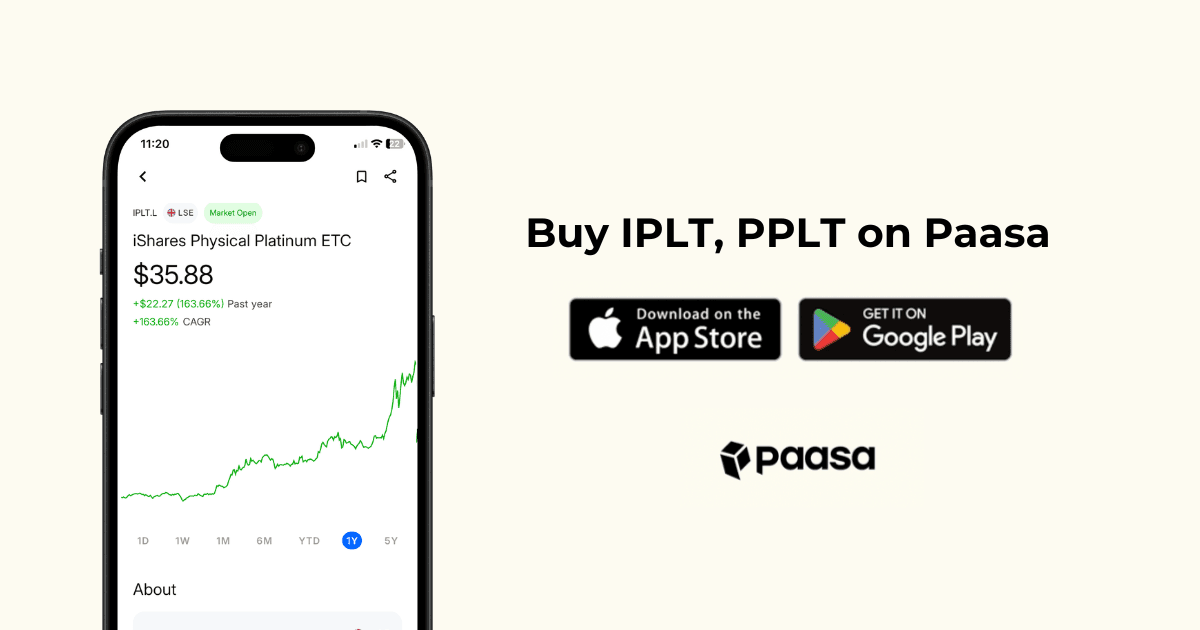
- European Fund: iShares Physical Platinum
- Ticker:
IPLT(USD) - Exchange: London Stock Exchange (LSE)
- Expense Ratio: 0.20%
- Why: It is the most cost-effective way to hold platinum globally.
- Ticker:
- US Fund: abrdn Physical Platinum Shares ETF
- Ticker:
PPLT - Exchange: NYSE Arca
- Expense Ratio: 0.60% (3x more expensive than the LSE option).
- Why: Good liquidity if you are restricted to US-only markets.
- Ticker:
2. Mining Stocks (Global)
- Sibanye-Stillwater (US/South Africa):
- Ticker:
SBSW - Exchange: NYSE
- Profile: A major player that also mines palladium and gold.
- Crucial Differentiator: They own the Stillwater mine in the USA, providing a rare hedge against South African political risk.
- Ticker:

Which route is right for you?
| Physical Platinum ETFs | Mining Stocks | Diversified Baskets |
Primary Goal | Own the metal (Store of value). | Aggressive growth. | Balanced sector exposure. |
Dividend Income | None. | Yes (Often high). | None. |
Key Risk | Fees: Annual expense ratio. | Country Risk: SA Politics. | Dilution: Platinum is a small %. |
Leverage | None (1:1 with metal). | High: Operational leverage. | Low. |
Best For | Value investors & Hedgers. | Risk-tolerant growth seekers. | Long-term defensive portfolios. |
Why Indian investors should choose non-US platinum funds
For Indians investing globally, where a fund is located should be an important consideration, as US-domiciled funds and stocks come with a significant taxation risk.
The United States enforces a strict Estate Tax on non-residents. If you hold US-domiciled assets (such as the PPLT ETF or stocks like Sibanye-Stillwater (SBSW) listed on the NYSE) and pass away, the US government levies a 40% tax on the value of those assets above $60,000.
This means that in the event of an untoward incident, your heirs could lose nearly half of your US-based portfolio to the IRS before the money is even repatriated to India.
This risk makes US funds a poor choice for long-term wealth preservation.
Even for short-term traders, holding these assets carries an unnecessary risk; if an unexpected event occurs while the position is open, the tax implications for your family are severe.
For more information on how the Estate tax can affect your investments, read How the US Estate Tax Works for Indians and NRIs.
The Solution: Non-US Funds
Funds listed on non-US exchanges (European exchanges like the London Stock Exchange, Swiss Stock Exchange, etc.) do not carry this risk.
They also provide the same exposure to commodities (or stocks). For example, you can replace the US-listed PPLT with the London-listed iShares Physical Platinum (IPLT) to get the exact same price exposure.
By choosing the non-US version of a fund, you get the same platinum exposure but completely eliminate the risk of a 40% tax wipeout. For Indian investors, this structural safety makes non-US funds the superior choice.
Invest in platinum ETFs with Paasa
Paasa is a truly global platform designed for the modern Indian investor. We provide direct access to over 10 global exchanges, including the United States, United Kingdom, Switzerland, Hong Kong, Germany, France, Canada, Netherlands, Japan, and Singapore.
This means you are not restricted to just US funds; you can buy all the global Platinum ETFs, ETCs, and mining stocks listed on these exchanges from a single interface.
The Compliance Advantage
Paasa makes global investing easy and removes the compliance friction with a specialized layer built specifically for Indian residents:
- Schedule FA Reporting: We generate the exact reports you need for your Indian tax returns, eliminating the need for manual calculations.
- Tax Filing & Advice: Get access to expert tax advice and seamless filing support to handle your global capital gains and dividends.
- FEMA & LRS Integration: We provide guidance on FEMA regulations and LRS limits to ensure compliance.
Whether you are buying ETFs in London or direct stocks in US, Paasa provides the global access you need with the India-specific compliance you require.
What other commodities can I invest in with Paasa?
Paasa provides access to all commodities and stocks listed on global stock exchanges across US, Europe and Asia.
Disclaimer
This article is intended for information only and does not constitute investment, tax, or legal advice. The material is based on public sources and our interpretation of current regulations, which may change. Investing in global markets entails risks, including currency risk, political risk, and market volatility. Past performance does not predict future outcomes. Please seek advice from qualified financial, tax, and legal professionals before acting.

