
Every global investment carries an Indian tax consequence, from the gain when you sell to the duty to simply report what you hold. This module is a working guide to all of it: the taxable events, the rates, and the reporting.
Why does India tax you on an American stock or an Irish fund? The company is foreign, the exchange is foreign, the money may never have touched India after you sent it out.
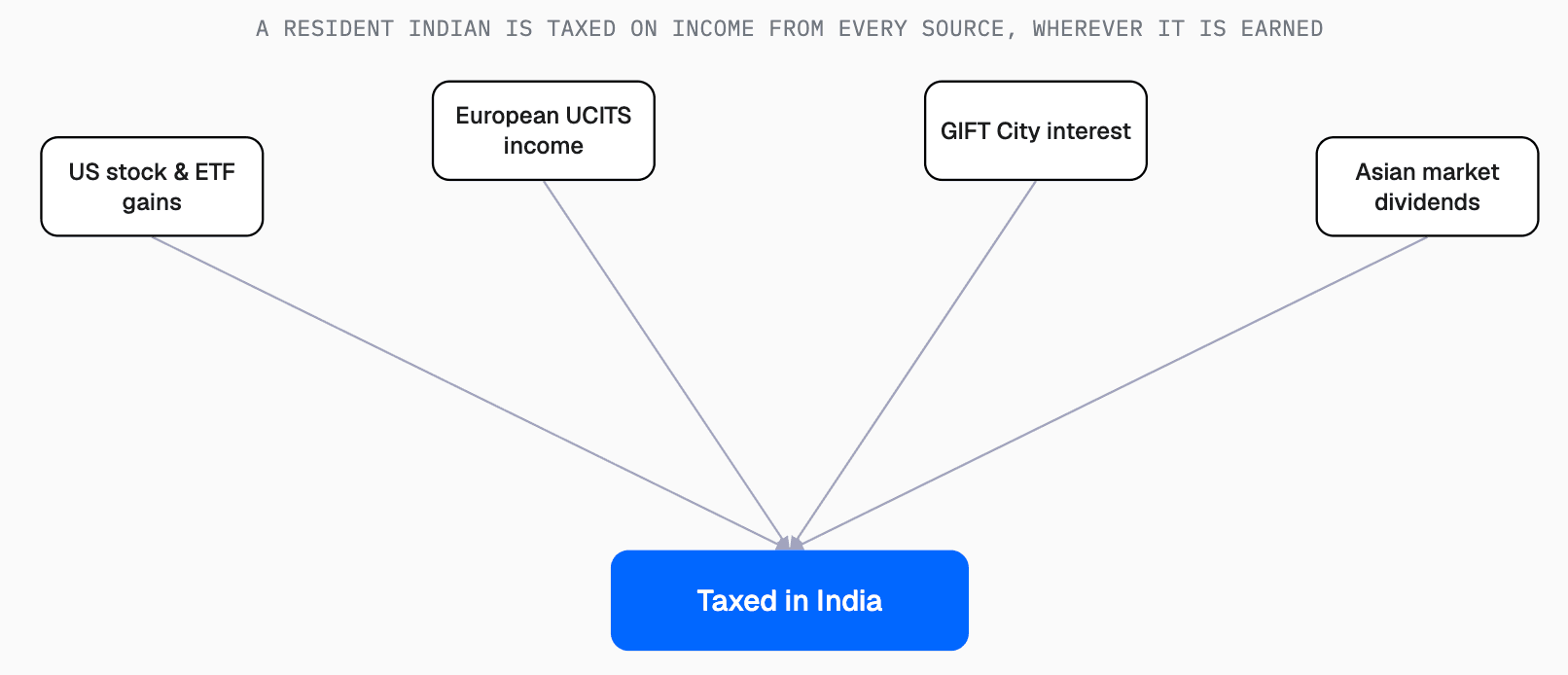
There is a single principle that governs everything in this module. As a resident of India, you are taxed in India on your worldwide income. Your tax home is India, and India taxes what its residents earn globally. If you are an Indian resident and you make money from a US share, that gain is taxable in India.
It covers the gain when you sell a foreign asset for more than you paid. It covers the dividends a foreign company pays you. It covers, in principle, any income your global holdings generate.
This module is written for the resident Indian investor, and the rules described throughout, the rates, the holding periods, the reporting, all assume that residency. If you are a Non-Resident Indian, your position is materially different: NRIs are generally taxed in India only on income that arises in India, not on their worldwide income, and their treatment of foreign investments follows a separate set of rules entirely, which we’ll cover in a different module.
Here is the whole map in one place, so you can see where each chapter fits and how the pieces connect.
When you sell at a profit, you trigger a capital gain, and how long you hold the asset decides whether it is taxed as long-term or short-term. This is the largest subject, and it is Chapter 2.
When you receive a dividend, that income is taxed in India, added to your income for the year. This is Chapter 3, which also flags that foreign dividends can be taxed abroad too, a cross-border wrinkle handled in Module 4.
When you remit money abroad, TCS is collected at source. It is not a real cost, it is advance tax that adjusts against your liability and is refunded if in excess. This is Chapter 4.
Simply holding foreign assets, even with no sale and no income, creates a duty to report them in your Indian return. There is no tax for merely holding, but there is a disclosure obligation, and the penalties for ignoring it are serious. This is Chapter 5.
One question. Less than 10 seconds.
Reinforce what you've learned before continuing to the next chapter.






Discussion