
Every global investment carries an Indian tax consequence, from the gain when you sell to the duty to simply report what you hold. This module is a working guide to all of it: the taxable events, the rates, and the reporting.
A capital gain is simply the profit you make when you sell an asset for more than you paid for it. Buy a foreign stock for a certain amount, sell it later for more, and the difference is your capital gain. That gain is what gets taxed.
Not all capital gains are taxed the same way. The single biggest factor deciding your tax is not how much you gained, but how long you held the investment before selling.
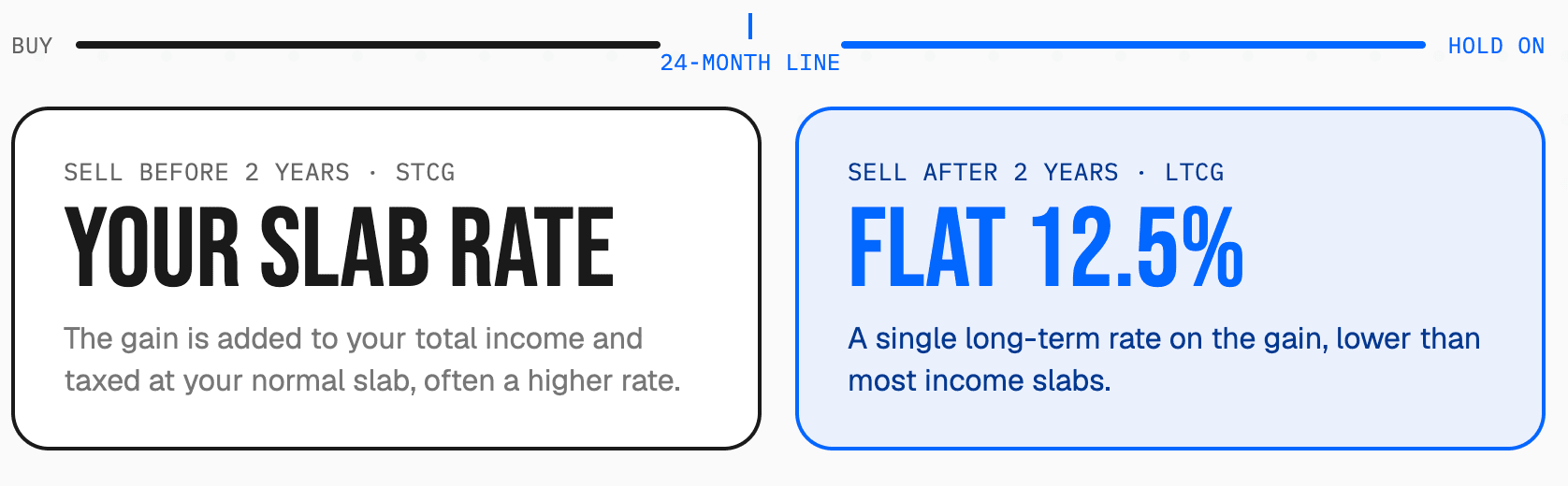
If you hold a foreign share or fund for more than 24 months before selling, your gain is a long-term capital gain, or LTCG. If you sell within 24 months, it is a short-term capital gain, or STCG..
Indian shares enjoy a much shorter 12-month threshold. Foreign shares do not get that treatment. For Indian tax purposes, foreign shares are treated like unlisted shares, which carry the longer 24-month holding period.
A long-term capital gain on foreign shares is taxed at a flat 12.5%. It does not matter what income tax slab you fall into. Two things are worth noting about this rate. First, there is no indexation, meaning you cannot adjust the cost at which you purchased upward for inflation before calculating the gain. Second, the whole profit is taxable, your capital gain is taxable from the very first rupee without any exemption.
A short-term capital gain is treated completely differently. It is added to your total income for the year and taxed at your normal income tax slab rate. So if you fall in a high slab, a short-term gain can be taxed at a much higher effective rate than 12.5%.
Your investment was in dollars, but your tax is calculated in rupees. So before any of the above can happen, the foreign figures have to be converted into rupees, and the rule for how is specific.
Indian tax uses a defined exchange rate for this, the SBI TT buying rate, taken from the last day of the month prior to the month of your transaction. Both your purchase cost and your sale proceeds are converted into rupees using the appropriate rate, and the gain is worked out in rupees, not dollars.
If the rupee weakens between when you bought and when you sold, that currency effect shows up inside the rupee gain automatically. There is no separate tax on the currency movement.
A small example makes it concrete. Suppose you bought a US share for $10 with the exchange rate at 85, meaning you paid 850 rupees and later sold it for $15 with the exchange rate at 90, effectively getting back 1350 rupees. To find your capital gain, you calculate the difference between those two rupee figures, i.e., 500 rupees. That single rupee number is then taxed as long-term or short-term depending on whether you crossed the 24-month line.
If you sell at a loss rather, that capital loss is not wasted. It can be set off against your capital gains, which reduces the total gain you are taxed on.
And if you cannot use a loss fully in the year it arises, it can generally be carried forward to set off against gains in future years, within limits set by current rules. A loss on one investment can lower the tax on gains from another, so losses are worth tracking rather than forgetting. Exactly how you report and carry them forward on your return is covered later in Chapter 6.
One question. Less than 10 seconds.
Reinforce what you've learned before continuing to the next chapter.






Discussion