
Every global investment carries an Indian tax consequence, from the gain when you sell to the duty to simply report what you hold. This module is a working guide to all of it: the taxable events, the rates, and the reporting.
TCS stands for Tax Collected at Source. For certain kinds of transactions, the government collects a slice of tax at the point the transaction happens, rather than waiting for you to declare it later.
It is not money you lose. It is your own tax, collected early, and it comes back to you.
TCS does not apply to every rupee you send abroad. It kicks in only once your total remittances in a financial year cross a threshold.
That threshold is currently 10 lakh rupees per financial year, counted cumulatively across all your LRS remittances, not per transaction. So the first 10 lakh you send abroad in a year attracts no TCS at all. Only the amount above 10 lakh is subject to it. For investment remittances, the rate on that excess is currently 20%.
The 10 lakh is an annual aggregate, so it is the total of everything you remit in the year that matters, and it resets each financial year.
It is not a cost at all. It is advance tax, which means it is treated as tax you have already paid, and it is set against your total tax bill for the year when you file your return. If your actual tax payable is higher than the TCS collected, the TCS simply reduces what you prove. If your liability is lower, the excess is refunded to you. Either way, the money returns to you, either as a smaller tax bill or as a refund.
The only real effect is timing: a portion of your money sits with the tax department for a while before it comes back. That is an inconvenience, a temporary lockup of cash, not a loss.
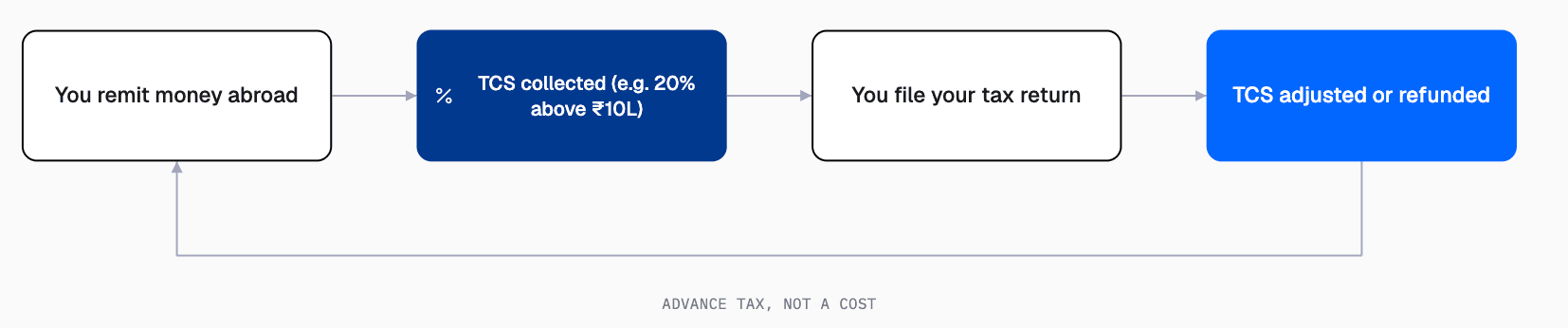
Suppose in one financial year you remit 15 lakh rupees to fund a foreign investment. The first 10 lakh attract no TCS. On the remaining 5 lakh, TCS at 20% comes to 1 lakh rupees, which the bank collects at the time of transfer and deposits against your PAN.
That 1 lakh does not disappear. It shows up as tax already paid on your behalf, visible in your tax records. When you file your return for the year, it is credited against whatever tax you owe.
With the taxes that arise from selling, from dividends, and from remitting all now covered, one India-side obligation remains, and it is the one people most often overlook because it involves no tax at all: the duty to report your foreign holdings. That is next.
One question. Less than 10 seconds.
Reinforce what you've learned before continuing to the next chapter.






Discussion