
Every global investment carries an Indian tax consequence, from the gain when you sell to the duty to simply report what you hold. This module is a working guide to all of it: the taxable events, the rates, and the reporting.
This chapter is about an obligation triggered by simply owning a foreign asset, even if you never sell it, never earn a rupee from it. There is usually no tax to pay for this. But there is a duty to report it in your Income Tax Return.
Reporting your foreign assets and paying tax on them are completely separate duties. You can owe zero tax and still be fully required to report. If you hold even a single share of a foreign company like Apple or Tesla, you must declare it, regardless of whether you made a profit or paid any tax.
Foreign investing touches three different schedules in your return, and knowing which does what removes most of the confusion.
Of these, Schedule FA is the one that applies to everyone holding a foreign asset, income or not, which is why the rest of this chapter concentrates on it.
If you are a resident Indian holding any asset outside India at any point during the relevant reporting period, you must complete Schedule FA when you file. Two points to keep in mind: there is no minimum value that exempts you from the disclosure itself and this applies to resident Indians.
Schedule FA does not exist on every ITR form. It appears only on ITR-2 and ITR-3. So a salaried person holding foreign shares who files ITR-1 out of habit has, by that very choice, failed to disclose, because the form they used has no Schedule FA at all.
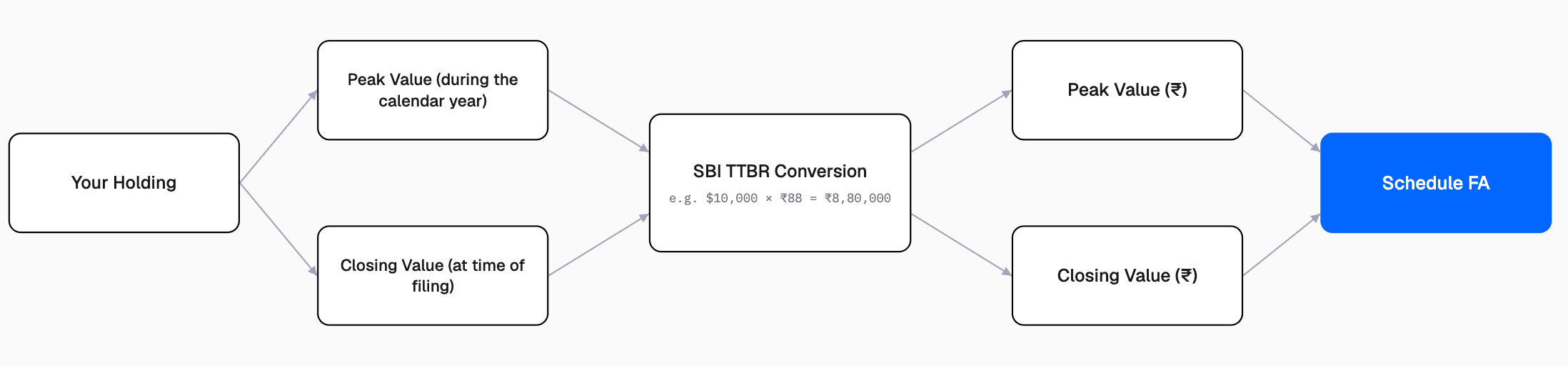
Schedule FA does not ask you for a single number per asset. For each foreign holding, it generally asks for two distinct values, and you have to compute both.
The first is the peak value. This is the highest value your holding reached at any point during the reporting period, its peak balance across the year. You cannot just look at what the asset was worth at year end; you have to identify the moment it was worth the most and report that figure.
The second is the closing value. This is what the holding was worth on the last day of the reporting period.
You convert using the SBI Telegraphic Transfer Buying Rate, the TTBR, which is the exchange rate the State Bank of India adopts for buying a foreign currency.
For the closing value, you use the TTBR as on the last day of the reporting period, December 31. For the peak value, you use the TTBR relevant to the date that peak occurred.
Almost everything else in Indian tax runs on the financial year, April to March. Schedule FA does not. Foreign assets are reported on a calendar-year basis, January to December.
One question. Less than 10 seconds.
Reinforce what you've learned before continuing to the next chapter.






Discussion