
Every global investment carries an Indian tax consequence, from the gain when you sell to the duty to simply report what you hold. This module is a working guide to all of it: the taxable events, the rates, and the reporting.
A dividend from a foreign company or fund is treated as income, added to your total income for the year under the head "income from other sources," and taxed at your normal income tax slab rate.
Because the dividend arrives in a foreign currency, the same conversion logic from the previous chapter applies. The dividend has to be converted into rupees before it can be taxed, using the defined exchange rate for the relevant date, and it is the rupee figure that gets added to your income.
Here is the one complication that we briefly discuss here with a detailed resolution and guidance contained in Module 4.
When a foreign company pays you a dividend, the foreign country often taxes that dividend at source before it ever reaches you. For US stocks, for example, a portion of the dividend is withheld by the US and only the remainder lands in your account. So the same dividend can be touched by tax twice: once abroad, where it is withheld at source, and once in India, where the full dividend is added to your income and taxed at your slab.
However, India has tax treaties with many countries precisely to prevent double taxation. Under such a treaty, you can claim credit in India for the tax already withheld abroad, so you are not taxed twice over.
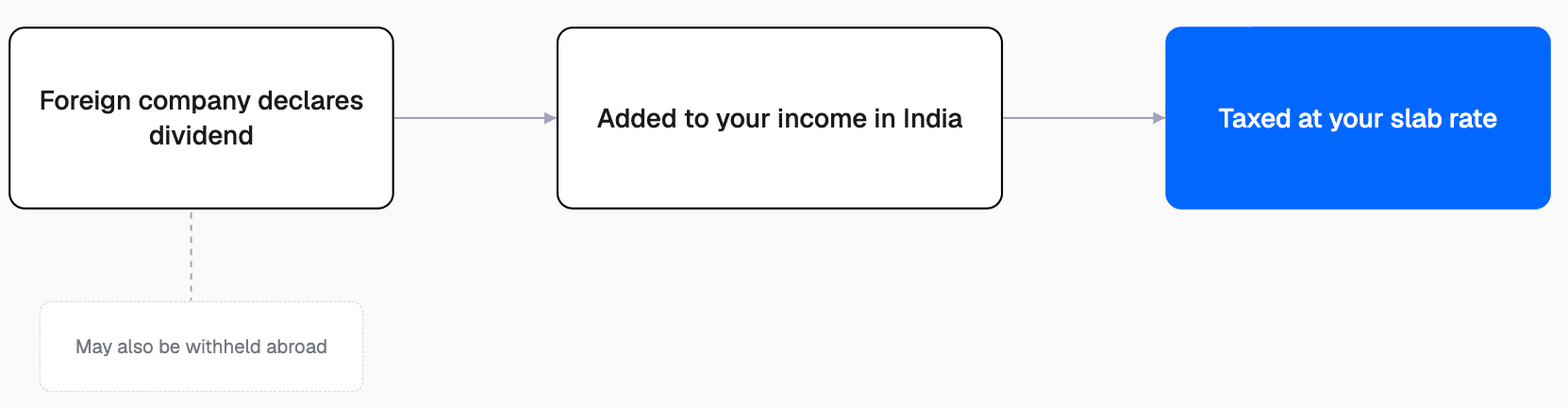
Dividends are the simpler of the two main taxable events. On the India side, a foreign dividend is just income, converted to rupees and taxed at your slab rate, with none of the holding-period machinery that governs capital gains. Next we turn to the tax touchpoint you meet at the very start of the journey rather than the end, when money leaves India: TCS on remittance.
One question. Less than 10 seconds.
Reinforce what you've learned before continuing to the next chapter.






Discussion