
Global Investing
UCITS Mutual Funds vs UCITS ETFs: Fees, Pricing and Minimums
UCITS mutual funds and UCITS ETFs follow the same EU rules but differ on trading, pricing, minimums and costs. Here is how they compare.

Abhighyan Sinha

UCITS mutual funds and UCITS ETFs follow the same EU rules and can hold the same assets. The difference is how you buy them and what they cost.
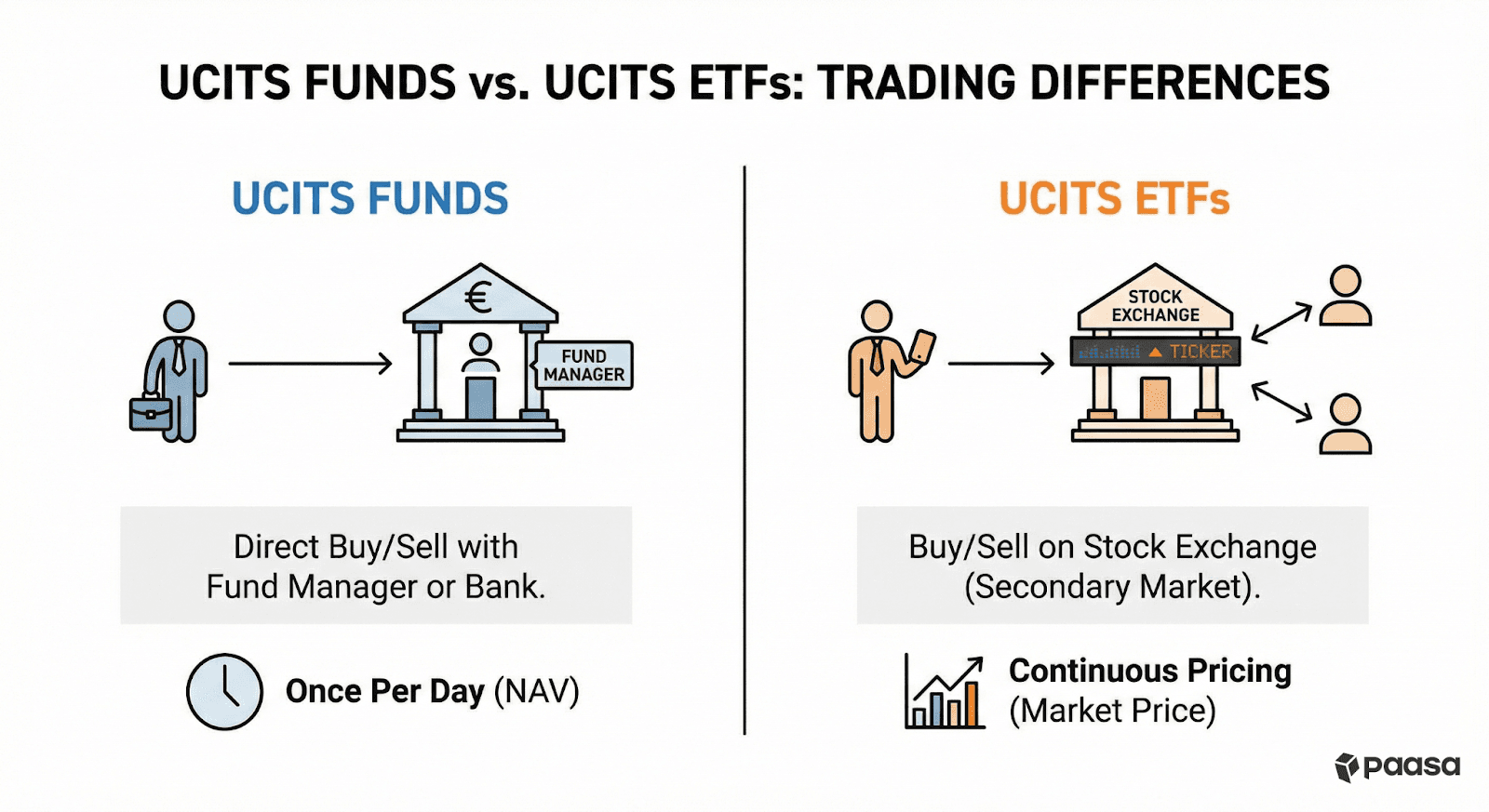
You buy a UCITS mutual fund from the fund house or a distributor at the next net asset value (NAV) it calculates, usually once a day. It often has a minimum investment and higher fees on retail share classes.
A UCITS ETF trades on a stock exchange, such as the London Stock Exchange, at a live price, usually with a lower expense ratio.
Both are set up under the EU's UCITS Directive, and most are domiciled in Ireland or Luxembourg, though they can invest in assets anywhere, including US shares.
This guide covers how the two differ on trading, pricing, minimums and costs, and when each one fits.
What is the difference between UCITS mutual funds and UCITS ETFs?
The core difference is how you buy and sell them, not what they hold.
- UCITS mutual funds: not listed on an exchange. You subscribe (buy) or redeem (sell) units through the fund manager or a distributor such as a bank or platform, at the next price the fund calculates.
- UCITS ETFs: listed on a stock exchange. You buy and sell units from other investors during market hours, like a share.
How do fees, pricing and minimums compare?
| UCITS mutual funds | UCITS ETFs | |
|---|---|---|
| How you trade | Orders are processed once a day | Traded during market hours |
| Price you get | The NAV calculated after your order (forward pricing) | The live market price when your order fills |
| Minimum investment | Often set by the fund, and higher for lower-fee share classes | Usually one unit |
| Share classes | Often several, with different fees and minimums | Usually one or a few |
| Ongoing costs | Retail share classes usually charge more | Usually lower |
| Entry and exit charges | Some funds charge them | None (you pay brokerage and the bid-ask spread) |
Every UCITS fund must publish a Key Information Document (KID) that lists its ongoing charges and any entry or exit charges. Check it before you invest.
Example. Suppose you want S&P 500 exposure. The iShares Core S&P 500 UCITS ETF (CSPX), an Ireland-domiciled accumulating ETF, has a total expense ratio (TER) of 0.07%. Compare that figure with the ongoing charges in the KID of any mutual fund you are considering for the same exposure.
Note: UCITS ETFs and US ETFs differ in domicile, which changes dividend withholding and US estate tax exposure for Indian investors. How UCITS ETFs compare with US ETFs covers both.
When does each one fit?
1. UCITS ETFs
ETFs suit investors who want to track an index, such as the S&P 500, the Nasdaq 100 or a world index:
- Lower costs: index ETFs usually have lower ongoing charges than retail share classes of mutual funds, without high minimums.
- Accumulating options: many UCITS ETFs come in accumulating share classes, which reinvest dividends inside the fund, so you have no dividend income to pay tax on each year. See accumulating vs distributing UCITS ETFs.
- Tax at sale: you pay capital gains tax when you sell, at 12.5% if held for more than 24 months, or your slab rate if held for 24 months or less (section 197 of the Income-tax Act 2025).
- Live prices: you see the price before you trade.
Note: Most ETFs track an index, so they offer less choice of active managers.
2. UCITS mutual funds
Mutual funds can suit investors who want something ETFs rarely offer:
- Active managers: some active strategies are only available as mutual funds.
- Less liquid assets: in areas like high-yield bonds or small companies, a mutual fund can close to new money to protect existing investors, which an ETF listed on an exchange cannot easily do.
Note: Retail share classes usually charge more than the institutional classes of the same fund, which need much larger minimums. Compare the KID's ongoing charges with what an ETF charges for similar exposure.
Where can you buy UCITS funds and ETFs?
To buy UCITS ETFs, you need a broker with access to European exchanges such as the London Stock Exchange. Many international investing apps in India offer only US exchanges, which limits you to US-domiciled funds.
On Paasa, you can buy both UCITS mutual funds and UCITS ETFs. Paasa gives you direct access to the London Stock Exchange, so you can buy UCITS ETFs in USD, GBP or EUR lines. Read how to buy UCITS ETFs from India for the steps.
For a shortlist of accumulating UCITS ETFs by index, see top UCITS ETFs for Indian investors, or compare funds with the UCITS screener.
Conclusion
UCITS mutual funds and UCITS ETFs follow the same rules and give you the same protections. The difference is in how you trade them and what they cost.
ETFs trade at live prices, usually with lower charges and no minimums beyond one unit. Mutual funds trade once a day and can give access to active managers, often at higher fees. Check the KID of any fund before you invest.
Related: What are UCITS ETFs? and What are UCITS?
About Paasa
Paasa is a global investing platform that gives you direct access to stocks, ETFs and UCITS funds on their home exchanges across the US, Canada, the UK, Germany, France, Switzerland, the Netherlands, South Korea, Japan, Hong Kong and Singapore.
- UCITS access: Buy UCITS ETFs and UCITS mutual funds in USD, GBP or EUR lines from one account.
- A dedicated relationship manager: One point of contact to help you compare funds by domicile, cost and share class before you invest.
- Tax reports: Schedule FA, capital gains and dividend reports built for Indian tax returns, included with the account.
Frequently Asked Questions
What is the difference between UCITS mutual funds and UCITS ETFs?
Both follow the EU's UCITS rules and can hold the same assets. You buy a UCITS mutual fund from the fund manager or a distributor at the price calculated after your order, while a UCITS ETF trades on a stock exchange at a live price. ETFs usually have lower ongoing charges and lower minimums.
Are UCITS mutual funds safer than UCITS ETFs?
No. Both follow the same UCITS Directive, including its rules on diversification and on holding assets with an independent depositary. The difference between them is in cost, pricing and how you trade, not in investor protection.
Are UCITS funds safer than US funds for Indian investors?
Not in terms of regulation, since both are regulated. For Indian investors, the main difference is tax. Ireland-domiciled UCITS funds are not US-situs assets, so they sit outside US estate tax, which can apply to non-residents holding more than 60,000 dollars of US-situs assets such as US ETFs.
Do UCITS mutual funds pay dividends?
Their distributing share classes do. Many UCITS mutual funds offer both distributing and accumulating share classes. A distributing class pays dividends, which Indian residents pay tax on at their slab rate. An accumulating class reinvests them inside the fund, so you pay tax only when you sell.
Can I switch from a UCITS mutual fund to a UCITS ETF?
Not directly. You have to redeem your mutual fund units and use the money to buy the ETF. Redeeming is a sale, so any gain is taxed in India as a capital gain.
What is forward pricing in UCITS mutual funds?
A UCITS mutual fund is priced once a day. When you place an order, you get the net asset value calculated after the order is accepted, so you do not know the exact price when you place it. An ETF trades at a live price that you can see before you trade.
Why do some UCITS mutual funds charge more than ETFs?
Many mutual funds have several share classes. Retail classes often include distribution costs and charge more than institutional classes of the same fund, which need much larger minimums. Index ETFs usually have one low ongoing charge. Each fund's Key Information Document lists its charges.
Do UCITS mutual funds have entry or exit charges?
Some do. A fund's Key Information Document lists any entry or exit charges. UCITS ETFs bought on an exchange have no entry or exit charges, and you pay only your broker's commission and the bid-ask spread.


Invest in global markets from India

Discussion
Disclaimer
The information provided in this post is for general informational purposes only. It is not intended as professional advice or to replace consultation with qualified professionals. While we strive to ensure the accuracy and reliability of the information presented, we make no representations or warranties of any kind, express or implied, about the completeness, accuracy, reliability, suitability, or availability with respect to the content contained herein. Any reliance you place on such information is therefore strictly at your own risk. We disclaim any liability for any loss or damage, including, without limitation, indirect or consequential loss or damage, or any loss or damage whatsoever arising from loss of data or profits arising out of, or in connection with, the use of this post. Always seek the advice of professionals or relevant authorities regarding your specific situation or circumstances.