



| SENATE SEATS CALLED | HOUSE SEATS CALLED | PROJECTED HOUSE SEATS | US 10 YEAR YIELD |
| 54 v 43 | 228 v 144 | 255 | 4.93% |
| Democratic caucus v Republican, 3 uncalled | 63 races still uncalled | NBC News Decision Desk estimate | 3 bp lower; touched 4.906% overnight |
Control of Congress is decided, but the count is not finished. By midday in India, NBC News had Democrats at 54 Senate seats against 43 for Republicans, and 228 House seats against 144, with 63 House races and three Senate races still open.
Gains came deep inside states President Trump carried by double digits in 2024. Here is what the numbers say, what changes in Washington from January, and what it means for Indian investors holding US dollar assets.
Table of contents
- The Scoreboard
- Seven Flips, Four of Them in Deep Red States
- The House: A Wave, Not a Ripple
- How Markets Took It
The scoreboard
Both chambers change hands for the 120th Congress, which sits from January 2027.
Republicans went into Election Day holding the Senate 53 to 47 and the House 219 to 214, counting one independent who caucuses with the GOP, with two vacancies. Because the Vice President breaks ties, Democrats needed a net gain of four Senate seats and a handful of House seats to take Congress.
They cleared both bars comfortably. NBC News, CBS News and MS NOW project Democratic control of both chambers, and the Associated Press has called the Senate for Democrats. In the Senate, NBC counts 54 Democratic seats after seven flips and no losses. In the House, NBC’s Decision Desk estimates Democrats will finish with about 255 seats against 180 for Republicans, a 75 seat margin, while MS NOW puts the Democratic floor at 245. Both are far above the 218 needed for a majority.
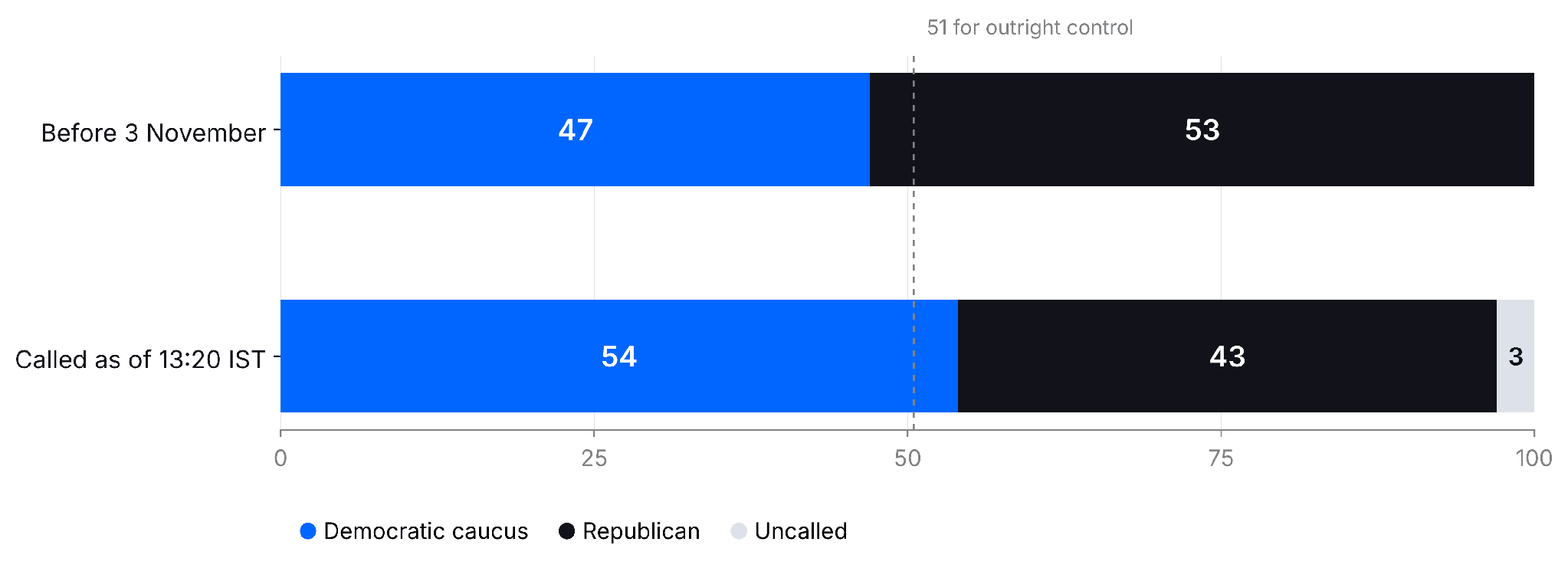
Seats by party, as called by NBC News at 07:54 UTC, 4 November 2026
Sources: NBC News Senate results; Associated Press via Al Jazeera; MS NOW. Two independents caucus with Democrats.
Seven flips, four of them in deep red states
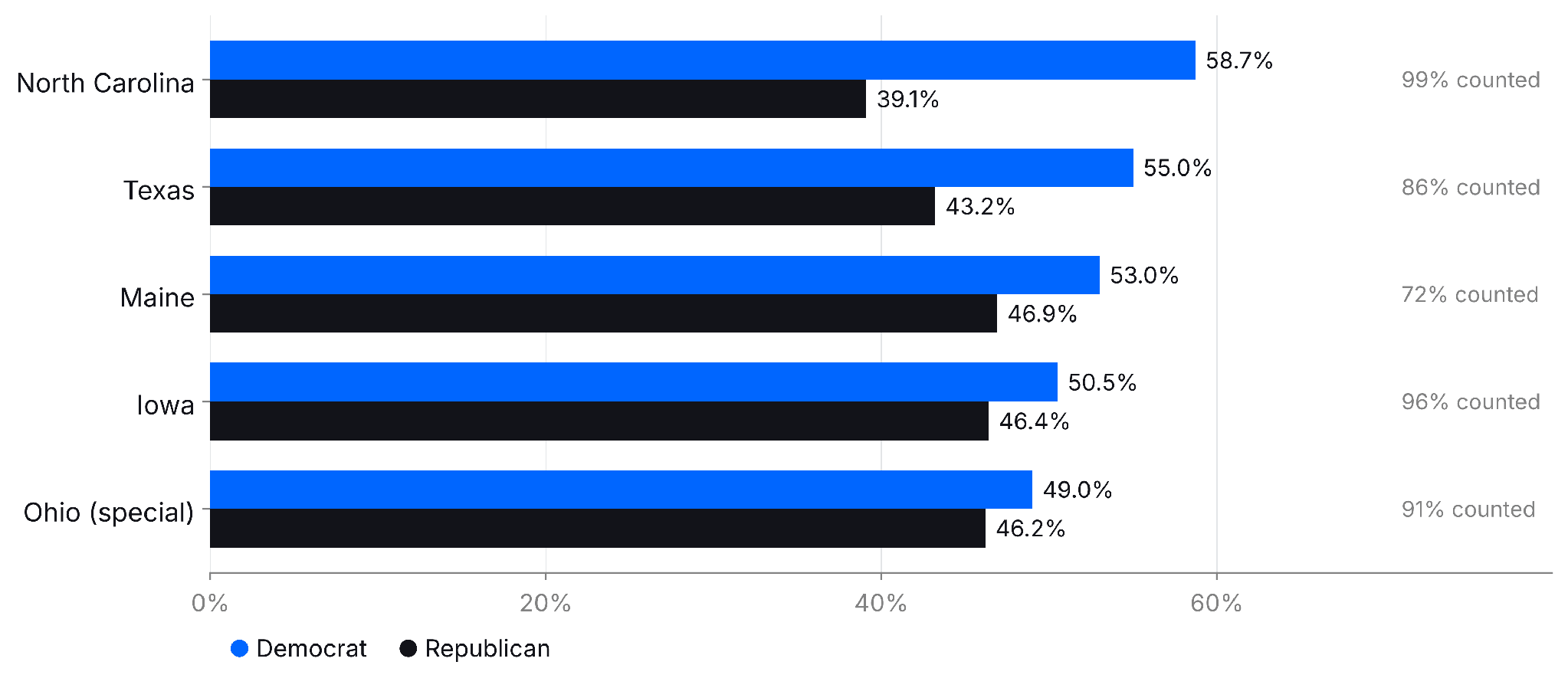
The Senate map was supposed to favour Republicans. Instead, Democrats won Republican held seats in North Carolina, South Carolina, Texas, Ohio, Iowa, Kansas and Maine. They also held every seat they were defending among the races called. Abdul El-Sayed defeated former Representative Mike Rogers in Michigan, becoming the first Muslim senator according to CBS News. Jon Ossoff held Georgia, Peggy Flanagan held Minnesota and Democrats kept New Hampshire. Republicans kept Florida, where Ashley Moody defeated Angie Nixon.
The history attached to these wins is what makes the night unusual. Roy Cooper becomes the first Democrat elected to the Senate from North Carolina since 2008.
James Talarico defeated Attorney General Ken Paxton to become the first Democratic senator from Texas since Lloyd Bentsen, who left office in 1993. Adam Hamilton is the first Democrat Kansas has sent to the Senate since 1932. In South Carolina, Annie Andrews unseated interim Senator Darline Graham, the first Democratic Senate win in the state since 1998. In Maine, Susan Collins conceded to Troy Jackson.
Three seats remain open. Alaska could take weeks to count. In Nebraska, Republican Pete Ricketts led independent Dan Osborn 49.9% to 44.2% with 79.7% of the expected vote counted.
| State | Democrat (winner) | Republican | Vote share | Context |
|---|---|---|---|---|
| North Carolina | Roy Cooper | Michael Whatley | 58.7% v 39.1% | First Democratic win since 2008 |
| Texas | James Talarico | Ken Paxton | 55.0% v 43.2% | First Democratic senator since Bentsen |
| Maine | Troy Jackson | Susan Collins (inc.) | 53.0% v 46.9% | Collins conceded |
| Iowa | Josh Turek | Ashley Hinson | 50.5% v 46.4% | Open seat held by Joni Ernst |
| Ohio (special) | Sherrod Brown | Jon Husted (inc.) | 49.0% v 46.2% | Brown returns after losing in 2024 |
| Kansas | Adam Hamilton | Roger Marshall (inc.) | Called | First Democrat since 1932 |
| South Carolina | Annie Andrews | Darline Graham (inc.) | Called | First Democratic win since 1998 |
Vote shares are partial NBC News counts at 72% to 99% of expected vote when the races were called and will move. Kansas and South Carolina were called by AP and NBC; shares were not published in our sources.
Called flips by vote share
Partial counts, share of expected vote counted shown at right
The House: a wave, not a ripple
History said the House would move. Brookings notes the president’s party has lost House ground in 20 of the 22 midterms since 1938. The scale is what stands out. With 228 seats already called, Democrats have passed the majority line by 10 seats with 63 races still to report, many of them in California, Nevada, Colorado and New York where mail ballots take longer. On NBC’s estimate of 255 seats, the Democratic gain of roughly 41 would equal 2018 and rank behind only 2010 and 1994 among the eight midterms since 1994. It came even after several Republican led states redrew congressional maps over the past 18 months to improve their odds.
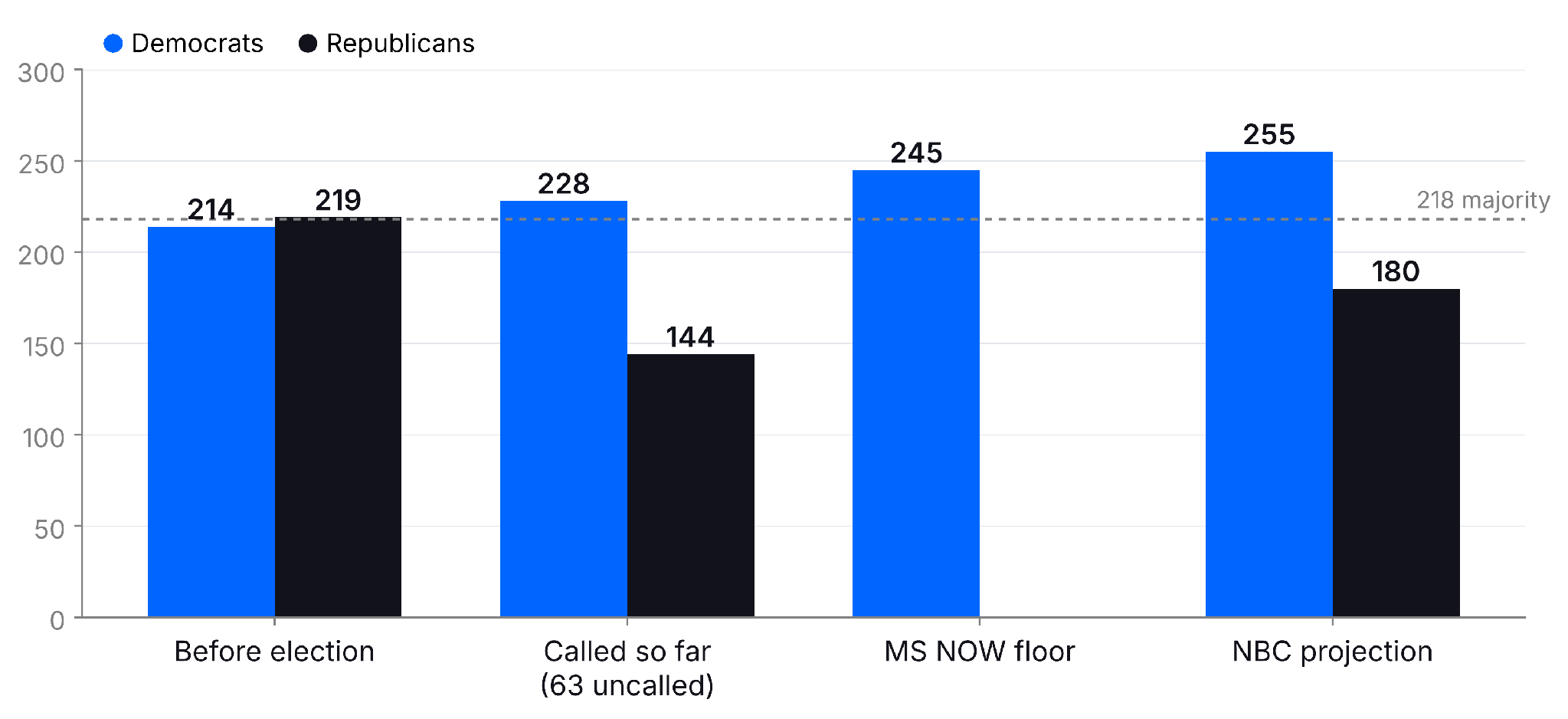
218 seats needed for a majority
Sources: CBS News (composition before the vote); NBC News called seats at 07:54 UTC and Decision Desk projection; MS NOW estimate, 4 November 2026.
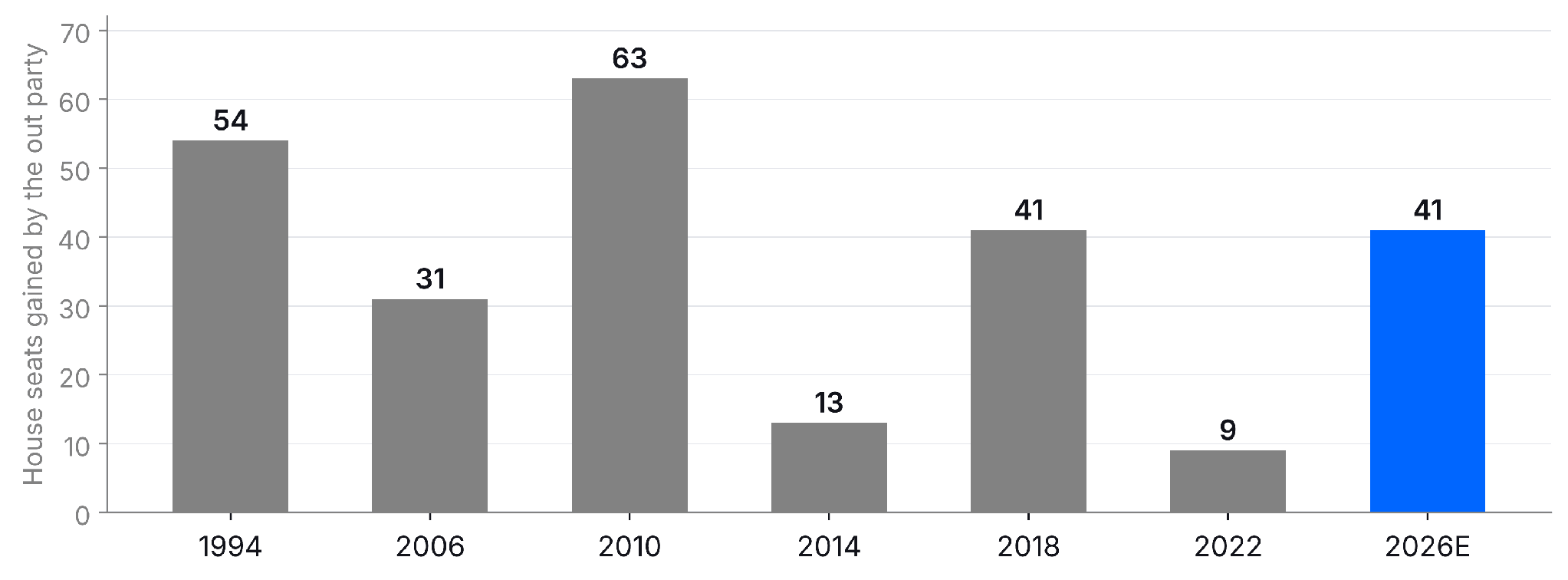
2026E uses NBC’s 255 seat projection against 214 seats held before the vote
Sources: Brookings Institution; US House election records; NBC News projection for 2026. The 2026 figure is an estimate.
Analysts quoted by Northeastern University and the Washington Post tied the result to voter frustration over the war with Iran, higher fuel prices and the cost of living. CBS News reported the House result arriving with presidential approval at a historic low. House Minority Leader Hakeem Jeffries pledged to make affordability the new majority’s first priority.
How markets took it
Markets had leaned toward a Democratic House for weeks. Prediction markets priced a 94% chance of a Democratic House and 74% for the Senate before the count, according to Brave New Coin, and Reuters reported more than $1.48 billion wagered on the outcome. The surprise was the size of the Senate result, and the first reaction was risk off.
Early in the Asian session Reuters reported S&P 500 futures down 1.2%, Nasdaq futures down more than 2% and the 10 year Treasury yield 6 basis points lower at 4.906%. The dollar index hit a one month low of 101.34, with the yen 0.7% stronger at 157.55 per dollar. Japan’s Nikkei fell 3.56% to 60,835.36 and South Korea’s Kospi 2.67% to 5,497.78 as AI linked names sold off.
Then dip buyers arrived. By 06:45 UTC Bloomberg had S&P 500 futures down only 0.3% and Nasdaq 100 futures down 0.4%. The 10 year yield sat 3 basis points lower at 4.93%, and five year yields had fallen as much as 9 basis points to 4.67% on bets that gridlock will curb deficit spending and Treasury issuance. The dollar was weaker against every Group of 10 currency. The MSCI Asia Pacific index ended the morning just 0.2% lower. Traders now turn to the Treasury’s quarterly refunding statement, due today.
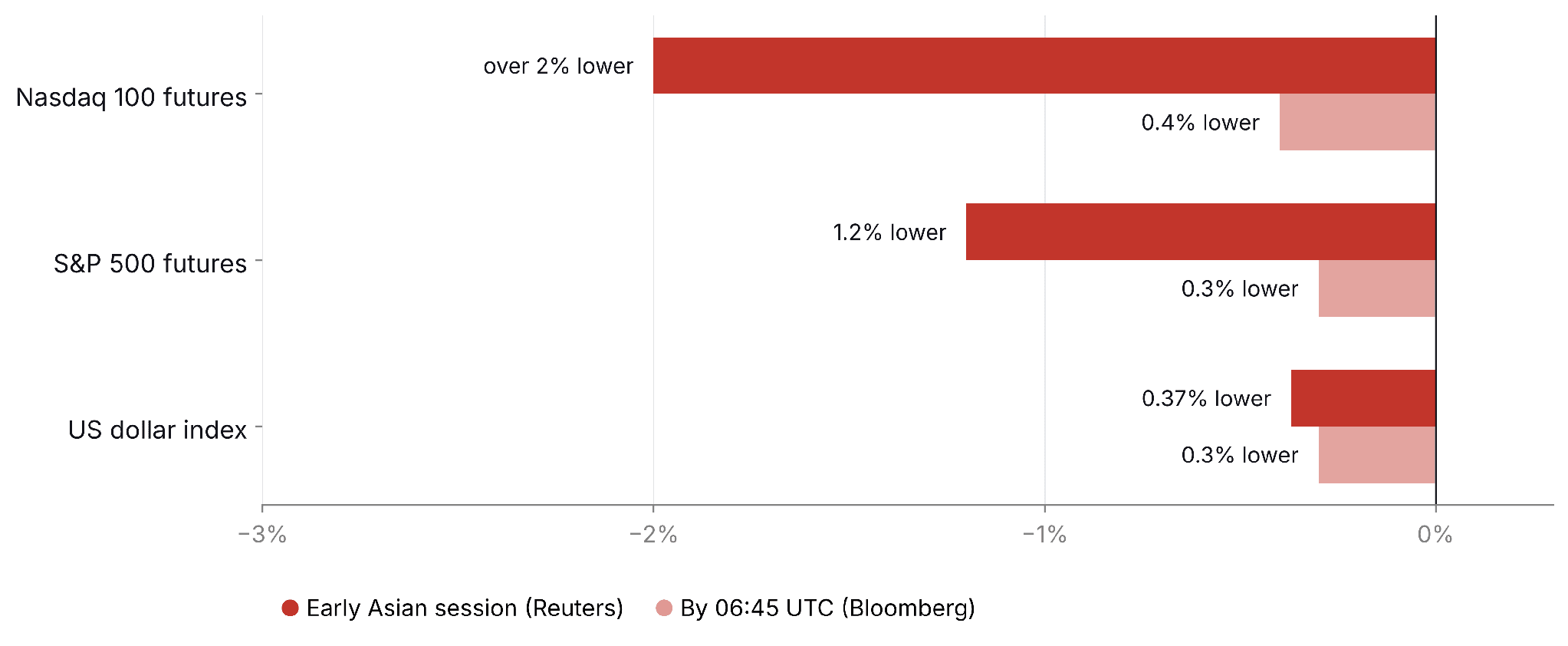
Move in US futures and the dollar index, early Asian session against 06:45 UTC
Sources: Reuters via Yahoo Finance (early session); Bloomberg markets wrap, 06:45 UTC, 4 November 2026. Intraday levels will change.
The sharper early fall in the Nasdaq reflects a specific worry. Analysts cited by Reuters pointed to the risk of tougher scrutiny of AI and Big Tech from a Democratic Congress, at a time when investors already question high valuations and rising AI spending.
The Nasdaq 100 had entered correction territory before the vote, about 10% below its October peak.
Michael Arone of State Street Global Advisors told Reuters the bigger risk was investors overreacting, and argued that a perception of greater Federal Reserve independence could support the dollar at the margin. Pepperstone’s Chris Weston had flagged before the results that for traders “the distinction between a narrow Democratic majority and a commanding victory is critical.”
The market got the commanding version, and by midday had already marked down much of its first reaction.
WHAT DIVIDED GOVERNMENT CHANGES FROM JANUARY 2027
|
TAKEAWAY Washington now has divided government for the final two years of the Trump term. That usually means less fiscal surprise, more oversight and more noise around deadlines. The first market move priced in risk to US tech and the dollar, and half a day later much of it had already faded. For Indian investors, the right response is a review of concentration and currency exposure within an existing LRS plan, not a wholesale shift in allocation. |
Limitations
Results are as of 07:54 UTC (13:24 IST) on 4 November 2026. Three Senate races, including Alaska and Nebraska, and 63 House races remain uncalled. Vote shares are partial counts. House figures of 245 and 255 are network projections, not final results. Market prices are intraday levels and will change.

