


If you are an Indian professional who receives foreign RSUs, maintaining accurate records is essential. Each vesting and sale generates information that you'll need to calculate your taxes correctly and report your income in your ITR.
RSUs are taxed at multiple stages. Vesting records determine salary income, and sale records are used to compute capital gains.
Missing documents can make it difficult to calculate your tax liability accurately later.
This guide explains what records to keep at each stage from vesting to selling shares and filing your Indian Income Tax Return (ITR) so you can calculate taxes accurately and stay prepared.
Table of contents:
- Why RSU Record-Keeping Is Different from Regular Salary
- Records to Keep Every Time Your RSUs Vest
- Records You'll Need for ITR Filing
- Review Your Records Before Filing Your ITR
Why RSU Record-Keeping Is Different from Regular Salary
Unlike regular salary, RSUs create tax obligations over multiple years. The records you keep today may be needed long after you receive your shares.
Two Taxable Events Depend on the Same Records
RSUs are taxed twice:
- At vesting: The Fair Market Value (FMV) of the vested shares is treated as salary income.
- At sale: When you sell shares, capital gains are calculated using the FMV at vesting as the cost of acquisition.
Because the cost of acquisition comes from your vesting records, keeping accurate records from the beginning is essential.
If you want to understand how taxes apply at each stage, read our guide on RSU Taxation: Grant, Vesting, and Sale.
Records to Keep Every Time Your RSUs Vest
Every vesting creates a separate tax event. Keeping the right records at the time of vesting makes it much easier to calculate your taxes and report future capital gains.
Vesting Details
Record the following for every vesting:
- Vesting date
- Number of shares vested
If your RSUs vest in multiple installments, keep these details separate for each vesting lot.
Fair Market Value (FMV)
Record the Fair Market Value (FMV) per share on the vesting date.
This value is treated as your salary income and also becomes the cost of acquisition for calculating capital gains when you sell the shares.
You can find the FMV in your vesting confirmation, brokerage portal, or employer's equity platform.
Exchange Rates
If your RSUs are denominated in a foreign currency, keep a record of both exchange rates used at vesting.
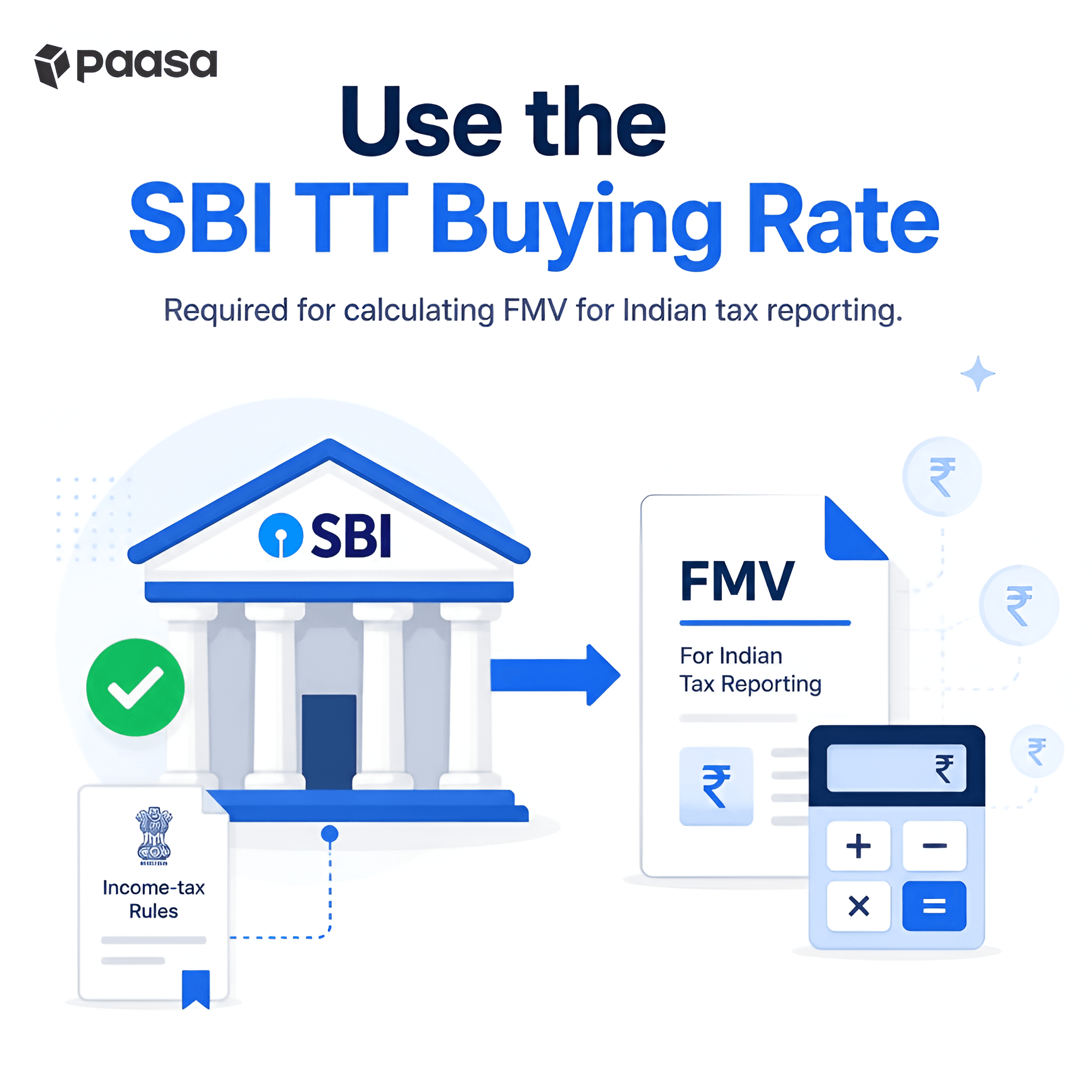
For Indian tax reporting, you must use the State Bank of India (SBI) TT Buying Rate (Telegraphic Transfer Buying Rate) prescribed under the Income-tax Rules to calculate the fair market value (FMV).
Tax Withholding Details
If your employer uses a sell-to-cover arrangement, record:
- Number of shares withheld to pay taxes.
- Number of shares credited to your brokerage account.
These records help you reconcile your vested shares with the shares you actually own.
Supporting Documents
Download and securely store copies of:
- Vesting confirmation
- Payslip for the vesting month
- Form 16
Store these documents safely, as you may need them years later when you sell your shares or file your ITR.
Why You Can't Rely Only on Form 16
Your Form 16 shows the salary income and tax deducted at the time your RSUs vested. However, it does not contain all the information required to calculate capital gains when you sell your shares.
To calculate your taxes correctly, you'll also need records such as your vesting statements, FMV on the vesting date, brokerage statements, and sale confirmations.
Records to Keep for Dividends
If your vested RSUs pay dividends, keep a record of every dividend you receive. These records help you report dividend income correctly and claim foreign tax credit, where applicable.
Track Every Dividend Received
For each dividend payment, record:
- Payment date
- Gross dividend amount
- Foreign tax withheld
- Exchange rate used for tax reporting
Supporting Documents
Keep copies of:
- Dividend statements
- Brokerage statements showing the dividend credit
- Any tax documents issued by the broker or company
Maintaining these records will make it easier to report dividend income, complete your ITR, and claim credit for foreign taxes paid, if eligible.
Records You'll Need for ITR Filing
When filing your Income Tax Return (ITR), you'll need records from every stage of your RSU journey. Keeping these documents organized makes it easier to report your income accurately and support your tax calculations.
| ITR Requirement | Records to Keep | Why They're Needed |
|---|---|---|
| Salary Reporting | Form 16, vesting statements, payslips | Report the salary income arising from RSU vesting. |
| Capital Gains Reporting | Brokerage statements, trade confirmations, cost of acquisition records, transaction fee details | Calculate and report capital gains accurately. |
| Foreign Asset Reporting (Schedule FA) | Foreign brokerage statements, year-end holdings statement | Report foreign assets held during the relevant reporting period, if applicable. |
| Foreign Tax Credit (Form 67) | Form 67, foreign tax statements, proof of taxes withheld | Claim credit for eligible foreign taxes paid. |
Keeping these records together before you begin filing your ITR can save time and help avoid reporting errors.
To learn how these documents are used while filing your return, read our guide on How to File ITR for Foreign RSUs.
Review Your Records Before Filing Your ITR
Before filing your ITR, take a few minutes to review your records. A quick cross-check can help identify missing income, incorrect tax calculations, or reporting mismatches before you submit your return.
Compare your records with the following:
| Source | What to check |
|---|---|
| AIS (Annual Information Statement) | Verify that your reported income matches the information available with the Income Tax Department. |
| Form 26AS | Check the taxes deducted or collected on your behalf. |
| Employer records | Reconcile your vesting details, salary income, and tax withheld with your Form 16 and payslips. |
| Brokerage statements | Confirm your sale transactions, dividends, and year-end holdings. |
Resolving any discrepancies before filing can help reduce the chances of notices or the need to revise your return.
How Long Should You Keep RSU Records?
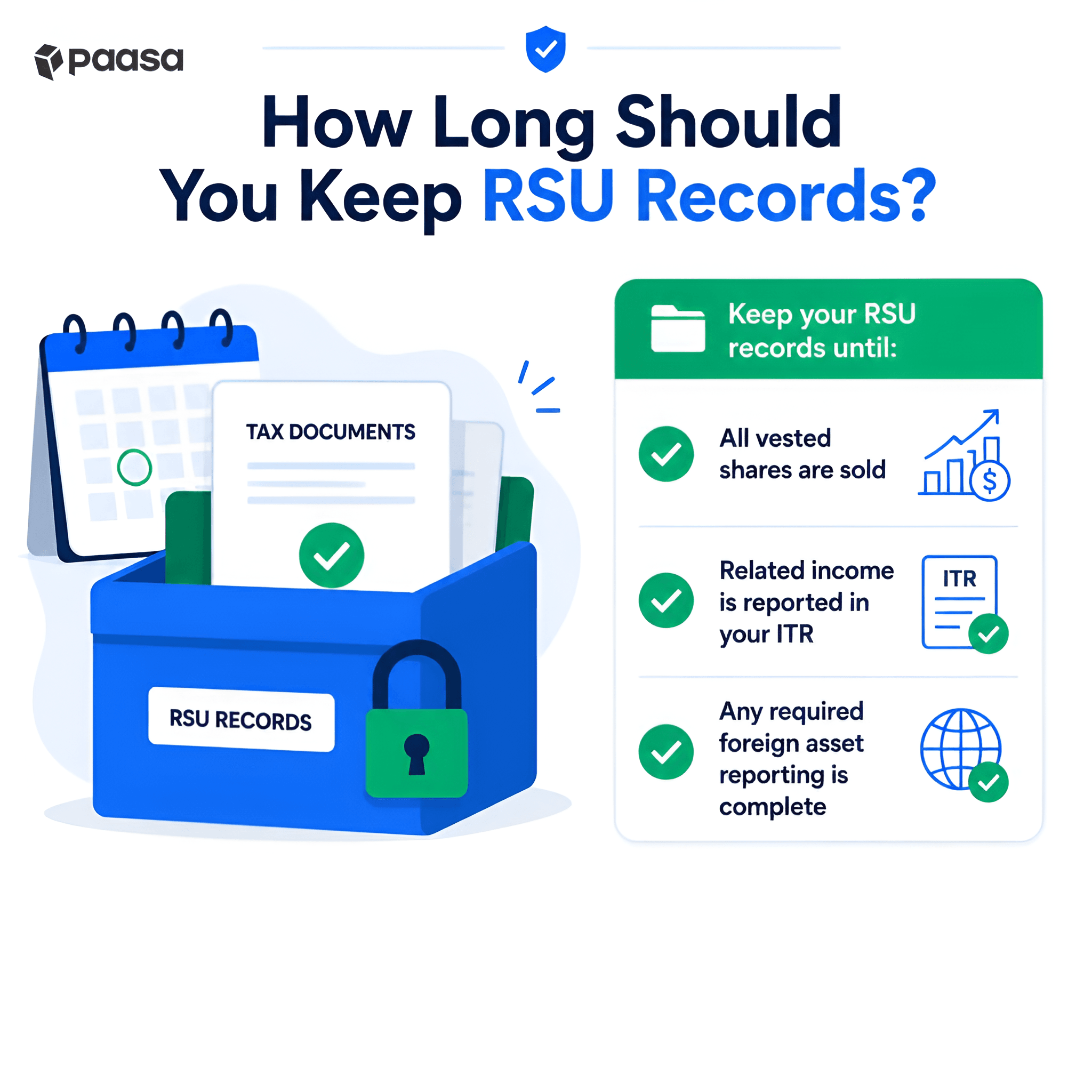
Keep your records until all vested shares have been sold and the related income has been reported in your ITR.
As a best practice, retain your supporting tax documents for several years after filing, especially if your RSUs or brokerage account qualify as foreign assets that may need to be reported in future tax filings.
Common Record-Keeping Mistakes
Keeping incomplete or disorganized records can make it difficult to calculate your taxes accurately. Avoid these common mistakes:
- Not downloading vesting confirmations: Some equity platforms only retain documents for a limited period.
- Losing historical exchange rates: Save the exchange rate used for each vesting and sale.
- Mixing multiple vesting lots: Keep separate records for every vesting lot, as each has its own cost of acquisition.
- Not recording withheld shares: Track the shares withheld for taxes under a sell-to-cover arrangement.
- Not tracking dividends: Keep records of dividend payments and any foreign tax withheld.
- Relying only on Form 16: Form 16 is useful for salary reporting, but you'll also need brokerage statements, vesting records, and sale confirmations to calculate capital gains and complete your ITR.
Maintaining organized records throughout the year makes tax filing simpler and reduces the risk of errors when reporting your RSUs.
How Paasa Can Help
Paasa helps Indian investors and RSU holders access global markets with ease, enabling investments across the US, Europe, China, Japan, and other major economies.
Trusted by HNIs, family offices, and institutions, Paasa combines international investing opportunities with India-focused support and compliance.
Paasa helps you hold and protect your RSU wealth with:
- In-kind transfer from your existing brokerage account
- Access to US, Europe, China, Japan, and other major economies
- Access to UCITS ETFs that protect against the US estate tax risk
- Comprehensive tax reporting tailored for Indian investors, including capital gains, dividend taxation, and TCS tracking.

