


If you're an Indian resident taxpayer who receives RSUs from a U.S. company such as Amazon, Microsoft, Google, Apple, or Meta, your ITR filing involves more than reporting your salary.
Depending on whether your RSUs vested, paid dividends, or were sold, you need to report salary income, capital gains, foreign assets, and foreign taxes.
RSUs are taxed twice, first as salary at vesting and again as capital gains on sale. Understanding this is key to accurate filing and claiming foreign tax credit.
This guide covers how to file your ITR for foreign RSUs, required documents, the correct ITR form, and key reporting steps.
Understand Your RSU Tax Journey Before Filing
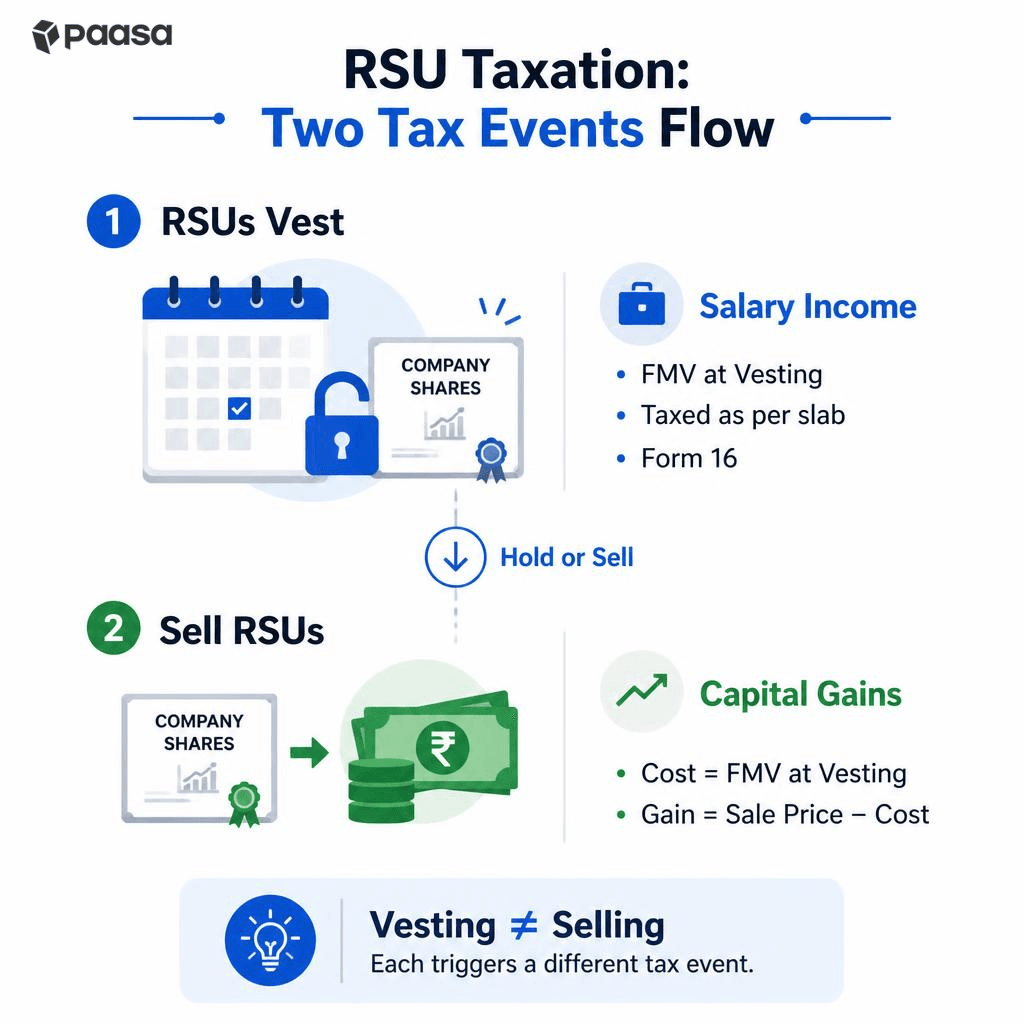
Before filing your ITR, understand how RSUs are taxed. Reporting depends on whether they vested, were sold, or both.
What Happens When Your RSUs Vest?
At vesting, the fair market value (FMV) of shares is treated as salary income and taxed as per your slab. Taxes withheld are reflected in Form 16.
Learn how to read and verify your RSU taxes in Form 16 for RSU Holders
What Happens When You Sell Your RSUs?
On sale, you can have capital gains. The cost is the FMV at vesting, and the sale price is what you receive. The difference is reported under Capital Gains.
Why This Matters for Your ITR
RSUs can create both salary income and capital gains. Each must be reported correctly. You also need to disclose holdings in Schedule FA and claim foreign tax credit if applicable.
Example:
Suppose you receive 1,000 Amazon RSUs. On the vesting date, Amazon's share price is $100 per share. The total fair market value (FMV) of your RSUs is $100,000 (1,000 × $100).
| Particulars | Amount |
|---|---|
| Number of Amazon RSUs vested | 1,000 |
| Fair Market Value (FMV) per share on vesting | $100 |
| Total FMV treated as salary income | $100,000 |
| Applicable income tax slab (example) | 30% |
| Tax payable on vesting (30% of $100,000)* | $30,000 |
*Illustrative only. Actual tax may vary based on your applicable tax slab
Later, when you sell the shares:
Suppose you sell all 1,000 Amazon shares when the share price has increased to $130 per share.
| Particulars | Amount |
|---|---|
| Number of Amazon shares sold | 1,000 |
| Sale price per share | $130 |
| Total sale proceeds | $130,000 |
| Cost of acquisition (FMV at vesting) | $100,000 |
| Capital gain ($130,000 − $100,000) | $30,000 |
| Amount taxable as capital gains | $30,000 |
The FMV at vesting date will be taken as your acquisition cost and used to calculate your capital gain.
In this case, even though you paid a tax of $30,000 on the FMV of $100,000, the full fair market value of $100,000 will be used to calculate the capital gains.
Gather These Documents Before You Begin
Before you start filing your ITR, keep the following documents ready. They will help you accurately report your salary income, RSUs, capital gains, and any foreign taxes paid.
| Document | Why you need it |
|---|---|
| Indian income documents (Form 16, Form 26AS, AIS, bank interest statements, etc.) | To report your Indian income correctly and reconcile salary, TDS, interest income, and other tax information. |
| RSU vesting statements | To determine the vesting date, fair market value (FMV), number of shares vested, and the amount taxable as salary. |
| Brokerage statements | To verify your RSU holdings, sale transactions, and account details. |
| Dividend statements (if applicable) | To report dividends received on vested RSUs and any foreign tax withheld. |
| Capital gains report | To calculate the gain or loss on the sale of RSUs using the FMV at vesting as the cost of acquisition. |
| Foreign tax paid details | To claim foreign tax credit through Schedule FSI, Schedule TR, and Form 67, where applicable. |
Before you begin, also ensure you know the correct ITR form applicable to your situation. If you're unsure whether to file ITR-2 or ITR-3, refer to our guide on Which ITR Form Should You Use if You Have Foreign Assets?
Which ITR Form Should You Use?
The ITR form you need to file depends on the type of income you earn.
If you are a salaried employee who receives foreign RSUs and do not have business or professional income, you will need to file ITR-2. If you also have business or professional income, you should file ITR-3.
Resident taxpayers holding foreign RSUs are not eligible to file ITR-1 or ITR-4, as these forms do not apply to taxpayers with foreign assets or foreign-source income.
Filing Your ITR: Step by Step
Step 1: Report Your Salary Income (Including Vested RSUs)
The fair market value (FMV) of your RSUs on the vesting date is treated as salary income and is included in your Form 16. Report your salary as reflected in Form 16 and verify it using Form 26AS and the AIS.
Step 2: Report Dividend Income (If Any)
If your vested RSUs paid dividends during the financial year, report them under Income from Other Sources. If foreign tax was withheld on the dividends, you may be eligible to claim a foreign tax credit.
Step 3: Report Capital Gains from Selling RSUs
If you sold your RSUs, report the gain or loss under the Capital Gains schedule. The FMV on the vesting date is treated as the cost of acquisition for calculating capital gains.
Step 4: Disclose Your RSUs in Schedule FA
If you're required to report foreign assets, disclose your vested RSUs and any overseas brokerage accounts in Schedule FA.
Read our detailed Schedule FA guide to understand what needs to be reported and how to complete the schedule correctly.
Step 5: Report Foreign Income in Schedule FSI
Report any foreign-source income, such as dividends, in Schedule FSI. This information is also used when claiming foreign tax credit.
Step 6: Claim Foreign Tax Relief in Schedule TR
If you paid tax on your foreign income outside India, report the eligible tax relief in Schedule TR under the applicable DTAA or the Income-tax Act.
Step 7: File Form 67 (If Applicable)
If you're claiming a foreign tax credit, file Form 67 before or on the due date for filing your ITR.
Read our detailed Form 67 guide to understand who needs to file it, the filing timeline, and the information required to claim foreign tax credit correctly.
Step 8: Verify and Submit Your Return
Review your return to ensure your salary income, capital gains, foreign income, and disclosures are complete. Once verified, submit your ITR through the Income Tax e-Filing portal.
Common Mistakes RSU Holders Make
Filing your ITR with foreign RSUs can be tricky due to multiple tax treatments and reporting requirements. Here are common mistakes to avoid:
Choosing the Wrong ITR Form
Resident individuals with foreign RSUs should file ITR-2 (or ITR-3 if they have business income). ITR-1 and ITR-4 are not applicable and invalidate your return.
Reporting Only Capital Gains
RSUs are taxed twice, as salary at vesting and as capital gains at sale. Reporting only the sale leads to incomplete filing.
Incorrect Cost of Acquisition
Use the FMV on the vesting date as the cost of acquisition. Using grant price or zero can overstate gains.
Skipping Schedule FA
Resident taxpayers must disclose foreign RSUs and brokerage accounts in Schedule FA. Missing this can attract penalties.
Missing Dividend Income
Dividends from RSUs must be reported under Income from Other Sources. You can claim foreign tax credit (FTC) if tax was withheld abroad.
Not Filing Form 67
To claim FTC, Form 67 must be filed within the deadline. Missing it can lead to denial of credit.
Using Incorrect Exchange Rates
Convert all foreign income and taxes using prescribed Income-tax Rules exchange rates, not arbitrary rates.
How Paasa helps
Managing RSUs from a foreign company means tracking vest dates, conversion rates, multiple tranches, and two separate tax heads across financial years. Paasa is built for exactly this.
All transactions are recorded in a format that makes your Schedule CG, Schedule FA, and Form 67 filings straightforward, without having to manually reconcile a foreign broker statement at the end of March.

