
Every global investment carries an Indian tax consequence, from the gain when you sell to the duty to simply report what you hold. This module is a working guide to all of it: the taxable events, the rates, and the reporting.
This chapter is about what to do when your assets actually produced income or you sold them. That is where two more schedules come in, Schedule FSI for foreign income and Schedule CG for capital gains.
When you sell a foreign stock, ETF, or fund, the gain or loss goes in Schedule CG, the capital gains schedule. This is the same schedule used for domestic capital gains; your foreign sales simply take their place within it.
As you saw in Chapter 2, foreign shares cross into long-term treatment at 24 months, so each sale has to be classified as short-term or long-term before it is entered, and reported in the corresponding part of the schedule. Both the purchase and sale values are entered in rupees, converted using the SBI TTBR of the last day of the month before each transaction.
When you sell at a loss, you enter it in Schedule CG. If you have gains the same year, the schedule is where the set-off happens, a short-term loss against short-term or long-term gains, a long-term loss only against long-term gains. If you cannot use the loss fully this year, it is carried forward, and that carry-forward has to be declared now to be preserved.
It cannot be set off against your dividend income, which sits in a different head of income entirely. So a loss on a stock cannot reduce the tax on a dividend.
Income you earned abroad, most commonly dividends, is reported in Schedule FSI, the Foreign Source Income schedule. Schedule CG handles what you made by selling and Schedule FSI handles what your holdings paid you while you held them.
For a dividend, that means the full amount before any foreign tax was withheld. If a US stock declared a dividend and tax was withheld at source, the gross dividend is what goes into your income, converted to rupees using the TTBR of the last day of the month before you received it.
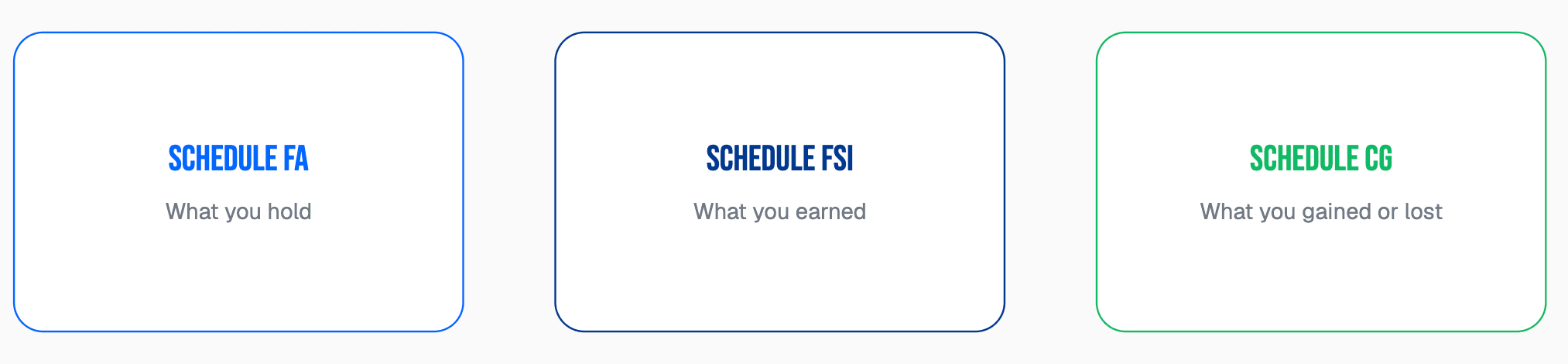
It helps to see the three schedules as a set rather than in isolation, because a single investor often touches all of them in one return. Suppose over a year you held foreign ETFs, received a dividend, and sold one holding. You would declare the holdings themselves in Schedule FA, report the dividend as income in Schedule FSI, and report the sale, gain or loss, in Schedule CG. Three schedules, three different jobs, one portfolio. Getting each entry into its correct schedule, in rupees, converted at the right rate, is the whole of the reporting task.
One question. Less than 10 seconds.
Reinforce what you've learned before continuing to the next chapter.






Discussion