
This module builds the foundation: why an Indian investor might look beyond home, and the core concepts, asset classes, products, and everything else that turn global investing from a wall of jargon into something you can read with confidence.
A mutual fund pools money from thousands of investors into one large fund, which a professional fund house then invests in a basket of companies. You own units of the fund, and each unit represents a slice of everything the fund holds. So far, this sounds exactly like an ETF, and at heart the idea is the same: pooled money, a diversified basket, a unit that is your share of it.
The difference lies in how you buy and sell. An ETF trades on a stock exchange through the day, at a live price, like a share. A mutual fund does not. You buy and sell mutual fund units directly from the fund house, and all orders placed on a given day are settled at a single price struck once that day, after the market closes. That price is the NAV, or Net Asset Value, which is simply the total value of everything the fund holds, divided by the number of units. There is no second-by-second price and no trading on an exchange. You place your order, and you transact at that day's NAV. This one structural difference is the essential thing that separates a mutual fund from an ETF.
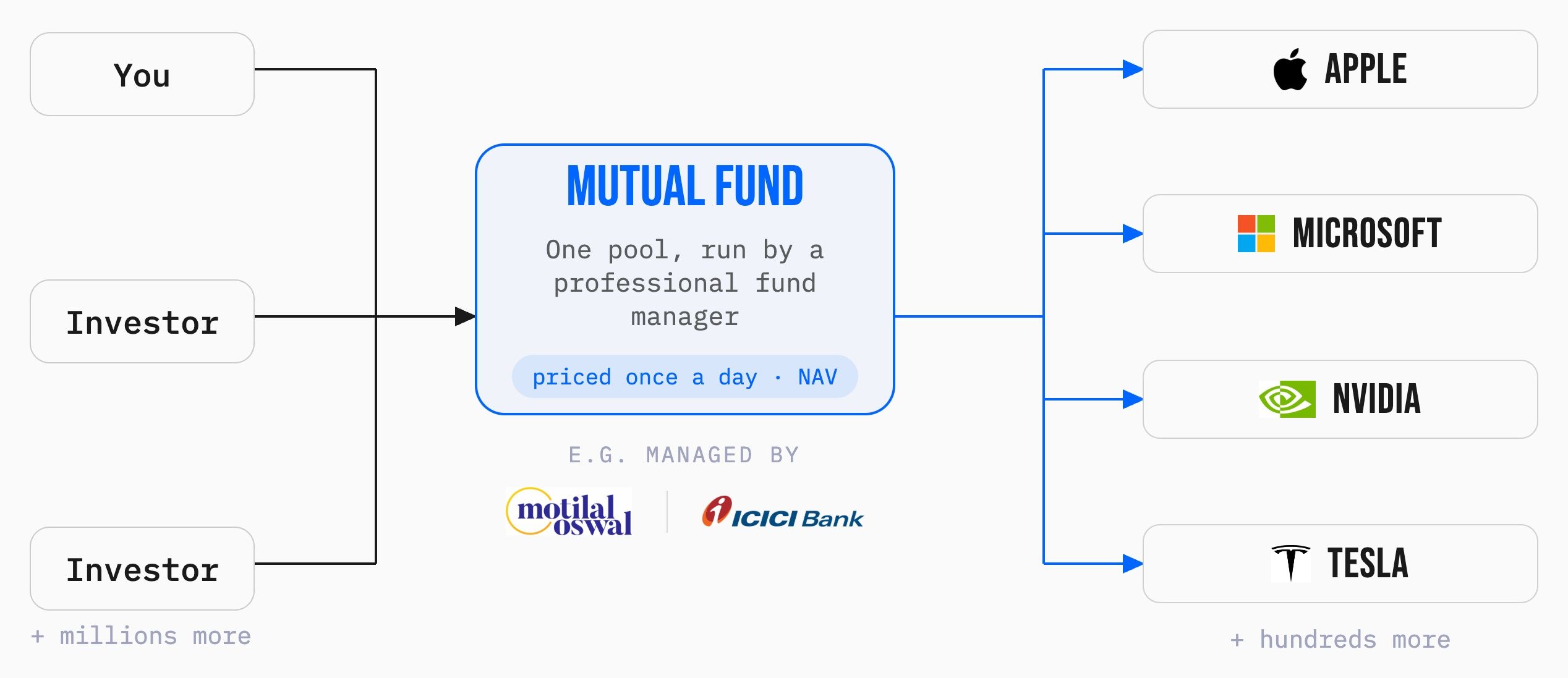
Mutual funds come in two flavours.
Everything so far applies to mutual funds in general. For our purposes, one particular kind matters most: the international mutual fund, a fund offered by an Indian fund house like Motilal Oswal or Parag Parikh that invests your money in companies outside India.
This is important because of how you access it. An international mutual fund is bought in rupees, through the same familiar Indian platforms you would use for any domestic fund. You do not open a foreign brokerage account, you do not personally convert currency, and you do not directly send money abroad yourself. The fund house handles the overseas investing on your behalf, behind the scenes. For someone who wants global exposure without the friction of going offshore, this is the most convenient method, and we will see in the next module just how much that convenience is worth.
One question. Less than 10 seconds.
Reinforce what you've learned before continuing to the next chapter.






Discussion