This module builds the foundation: why an Indian investor might look beyond home, and the core concepts, asset classes, products, and everything else that turn global investing from a wall of jargon into something you can read with confidence.
An ETF gives you a whole basket of companies in a single, easy-to-trade unit. This chapter explains how they work, the different kinds, and why they have become the workhorse of global investing.
ETF stands for Exchange Traded Fund, and the name tells you almost everything. It is a fund, a single pooled basket holding many investments at once. And it is exchange traded, meaning that basket is bought and sold on a stock exchange, just like an ordinary share.
So instead of buying one slice of one company, you buy one unit of a fund, and that unit represents a tiny piece of everything the fund holds. Buy one unit of an ETF that tracks the 500 largest American companies, and in that single purchase you own a portion of all 500. One click, the price of one share, and you have the diversification that would otherwise take fifty separate purchases.
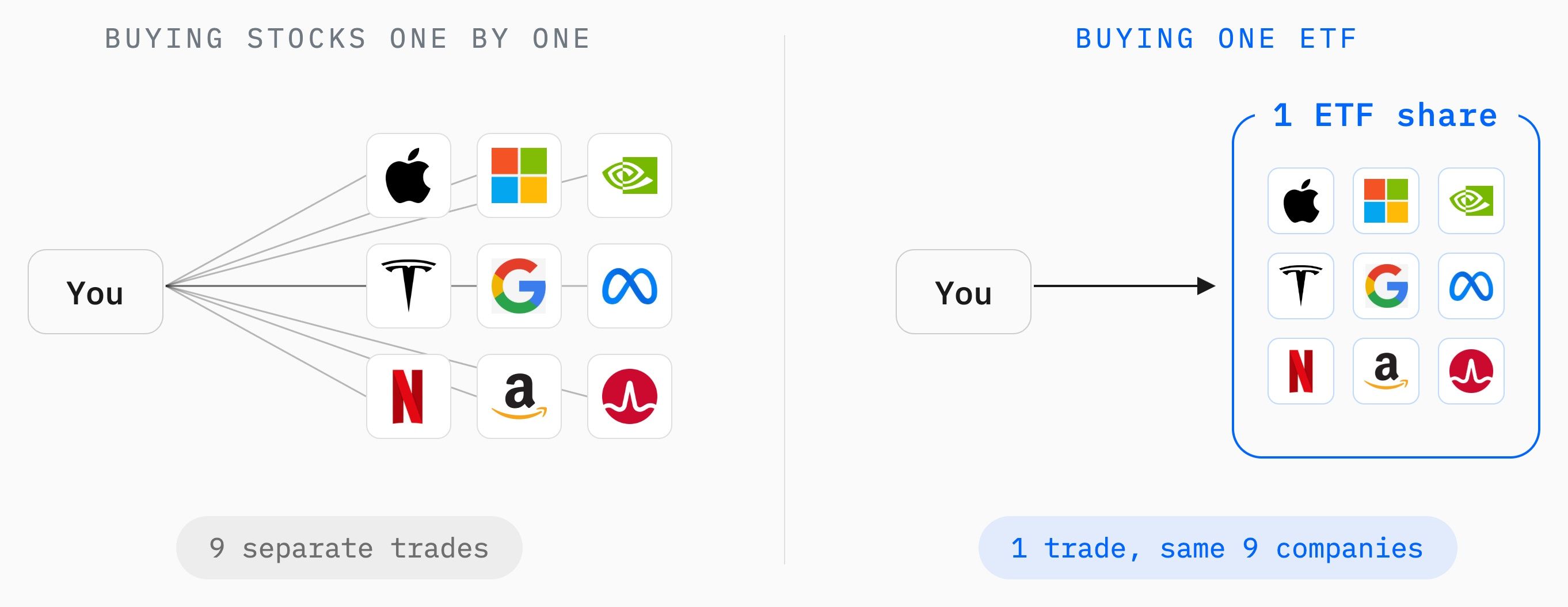
Behind every ETF sits a real basket of assets. An ETF tracking the 500 largest US companies actually holds those 500 stocks, in the right proportions, and your unit is a claim on a slice of that real basket. An ETF does not imitate an index; it genuinely owns the holdings.
Most ETFs are built to track an index, a defined list of holdings put together by rules. The fund's only job is to mirror that list: when a company enters the index the fund buys it, when one drops out the fund sells it. No manager forms views on what will do well. This is passive investing in its purest form, the idea from Chapter 1, and it is why ETFs are usually very cheap to own.
Because an ETF trades on an exchange, its price moves through the day as people buy and sell, and stays closely tied to the value of the basket inside. The practical result is what matters to you: you can buy or sell at any moment the market is open, at a known price, as easily as a share. The small cost of running the fund is charged as a yearly fee called the expense ratio, and is usually very low because the fund is passive. We will return to expense ratios when we compare costs across routes.
Index, sector, and thematic ETFs
ETFs differ by what their basket holds, and broadly fall into three kinds, from broadest to narrowest.
Physical versus synthetic ETFs
ETFs also differ in how they deliver returns.
Open-ended versus closed-ended ETFs
One structural distinction concerns the supply of units.
Accumulating versus distributing ETFs
An ETF holds many companies, so it collects a steady stream of dividends. What it does with that cash gives us two versions of the same ETF.
A distributing ETF pays those dividends out to you as cash, periodically, to spend or reinvest as you choose. An accumulating ETF instead automatically reinvests them back into the fund, buying more holdings on your behalf. You receive no cash, but the value of your units grows to reflect the reinvested income.
Two reasons this distinction is important.
One question. Less than 10 seconds.
Reinforce what you've learned before continuing to the next chapter.







Discussion