
This module builds the foundation: why an Indian investor might look beyond home, and the core concepts, asset classes, products, and everything else that turn global investing from a wall of jargon into something you can read with confidence.
A Fund of Funds, or FoF, is exactly what it sounds like: a fund that, instead of buying individual companies, invests in another fund. Most funds you encounter buy stocks or bonds directly. A Fund of Funds does something one step removed. It takes your pooled money and puts it into one or more other funds, and those underlying funds are the ones that actually hold the companies. You are buying a fund that buys funds.
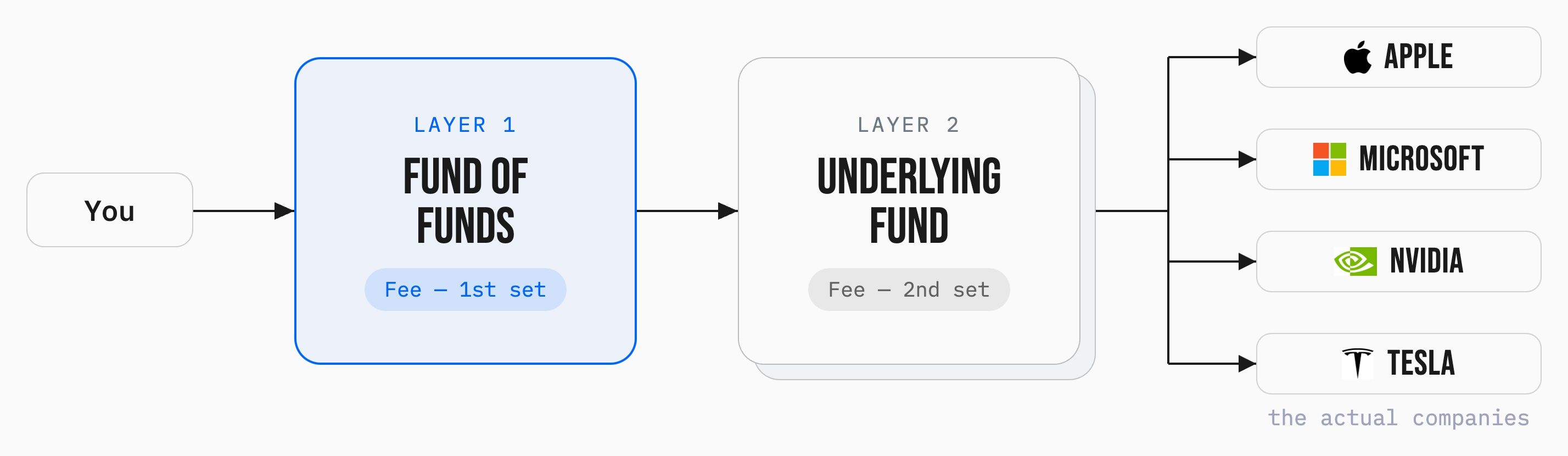
The clearest way to picture it is as a layer sitting on top of another layer. Imagine you want exposure to US companies. Rather than build a fund that goes out and buys Apple, Microsoft, and hundreds of others itself, a Fund of Funds simply buys units of an existing, established fund that already holds all of them. Your money flows into the top fund, the top fund channels it into the underlying fund, and the underlying fund holds the actual shares. Two stacked containers, with your money resting in the inner one.
Because this extra layer often solves a real problem of access. Take an Indian investor who wants to own a large US index fund. Buying that US fund directly can mean opening a foreign brokerage account, converting rupees into dollars, and sending money abroad. A Fund of Funds removes all of that. An Indian fund house creates a local, rupee-denominated FoF, and that FoF handles the offshore part. You simply buy the Indian FoF in rupees, through the same platform you use for any domestic fund.
This is why many international mutual funds available in India are built as Funds of Funds.
Because there are two funds stacked on top of each other, there can be two sets of fees. The underlying fund charges its own expense ratio for running its portfolio, and then the FoF sitting on top charges its own fee for the wrapper it provides. Neither fee is necessarily large, but stacked fees quietly eat into long-term returns.
The cleanest way to see the relationship is this: an international mutual fund describes what the fund invests in, while Fund of Funds describes how it is built. One is about destination, the other about structure.
An international mutual fund is simply any Indian mutual fund whose money ends up invested in companies outside India. A Fund of Funds is a fund that invests by buying units of another fund rather than buying shares directly.
The two meet because a very common way to build an international mutual fund is as a Fund of Funds. When an Indian fund house wants to give you US exposure, the easiest route is often to have its fund buy a large, established overseas fund that already holds those US companies.
One question. Less than 10 seconds.
Reinforce what you've learned before continuing to the next chapter.






Discussion