
This module builds the foundation: why an Indian investor might look beyond home, and the core concepts, asset classes, products, and everything else that turn global investing from a wall of jargon into something you can read with confidence.
Investors can get returns on their money either actively or passively. Investment products are often designed keeping either of these philosophies in mind. This chapter breaks down the fundamentals of Active and Passive investing and how you should think about the contrast.
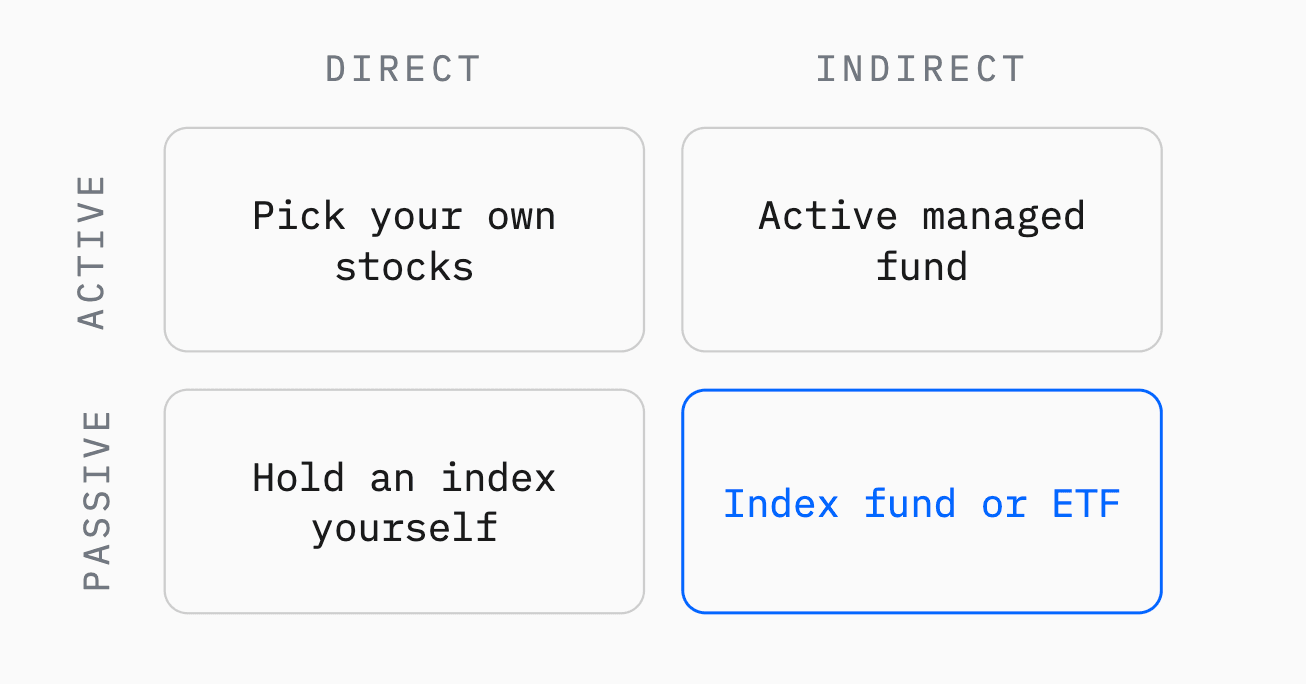
Active investing is the attempt to beat the market. Someone, either you or a professional fund manager, studies companies, forms opinions, and deliberately picks what to buy and what to avoid, hoping to do better than the market average. Maybe they judge that one carmaker will outsell another, or that a particular company is undervalued, and they weigh the money accordingly. It is hands-on, it needs skill and time, and because that effort has to be paid for, it usually costs more. Someone is doing real work, researching, deciding, adjusting, and that work shows up as a higher fee.
When you yourself manage your portfolio, deciding what to buy and when to buy it, you are considered to be actively investing. When you buy units of a Mutual Fund managed by an investment professional who buys and sells based on some philosophy or strategy, you are buying an active investment product.
Passive investing does not try to beat the market. It tries to become the market. Instead of hand-picking winners, it simply buys a little of everything in a particular index, say the S&P 500 or Nasdaq, and earns whatever that whole basket delivers. There is no judgement about which of the 500 will do best; you simply own all of them in their actual proportions in the index. Because nobody has to be paid to make clever calls, passive investing is typically far cheaper.
Index ETFs are a classic example of this. The company managing an Index ETF simply follows the index proportions at all times.
Suppose two people want US equity exposure. The first hands her money to an active fund manager who studies the market and bets on the thirty companies he believes will outperform, charging a fee for the expertise. The second simply buys an index ETF of S&P 500 and holds all of them, paying very little. If the manager's picks do well, the first person beats the market. If they do not, and often they do not, she has paid more to end up behind the second person, who never tried to be clever at all.
So this choice is a trade-off between cost and effort on one side, and the ambition to outperform on the other. Active gives you a shot at beating the market, at higher cost and with no guarantee. Passive gives up that shot in exchange for lower cost, simplicity, and the market's return with near-certainty. Neither is right for everyone, but knowing which one you are choosing, and why, is the foundation for almost every product decision that follows.
One question. Less than 10 seconds.
Reinforce what you've learned before continuing to the next chapter.







Discussion