
This module builds the foundation: why an Indian investor might look beyond home, and the core concepts, asset classes, products, and everything else that turn global investing from a wall of jargon into something you can read with confidence.
There are two ways by which you can own an equity investment product: Direct Ownership and Indirect (or Pooled) Ownership.
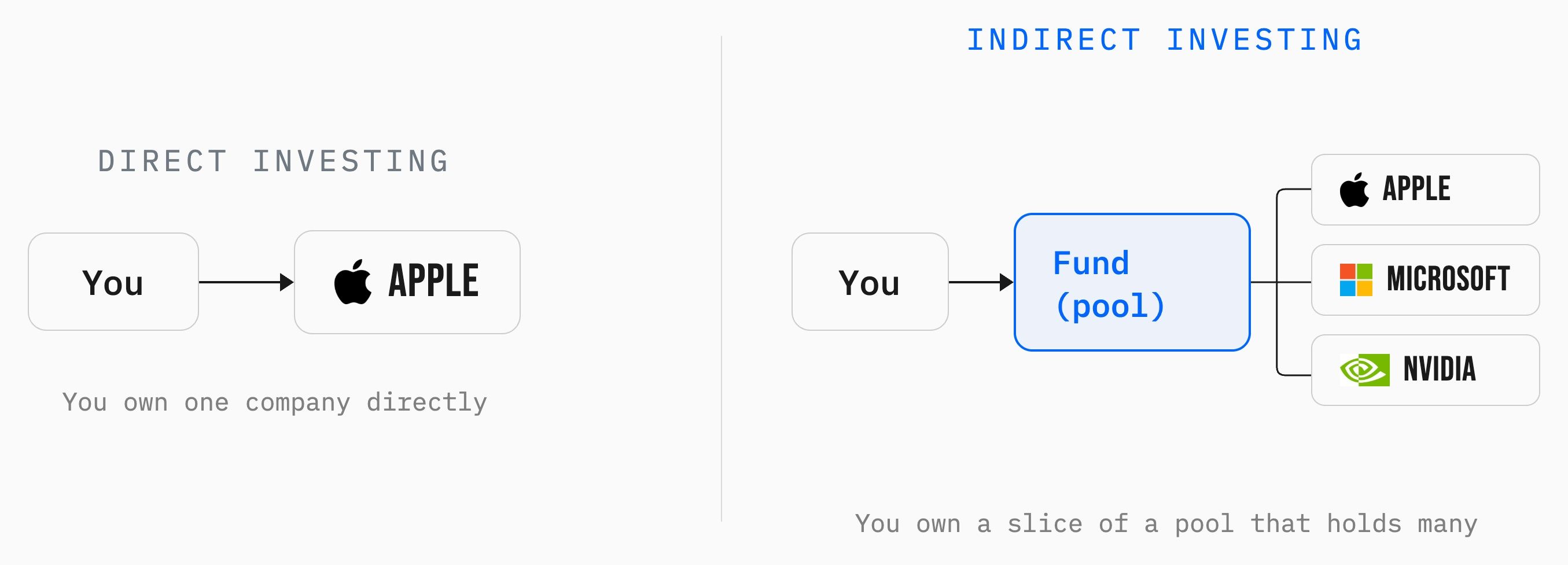
Here you buy the asset yourself and own it outright, in your own name. If you buy ten shares of Apple, those ten shares are yours. You decide when to buy, you decide when to sell, and you carry the full consequence of that decision, the gains when it goes well and the losses when it does not. There is nobody standing between you and the asset. If Apple pays a dividend, it comes to you. If there is a shareholder vote, the right is yours. You are on the register as an owner, and everything that flows from the asset flows directly to you.
Directly buying a stock via a broker or buying a government bond are mechanisms of getting direct ownership. You might already be used to this if you invest in Indian markets.
Here your money is gathered together with money from thousands of other investors into a single large pool, and that pool is used to buy a whole basket of companies. You own a share of the pool rather than the individual companies inside it. You do not own Apple directly; you own a unit of a fund, and the fund owns Apple along with many others. Say you put in a small amount and the fund holds a hundred different companies, your single unit now represents a piece of all hundred at once. You never placed a hundred separate orders, and you do not manage any of them. Someone runs the pool, and you simply hold your slice of it.
When you buy units in a Mutual Fund or Fund of Funds, you get pooled ownership.
Direct ownership is like cooking your own meal: you choose every ingredient, you control the recipe, you decide exactly how it turns out, and the result, good or bad, is entirely your responsibility. If it is too salty, that is on you; if it is perfect, that is on you too. Pooled ownership is like ordering a thali: you get a balanced plate with many items on it, prepared by someone whose job is to prepare it. You did not pick each dish or cook any of them, and you cannot send back just the one sabzi you dislike. You give up some control, but in return you gain convenience, and a variety on your plate that would have taken you far more effort to assemble yourself.
Notice that neither is simply better than the other. Cooking gives you total control at the cost of total effort; the thali gives you ease and variety at the cost of control. The same trade sits at the heart of direct versus pooled ownership, and which one suits you depends on how much control you want and how much work you are willing to do to have it.
One question. Less than 10 seconds.
Reinforce what you've learned before continuing to the next chapter.






Discussion