



Three unrelated events have converged into a single narrative this week. A record breaking IPO faces its first true supply test. The largest companies in the world reported earnings that split the market into clear winners and losers. And a currency intervention that had not been used in nearly three decades is already fading.
Each carries direct portfolio implications, and each is explained below in full with the numbers behind it.
Table of contents
- SpaceX: The First Lock Up Test
- Big Tech Earnings: A Divided Season
- USD/JPY: Intervention and Its Fade
- Limits of This Analysis
SpaceX: The First Lock Up Test
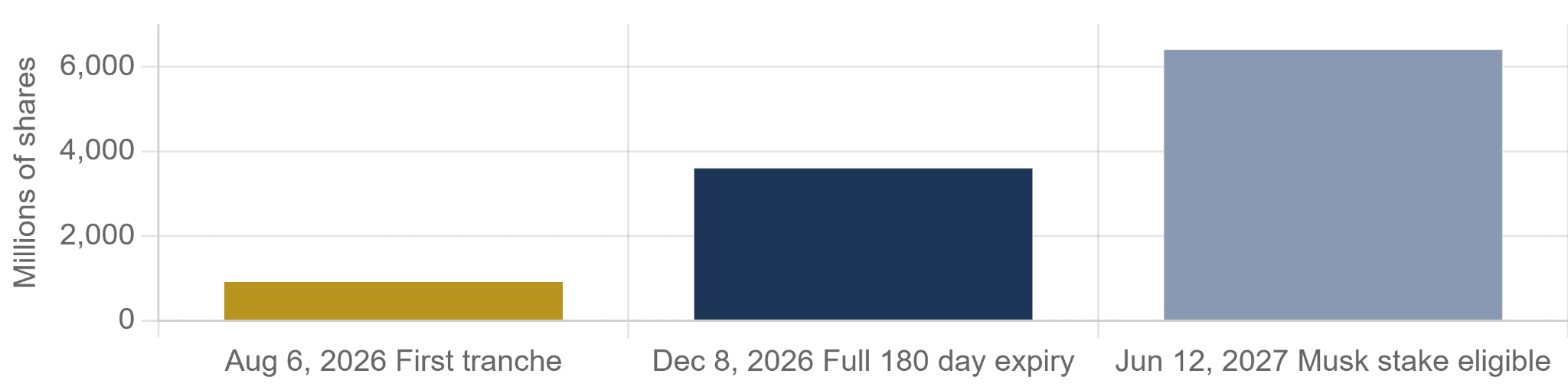
SpaceX listed on Nasdaq on June 11, 2026, at 135 dollars a share, the largest IPO in stock market history. Only about 4 to 5% of total shares outstanding entered public hands at listing. The remaining block sits under a staggered lock up structure tied to the company's earnings calendar rather than a flat calendar date.
The first tranche unlocks on August 6, 2026, two trading days after SpaceX posted its debut quarterly results as a public company on August 4. That tranche covers up to 20% of the 180 day lock up block, or roughly 911.5 million shares.
A second, larger tranche of about 62 billion dollars in value was conditional on the stock trading at least 30% above the IPO price for 5 of the 10 sessions before earnings. That condition was not met, so the second tranche stays locked for now.
Debut earnings came in ahead of expectations, with revenue up 92% year over year against a consensus estimate near 6.8 billion dollars. Despite the beat, the stock remains more than 50% below its post IPO peak, and Wall Street consensus around the lock up date had priced in a possible drop toward 100 dollars a share.
Morgan Stanley pushed back on that floor, arguing it would imply little or no value for the company's AI and connectivity businesses.
The full 180 day lock up block expires December 8, 2026. Elon Musk's stake of about 6.4 billion shares carries a separate 366 day restriction with no early release provisions, first becoming eligible for transfer on June 12, 2027.
Big Tech Earnings: A Divided Season
Five of the seven Magnificent Seven companies reported over a 72 hour window in late July. The market response split sharply along one line: companies that tied AI capital spending to demonstrated demand were rewarded, and companies that could not were sold off.
- Microsoft delivered the strongest reaction, with shares rising 15 to 16% and adding about 450 billion dollars in market value in a single session, the largest one day gain of the cycle. Revenue grew 17% year over year with a 45.1% operating margin, and Azure growth remained the central focus for investors. Amazon rose about 10% on stronger AWS growth and expanding margins.
- Alphabet's Google Services division posted 94.5 billion dollars in revenue, up 15% year over year, with operating income up 20% to 39.5 billion dollars. The stock still fell as much as 15% immediately after the print, before recovering more than 17% over the following days as investors reassessed the sell off. Meta fell 8 to 10% after raising 2026 capital expenditure guidance to a range of 125 to 145 billion dollars, with investors questioning whether ad revenue growth justified the spend. Apple beat on both revenue and profit but still declined about 4%, weighed down by services misses and supply constraints.
- Combined, Amazon, Alphabet, Meta, and Microsoft now guide to about 725 billion dollars in 2026 capital expenditure, a 77% increase from the prior year. Nvidia, the final Magnificent Seven name to report, is scheduled for August 26, 2026.
USD/JPY: Intervention and Its Fade
On July 31, 2026, the United States and Japan jointly purchased yen in the open market, the first coordinated US Japan intervention in nearly three decades.
Japan's Finance Minister Satsuki Katayama confirmed the action on August 3, describing it as a response to excessive volatility and disorderly currency movement. The intervention pushed USD/JPY down to about 155.23, a sharp reversal from a 52 week high near 164.00.
The effect has proven partial and temporary. By August 7, the pair had climbed back to about 158.41, giving back nearly half of the intervention-driven gain within a week. Traders now watch for a second round of coordinated action.
The underlying driver remains the interest rate gap between the two economies. The Bank of Japan's policy rate stands at 0.75%, against a US Federal Funds rate of 3.50 to 3.75%, a spread of up to 300 basis points.
That gap continues to fund the yen carry trade, where investors borrow cheaply in yen to invest in higher yielding dollar assets, and it is the structural force intervention alone cannot offset. BOJ minutes from its June meeting, released August 5, showed policy board members flagging that underlying inflation could exceed the 2% target, seen by markets as an early signal toward faster tightening.
Limits of This Analysis
Figures reflect data available as of August 7, 2026, and are subject to revision as companies file amended results. SpaceX lock up mechanics are drawn from its June 2026 prospectus and are subject to company discretion on early release provisions. Currency levels are indicative spot rates and move intraday. This piece is for informational purposes and does not constitute investment advice.

