

If you receive RSUs from a foreign employer or hold other foreign stocks, you need to disclose them in Schedule FA (Foreign Assets) when filing your Income Tax Return.
Many taxpayers assume Schedule FA only applies after they sell their shares. However, vested RSUs are foreign assets and need to be reported even if you continue to hold them.
This guide explains who needs to file Schedule FA, which RSUs should be reported, where to report them, how to value them, and the documents you'll need for accurate filing.
Table of Contents:
- What is Schedule FA?
- Who Needs to File Schedule FA for RSUs?
- Which RSUs Should Be Reported?
- How Do You Report RSUs in Schedule FA?
- How to Value RSUs for Schedule FA
- Common Schedule FA Mistakes RSU Holders Make
- How Paasa helps
What is Schedule FA?
Schedule FA (Foreign Assets) is a mandatory section in ITR-2 and ITR-3 where you report any foreign assets you held during the relevant calendar year.
Schedule FA is only a reporting requirement. It doesn't determine how much tax you owe or result in additional tax simply because you've disclosed an asset.
However, if you're required to report a foreign asset and fail to do so, or provide incomplete or incorrect information, you will face penalties of ₹10 lakh under the Black Money Act.
Who Needs to File Schedule FA for RSUs?
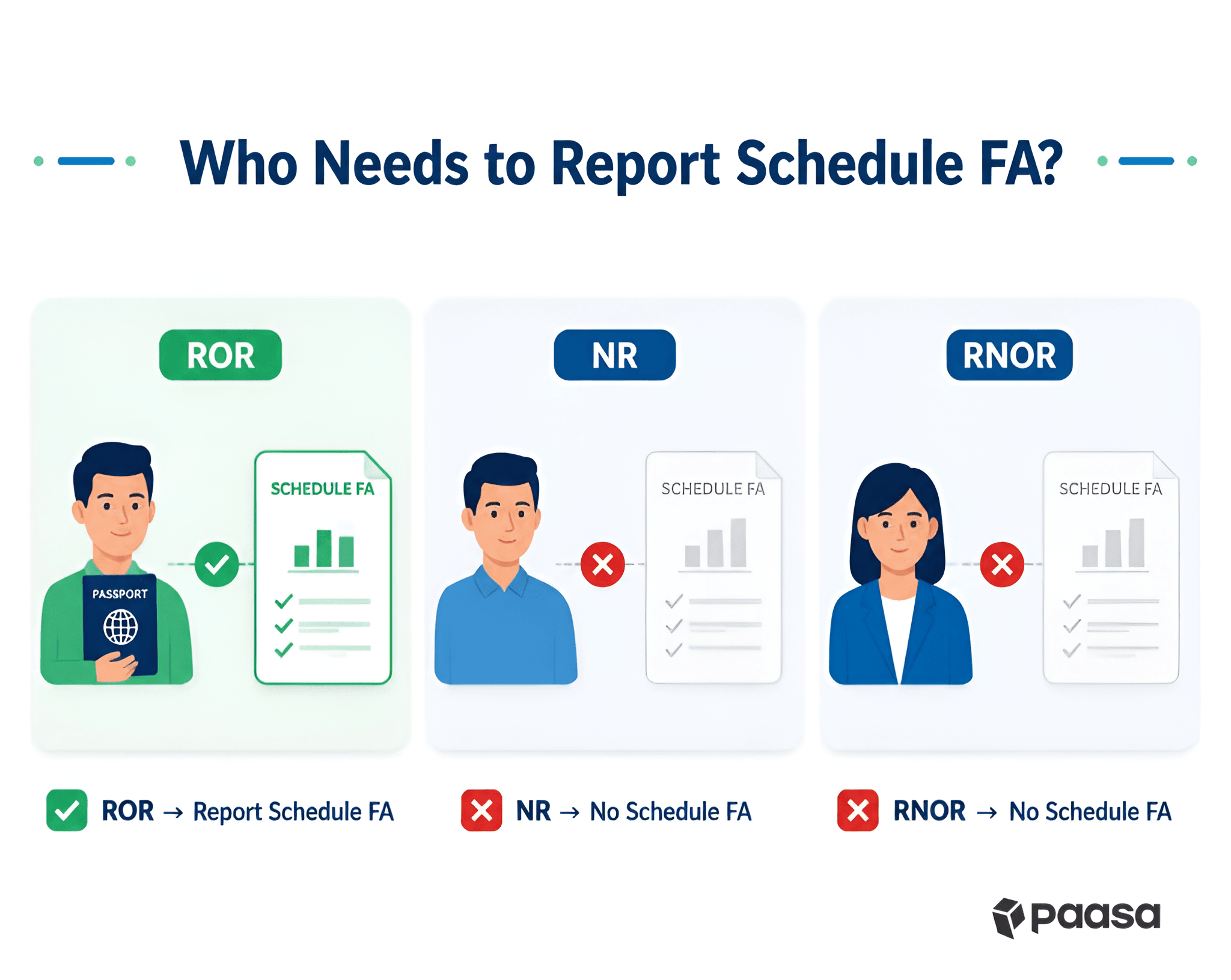
You are required to file Schedule FA only if both of the following conditions are met:
- You qualify as a Resident and Ordinarily Resident (ROR) under the Income Tax Act.
- You held a foreign asset at any time during the relevant reporting period (calendar year), including vested RSUs or foreign shares.
If you are a Non-Resident (NR) or Resident but Not Ordinarily Resident (RNOR), you are not required to report foreign assets in Schedule FA, even if you hold foreign RSUs or shares.
Your Schedule FA filing requirement depends on your residential status. Learn how to determine it in our guide on Resident vs RNOR vs Non-Resident in India.
You receive RSUs from a foreign employer
If you have vested foreign RSUs, they need to be reported in Schedule FA.
This applies even if you have not sold the shares.
Which RSUs Should Be Reported?
You only need to report vested RSUs in Schedule FA. Once your RSUs vest, you own the underlying shares, and those shares are considered foreign assets for reporting purposes. Unvested RSUs do not need to be reported because you do not yet own the shares.
| RSU / Foreign Asset Status | Reportable in Schedule FA? | Explanation |
|---|---|---|
| Unvested RSUs | No | Unvested RSUs are only a promise to receive shares in the future. Since you do not yet own the shares, they are not considered reportable foreign assets for Schedule FA. |
| Vested RSUs | Yes | Once your RSUs vest, they become shares of a foreign company. If you held these shares at any time during the relevant calendar year, they should be reported in Schedule FA, even if you continue to hold them at year-end. |
| Shares Sold During the Calendar Year | Yes | If you sold foreign shares during the calendar year, they should still be disclosed in Schedule FA if you held them at any point during that year. Even though you no longer own the shares on 31 December, they were foreign assets during the reporting period. |
| Shares Sold for Tax Withholding (Sell-to-Cover) | Yes | Many employers automatically sell a portion of vested RSUs to cover withholding taxes (sell-to-cover). These shares should also be reported in Schedule FA because you briefly owned them before they were sold to meet your tax obligation. |
How Do You Report RSUs in Schedule FA?
Vested RSUs are reported under Table A3 - Foreign Equity and Debt Interest in Schedule FA.
If the shares are held through a foreign brokerage or custodial account, that account is reported separately under Table A2 - Foreign Custodial Accounts.
Information required for reporting
When completing Schedule FA, you'll need to provide details such as:
- Name and address of the foreign brokerage or custodian
- Country where the account is held
- Account number or unique account identifier
- Initial value, peak value, and closing value of the account
- Income earned from the account during the year, if applicable
The values should be reported using the prescribed exchange rate as per the Income Tax Rules.
Reporting multiple grants or brokerage accounts
You do not need to report each RSU grant separately. Instead, report the foreign custodial or brokerage account that holds your vested shares.
If you have RSUs or foreign shares held across multiple brokerage or custodial accounts, each account should be reported separately in Schedule FA.
What Documents Do You Need?
Having the right documents makes it much easier to complete Schedule FA accurately. Depending on your RSU activity during the year, you need the following:
RSU vesting statements
These show when your RSUs vested, the number of shares received, and their fair market value (FMV) on the vesting date.
Brokerage account statements
Your brokerage statements provide details of the shares held in your account, purchases and sales, dividends received, and account balances.
They also help determine the initial, peak, and closing values required for Schedule FA.
Employer equity reports
Most employers provide annual equity statements or stock plan reports that summarize your RSU grants, vesting history, tax withholding, and share transactions.
Dividend statements (if applicable)
If your foreign shares paid dividends during the year, keep the dividend statements or transaction reports.
These help you report foreign-source income correctly and support any foreign tax credit claim, if applicable.
How to Value RSUs for Schedule FA
Schedule FA requires you to report three values for your foreign shares: Initial Value, Peak Value, and Closing Value.
Since your RSUs are denominated in a foreign currency, these values must be converted into Indian Rupees (INR) using the applicable SBI Telegraphic Transfer Buying Rate (TTBR).
Initial Value
The Initial Value is the value of your RSUs on the vesting date, as this is when they become your property.
Calculate it as:
Number of shares × Fair Market Value (FMV) on the vesting date × Applicable SBI TTBR
Example:
Suppose you are an Indian software professional working at Amazon. On 15 June 2025, 50 RSUs vest when Amazon's share price is USD 200 per share. If the applicable SBI TTBR exchange rate is ₹86, your Initial Value would be:
50 × USD 200 × ₹86 = ₹8,60,000
If you have multiple vesting events, each vesting tranche will have its own initial value.
Peak Value
The Peak Value is the highest market value of your total shareholding at any point during the reporting period.
To calculate it:
Total shares held on the peak date × Market price on that date × Applicable SBI TTBR
Closing Value
The Closing Value is the market value of the shares you continue to hold on 31 December of the relevant calendar year.
Calculate it as:
Shares held on 31 December × Market price on 31 December × Applicable SBI TTBR
Applicable Exchange Rate
All values reported in Schedule FA must be converted into INR using the correct State Bank of India's Telegraphic Transfer Buying Rate (TTBR) applicable under the Income Tax Rules.
Example
Suppose you work at Amazon and receive RSUs as part of your compensation. During 2025, 40 of your RSUs vest on 15 March, and another 20 RSUs vest on 18 September. You continue to hold all 60 shares through 31 December 2025:
| Amount | |
|---|---|
| Tranche 1 - 40 shares vested on 15 March 2025 (FMV: $180/share, SBI TTBR: ₹86.95/USD) | ₹6,26,040 |
| Tranche 2 - 20 shares vested on 18 September 2025 (FMV: $240/share, SBI TTBR: ₹87.70/USD) | ₹4,20,960 |
| Peak Value (60 shares × $265 × ₹88.95 TTBR) | ₹14,14,305 |
| Closing Value on 31 December 2025 (60 shares × $252 × ₹89.47 TTBR) | ₹13,52,786 |
The SBI TT Buying Rate (TTBR) used is the rate applicable on the date of each event: vesting date for each tranche, peak value date for Peak Value, and 31 December 2025 for Closing Value.
During November 2025, Amazon's share price reached its highest level for the year at USD 265, making this the Peak Value.
On 31 December 2025, the share price was USD 252, which is used to calculate the Closing Value.
Each tranche is entered as a separate line in Table A3 with its own vest date and initial value. The peak and closing values reflect the total holding at those points.
Calendar Year vs Financial Year Reporting
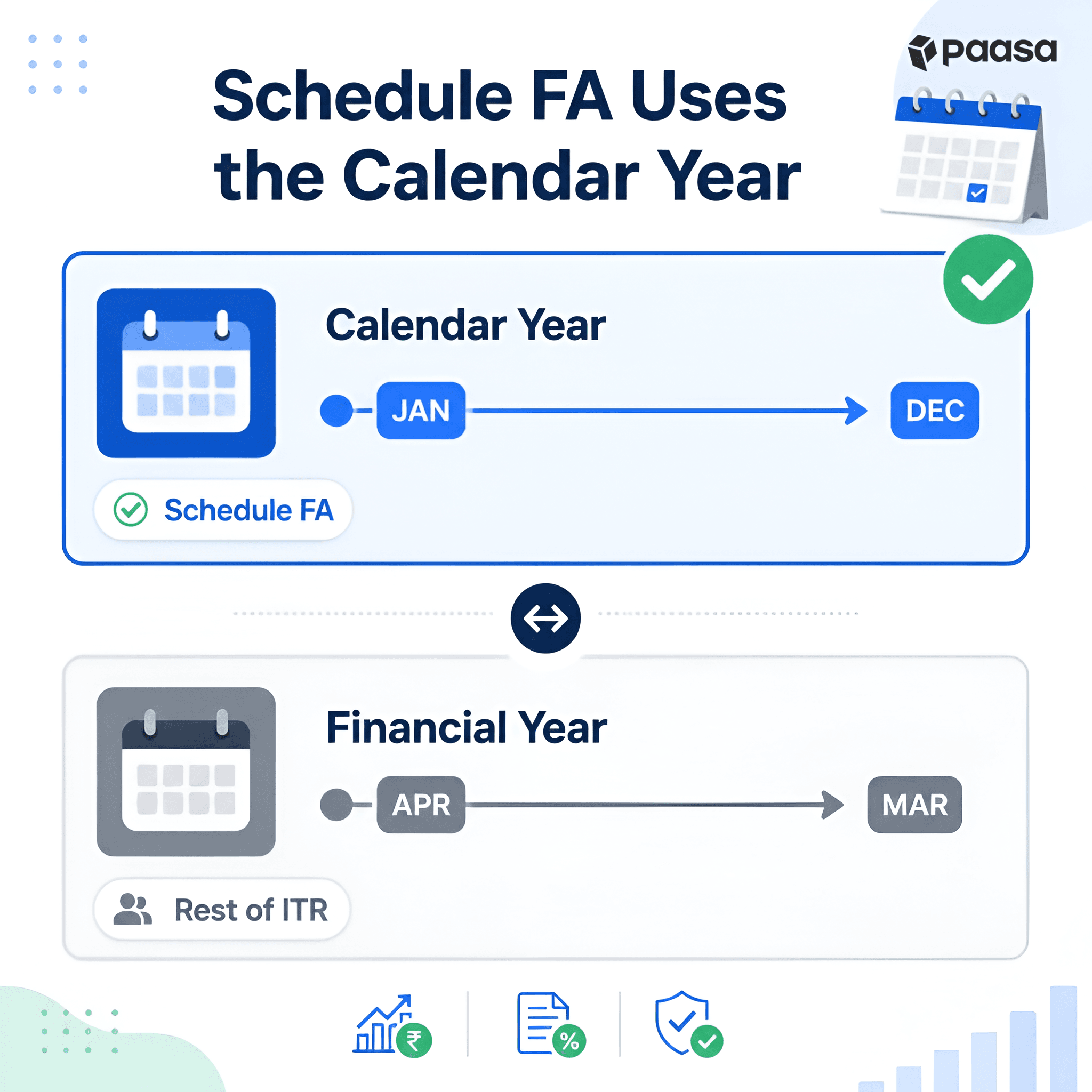
Unlike the rest of your Income Tax Return, Schedule FA follows the calendar year (1 January to 31 December) rather than the financial year (1 April to 31 March).
For example, while your ITR for FY 2025-26 reports income earned between 1 April 2025 and 31 March 2026, Schedule FA for the same return requires you to disclose foreign assets held between 1 January 2025 and 31 December 2025.
Common Schedule FA Mistakes RSU Holders Make
Even experienced investors can make mistakes when reporting foreign RSUs. Here are some of the most common ones to avoid.
Using the financial year instead of the calendar year
Schedule FA follows the calendar year (1 January to 31 December), not the financial year used for the rest of your Income Tax Return. Using the wrong reporting period is one of the most common filing errors.
Not keeping supporting documents
Many taxpayers rely only on Form 16. However, you'll also need documents such as RSU vesting statements, brokerage statements, and employer equity reports to calculate the correct values and support your disclosure.
Assuming Form 16 is enough
Reporting RSU income in Form 16 does not automatically satisfy your Schedule FA reporting obligation.
If your vested RSUs qualify as reportable foreign assets, you'll still need to disclose them separately in Schedule FA.
Ignoring Schedule FA altogether
Failing to report eligible foreign assets or providing incorrect information attract penalties under the Black Money Act, including a penalty of ₹10 lakh, subject to the provisions of the law.
If you're looking for a complete overview of Schedule FA, including other reportable foreign assets, read our Schedule FA Guide for Indian Investors.
How Paasa helps
Paasa records every vest date, share count, and conversion rate as transactions happen. When it is time to file, your initial values, peak values, and closing values are already calculated, you do not need to reconstruct the numbers from a broker statement at the end of the year.
Paasa also helps you diversify your RSUs and avoid exposure to the US Estate Tax.
Explore how Paasa works for Indian investors with RSUs.

