


On September 16, 2026, the Federal Open Market Committee raised the federal funds rate by 25 basis points to a target range of 3.75% to 4%, its first increase since July 2023.
The vote was unanimous, a reversal from the divided committee of prior meetings. The move followed weeks in which Brent crude climbed past $107 a barrel, up almost 9% in a single week, as renewed US Iran hostilities put fresh strain on global supply expectations.
Core PCE inflation is now tracking at 3.4% and headline PCE at 3.7% for 2026, both revised up 0.1 percentage point from the Fed's June projections. The committee's updated dot plot points to a federal funds rate of 4.1% to 4.4% by year end, with further increases pencilled into 2027.
Fed Chair Kevin Warsh framed the move as necessary to defend the central bank's credibility on its 2% inflation target. That is a defensible goal on its own terms. The question this piece asks is whether the tool being used actually matches the problem, and what it costs elsewhere in the economy while it tries.
Table of contents
- The Debt Service Bill Just Got Bigger
- A Trillion-Dollar CRE Wall Meets Higher Rates
- Housing and a Softening Labor Market
- What Could Break First
- The Takeaway: Demand Tools vs. Supply Shocks
The Debt Service Bill Just Got Bigger
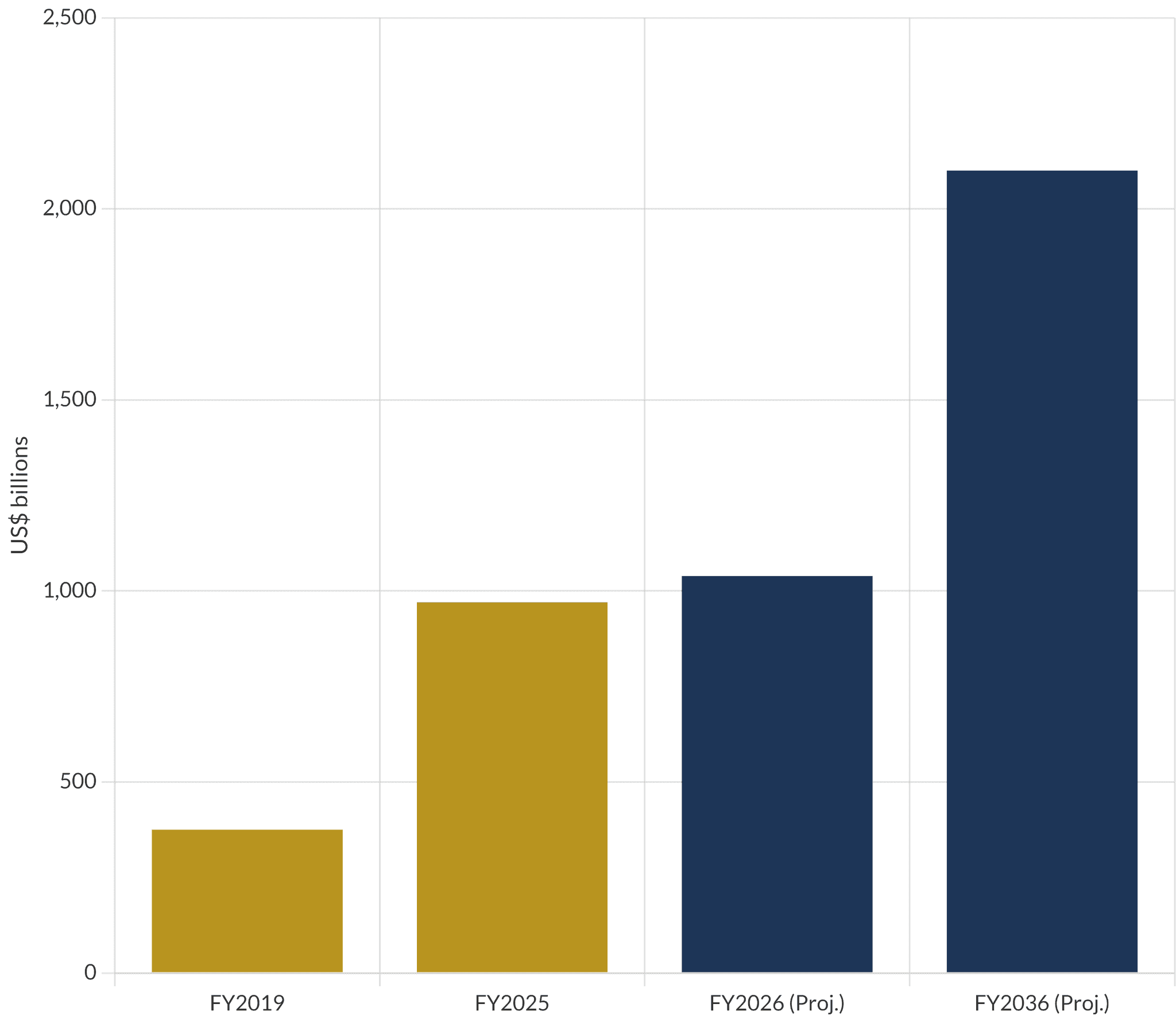
Net interest on federal debt reached an estimated $1.25 trillion over the year to 2025, according to an analysis by DoubleLine, equal to 18.5% of federal revenue and above the previous high of 18.4% set in 1991.
Separately, the Congressional Budget Office's own tracker shows interest costs surpassing $1 trillion in fiscal year 2026 for the first time on record, on total federal debt of roughly $40 trillion, with $16.2 trillion in cumulative interest payments projected over the coming decade.
Every additional 25 basis points raises the average rate at which that debt rolls over. A hiking cycle does not just fight inflation, it compounds what is already the fastest growing line item in the federal budget, one that now outpaces spending on national defense and is closing in on Medicare.
A Trillion Dollar Wall Meets A Higher Rate
Commercial real estate faces its own reckoning.
S&P Global Market Intelligence estimates roughly $1.15 trillion in CRE mortgages mature in 2026, rising to $1.26 trillion in 2027, the largest concentration of loan maturities on record. Much of this debt was originated between 2014 and 2021 at rates of 3% to 4%.
Borrowers refinancing today face rates closer to 6% to 7%, alongside stricter debt service coverage requirements and lower loan proceeds against properties that, in some segments, are worth less than when the original loan was written.
The office sector remains under the most pressure, though data centers and industrial properties are holding up better.
A further hike, or even just a longer hold at these levels, extends the window in which this refinancing gap has to be closed with fresh equity, distressed sales, or extensions that only delay the reckoning.
Housing And A Labor Market That Was Already Softening
The 30 year fixed mortgage rate averaged 6.97% for the week of September 14, 2026, up from 6.08% in mid March, tracking the same oil driven move in Treasury yields that pushed the Fed toward this hike.
Higher financing costs are already weighing on purchase activity even as inventory improves, and a further move higher risks freezing housing turnover for a second consecutive year.
Labor market conditions add to the concern. J.P. Morgan Private Bank describes the current environment as a low hire, low fire equilibrium, with unemployment holding in a 4.2% to 4.4% range through much of 2026, but with labor force participation drifting lower alongside it, a sign of a labor market losing underlying strength rather than genuinely tightening.
Raising rates into that kind of environment, in response to a shock the Fed did not cause and cannot reverse, is the textbook setup for stagflation, a combination of weak growth and elevated inflation that is notoriously difficult to unwind once it takes hold.
What Could Break First
None of this means the Fed is wrong to worry about its credibility. A central bank that lets an inflation overshoot pass without response risks a far more painful correction later.
But the transmission of this particular hike runs through channels that were already under stress before September 16.
Regional lenders with concentrated commercial real estate exposure face refinancing at the same moment funding costs rise. Housing transaction volumes, already depressed for two years, face a further squeeze just as inventory was starting to normalize.
And a federal government running structural deficits now pays more to borrow at precisely the point interest costs were becoming the second largest item in its own budget. If any one of these strains forces a policy reversal within a few quarters, the credibility the Fed is trying to protect could end up weaker, not stronger.
The takeaway
The Fed is using a demand side tool against a supply side shock.
It may slow inflation eventually, but the more immediate and more certain effect is higher debt service for Washington, a harder refinancing environment for a trillion dollar wall of commercial real estate debt, and a mortgage market that was already struggling to find its footing.
Watch oil prices, not the Fed calendar, for the real signal on where this goes next.

