



If you hold foreign stocks or ETFs, filing your Income Tax Return (ITR) involves more than reporting your Indian income.
You need to disclose your foreign holdings, report dividend and capital gains income, complete schedules such as Schedule FA, Schedule FSI, and Schedule TR, and file Form 67 to claim foreign tax credit where applicable.
This guide explains which ITR form to use, the documents you'll need, how to report your foreign investments, and the key disclosures required to stay compliant with Indian tax law.
Before You Start Filing
Before you begin filing your ITR, keep the following documents and information ready. Having these on hand will make it easier to accurately report your foreign investments and claim any applicable foreign tax credit.
| Document | Why you need it |
|---|---|
| Brokerage statements | To report your foreign stock holdings, purchase and sale transactions, and account details. |
| Dividend statements | To report foreign dividend income and any tax withheld by the foreign country. |
| Capital gains report | To calculate capital gains or losses from the sale of foreign stocks. |
| Foreign tax paid details | To claim foreign tax credit through Schedule FSI, Schedule TR, and Form 67, where applicable. |
| Exchange rates | To convert foreign income, taxes paid, and capital gains into Indian Rupees using the prescribed exchange rate. |
| Indian income documents | Form 16, Form 26AS, AIS, bank interest, etc., to reconcile TDS and other Indian income. |
Before you start filing, also ensure you know the correct ITR form applicable to you. If you're unsure whether you should file ITR-2 or ITR-3, read our guide on Which ITR Form Should You Use if You Have Foreign Assets?
Step-by-Step: Filing Your ITR with Foreign Stocks
Once you have all documents ready, you can begin filing your ITR. Along with Indian income, you must report foreign investment income and complete the relevant schedules.
Step 1: Report Your Indian Income
Report all income earned in India, including salary, house property, business/professional income (if applicable), and other sources.
Verify TDS details using Form 16, Form 26AS, and the AIS before proceeding.
Step 2: Report Foreign Dividend Income
Foreign dividends are taxable under Income from Other Sources.
Report the gross dividend in INR using the prescribed exchange rate. If tax was deducted abroad, you can claim foreign tax credit under DTAA rules.
Also report this in Schedule FSI, claim relief in Schedule TR, and file Form 67 if claiming credit.
For a detailed walkthrough of Schedule FSI, Schedule TR, and Form 67, see our guide on How to Report Foreign Assets in Your ITR.
Step 3: Report Capital Gains from Foreign Stocks
Report gains or losses from foreign stock sales under the Capital Gains schedule.
Capital Gain = Sale Price − Cost − Expenses
Convert all amounts into INR using prescribed exchange rates before calculation.
Include these gains in your foreign income reporting as required.
Step 4: Fill Schedule FA
Resident taxpayers must report foreign assets in Schedule FA. Include details of overseas accounts, stocks, country, and peak value. Ensure accuracy with brokerage statements.
For a step-by-step explanation of what to report and how to calculate the required values, read our detailed Schedule FA guide.
Step 5: Fill Schedule FSI
Report foreign income (dividends, capital gains) in Schedule FSI. Provide country, income type, amount, and taxes paid abroad.
Step 6: Fill Schedule TR
Claim foreign tax credit in Schedule TR under DTAA or the Income-tax Act. Ensure it matches taxes reported in Schedule FSI.
Step 7: File Form 67 (If Applicable)
File Form 67 before or on the ITR due date to claim foreign tax credit. Include details of foreign income and taxes paid.
Read our detailed Form 67 guide to understand who needs to file it, the due date, and the information required to claim foreign tax credit correctly.
Step 8: Verify and Submit Your Return
Review all entries, especially Schedules FA, FSI, TR, and Form 67. Ensure consistency with documents, then submit and verify your return on the e-Filing portal.
Common Filing Mistakes
Filing an ITR with foreign stocks involves extra reporting, making errors more likely. Avoid these common mistakes:
Choosing the Wrong ITR Form
Do not use ITR-1 if you hold foreign stocks or earn foreign income. Use ITR-2 (or ITR-3 if you have business income).
Missing Schedule FA
If you are an Indian tax resident, you must report all foreign assets held at any time during the relevant calendar year in Schedule FA of your ITR.
This includes foreign stocks, RSUs, overseas bank accounts, and other specified foreign assets, even if they were sold before the end of the year.
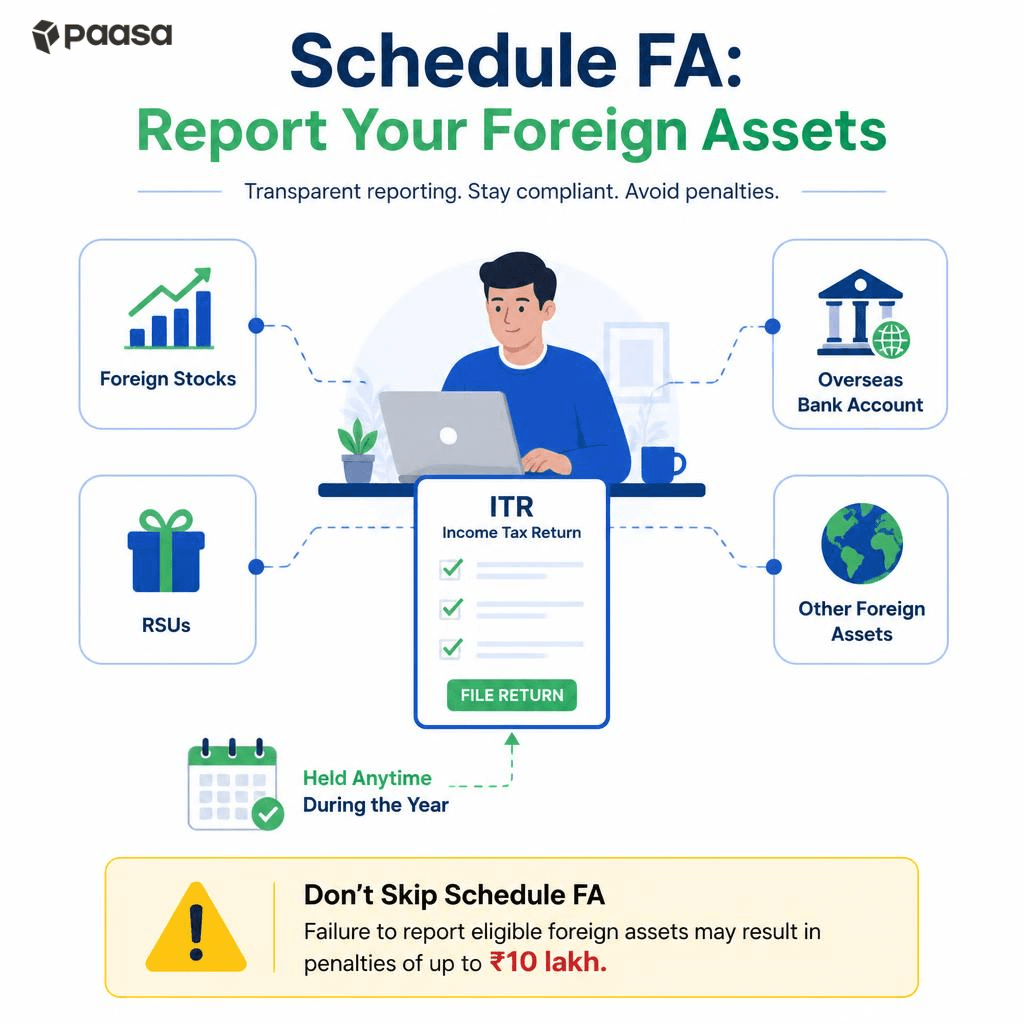
Failing to disclose these assets can make your return non-compliant and attracts a penalty of ₹10 lakh under the Black Money (Undisclosed Foreign Income and Assets) and Imposition of Tax Act, 2015, subject to the exceptions provided under the law.
Not Reporting Foreign Dividends
Foreign dividends are taxable in India and should be reported under Income from Other Sources. You can claim foreign tax credit if tax was deducted abroad.
Incorrect Capital Gains Calculation
Calculate gains correctly and convert values to INR using prescribed exchange rates. Errors can lead to incorrect tax reporting.
Missing Form 67
File Form 67 on time to claim foreign tax credit. Missing it results in denial of the credit.
Using the Wrong Exchange Rate
Use the correct SBITTBR exchange rate prescribed under tax rules to avoid reporting errors.
How Paasa helps
Paasa is the platform used by global Indian investors, NRIs, and family offices to invest across US, UK, China, Singapore, Switzerland, and beyond.
Paasa's tax advisory service provides complete filing support, from calculating correct values and exchange rates to ensuring every schedule reconciles.
What documents does Paasa provide for tax filing?
At the end of the financial year, Paasa provides a ready-to-file tax package containing:
- Capital Gains Report: A clear breakdown of Short-Term vs. Long-Term capital gains, calculated using the 24-month holding rule for unlisted shares.
- Dividend and Interest Reports: Consolidated statements showing income earned and tax withheld abroad, making it straightforward to fill Schedule FSI.
- Schedule FA Report: Peak value and closing value of your entire portfolio in INR, calculated using the mandatory SBI TT Buying Rates. You can copy-paste these numbers directly into your ITR.
If you invest in global equities and have questions around taxation, FEMA, LRS, or compliance, feel free to reach out to our team.

