
If part of your pay comes as company shares, you're already a global investor, whether you meant to be one or not. This module is built specifically for RSU holders. It walks through the full lifecycle of an RSU from grant to sale, how it is taxed, and the problems unique to them.
This chapter covers the duty to report your RSU holdings. Many people who diligently pay their vesting tax never realise a separate reporting obligation started at the same time, and that gap is what this chapter seeks to address.
Reporting your foreign shares and paying tax on them are two entirely separate duties. You can have paid every rupee of tax at vesting and sale correctly, and still be in serious breach if you failed to report the holding itself.
Your vested shares are shares in a foreign company, held in a foreign brokerage account. That is a foreign asset by definition. So from the moment your first block vests, you hold a foreign asset, and the obligation to report it begins.
The place this reporting happens is called Schedule FA, which stands for Foreign Assets. If you are a resident Indian holding shares in a foreign company, your vested RSUs must be disclosed here.
This applies to vested RSUs, not unvested ones. Once they vest and become shares in your name, they are a foreign asset and must be declared. So the reporting obligation switches on at exactly the same moment as the vesting tax: the vesting date.
For each foreign holding, Schedule FA generally wants details of the holding and two values in particular: the peak value the holding reached during the reporting period, and its closing value at the end of the period, each converted into rupees at the prescribed SBI TT buying rates for the relevant dates.
For an RSU holder whose shares vest in blocks across the year and whose account value moves with the share price, this is genuinely tedious, which is why keeping good records, or using a platform that generates a Schedule FA report for you, matters.
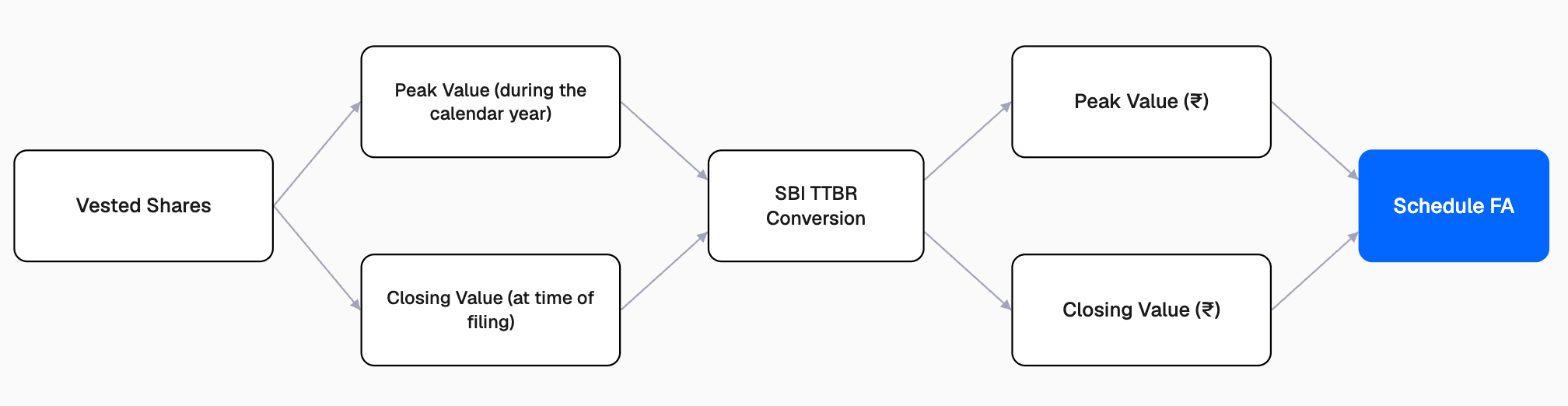
Foreign assets are reported on a calendar-year basis, January to December. So the RSU holdings and values you declare in Schedule FA are those for the calendar year, not the financial year your salary and capital gains follow.
Schedule FA does not exist on every income tax return form. It appears only on ITR-2 and ITR-3. A salaried employee, used to filing the simple ITR-1 that their salary alone would suggest, may file it out of habit, without realising that holding foreign shares makes ITR-1 the wrong form. And filing ITR-1 while holding foreign assets is treated as failing to disclose them, because the form you used has no Schedule FA to disclose them in.
The penalty for failing to disclose foreign assets is among the harshest in Indian tax law, and it applies even when no tax was due and even when the omission was careless rather than deliberate. Non-disclosure falls under the Black Money Act, which carries a flat penalty of 10 lakh rupees for each year a foreign asset goes undisclosed. For an RSU holder who paid all their tax faithfully but never realised they had to report the shares, this is a devastating and entirely avoidable outcome.
One connected point worth flagging: if your RSU shares are in a US company and you eventually receive dividends on them, or you need relief for any tax withheld abroad, there is additional reporting and a foreign tax credit to claim, through Form 67 and the related schedules. This has been covered in detail in here.
One question. Less than 10 seconds.
Reinforce what you've learned before continuing to the next chapter.






Discussion