When you invest abroad, a second country often taxes you too, before India ever gets involved. This module explains that foreign layer, dividend withholding, the treaty and foreign tax credit that stop you being taxed twice, and US estate tax, and ends by comparing the routes on their full, two-sided tax picture.
A company declares a dividend, and what shows up in your brokerage account is less than the full amount, with the difference already gone to the US tax authority. This happens automatically, every time a dividend is paid, without any action from you. The only thing within your control is the rate at which it is withheld.
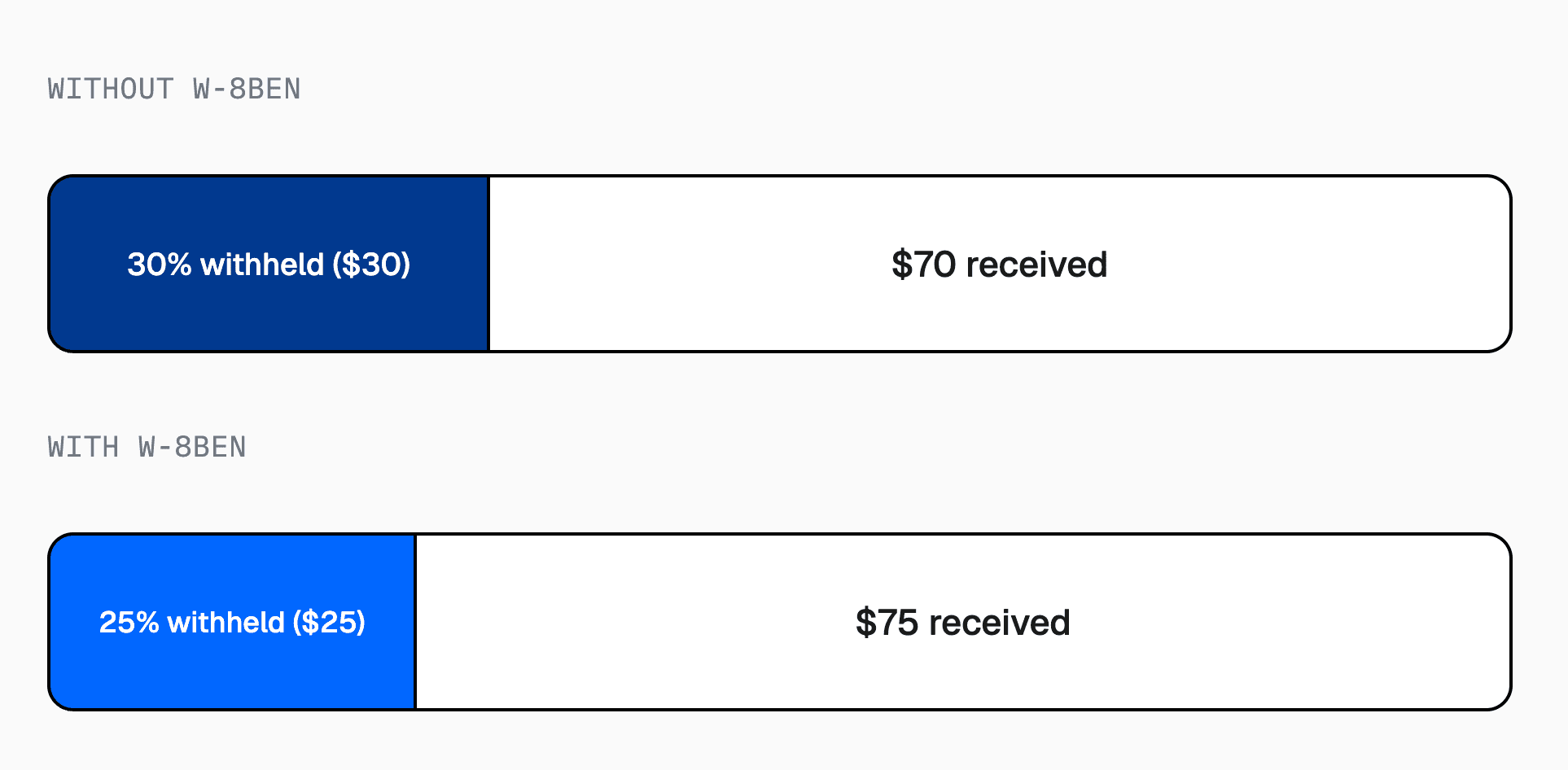
The United States has a standard withholding rate on dividends paid to foreign investors, and it is 30%. That is the rate that applies to a non-resident by default, with no treaty benefit claimed. On a 100 dollar dividend, 30 dollars would be withheld and 70 would reach you.
But India and the US have a tax treaty, the DTAA, and under it the withholding rate on dividends paid to an Indian resident is reduced to 25%. So with the treaty applied, a 100 dollar dividend has 25 dollars withheld and 75 reaches you.
You may read that the DTAA reduces US dividend withholding to 15%. For an individual retail investor, that is wrong. The 15% rate under the treaty applies only to companies that own at least 10% of the voting stock of the dividend-paying company. No ordinary retail investor owns 10% of Apple or Microsoft, so the rate that applies to you as an individual is 25%, not 15%. It is worth knowing this so you are not misled into expecting a lower rate than you will actually get.
The W-8BEN is a US tax form that certifies you are a foreign person and a resident of a treaty country. Once it is on file with your broker, your dividends are withheld at the treaty rate of 25% rather than the default 30%.
The good news is that it is usually painless. It is a one-time form, completed when you open your foreign investment account, and on most Indian platforms that offer US stocks the W-8BEN is presented to you during account setup, sometimes handled largely on your behalf.
Note what is not yet resolved: the dividend is also taxable in India, since your worldwide income is taxable there. What stops you being taxed twice on it is the foreign tax credit, which uses exactly this withheld amount as a credit against your Indian tax. That reconciliation is the subject of the next chapter.
One trap worth flagging, because it catches people who reinvest. If you hold a stock or a distributing ETF and your dividends are automatically reinvested through a plan, the dividend is still paid to you first, so it is still withheld and still taxed exactly the same way.
On the other hand, an accumulating ETF is genuinely different (refer here to understand the two types of ETFs better). Here the fund never pays a dividend out to you at all. It receives dividends from the companies it holds and reinvests them inside the fund. Because nothing is distributed to you, there is no personal dividend event, which means no dividend withholding on you and no dividend income to add to your Indian return each year.
The tax does not vanish entirely, there is still some withholding inside the fund on its own holdings, which you cannot see or reclaim, and the reinvested value eventually shows up as a larger capital gain when you sell. But the personal, annual dividend tax that a distributing holding creates is genuinely avoided, which is exactly why accumulating funds, and Irish-domiciled UCITS ones in particular, are often more efficient for a long-term investor.
One question. Less than 10 seconds.
Reinforce what you've learned before continuing to the next chapter.






Discussion