
How does an Indian investor actually go global? This module is the starting point for doing it. It covers the ground rules and the groundwork, how money legally moves abroad, what markets and instruments are open to you, what it all costs, and how you will be taxed.
Sending money from India to another country is called remittance. When you pay for a relative's education abroad, book an overseas holiday, or invest in a foreign stock, the money has to physically leave the Indian financial system and arrive in another. That act of sending it out is remittance.
Now, sending money abroad is not unlimited, and this is where the rules come in. The framework that governs it is the Liberalised Remittance Scheme, in short, LRS. It sits under FEMA, the Foreign Exchange Management Act, which is the law that regulates how money moves in and out of India. The LRS is what makes personal global investing legal and accessible: it is the Reserve Bank of India's way of saying that ordinary residents are free to send money abroad, within defined limits, without needing special permission each time.
Under the LRS, every resident Indian is allowed to remit up to USD 250,000 abroad per financial year, across all purposes combined, whether investing, travel, education, or anything else. That is roughly 2.5 crore rupees, and it resets every financial year on the 1st of April. It applies to you as an individual, which means each member of a family has their own separate limit.
An important thing to note is that this limit is tracked via your PAN Card. Which means, even if you remit money through two bank accounts, you can still only send USD 250,000 overall.
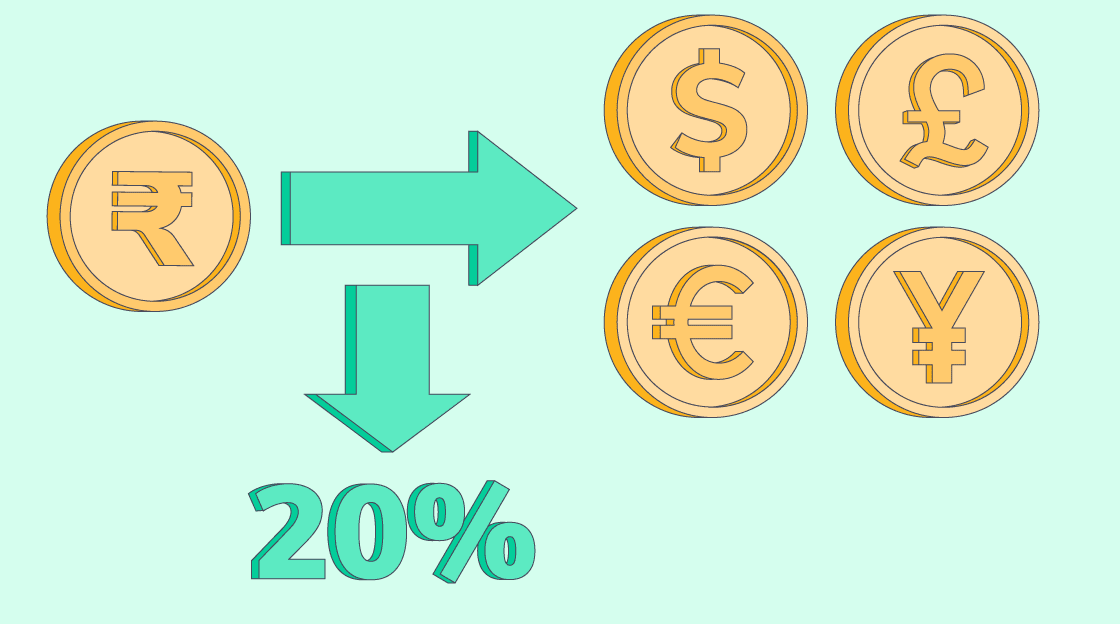
Within that limit, the LRS permits a wide range of purposes, and investing is squarely one of them. You are allowed to buy foreign shares, ETFs, and mutual funds, and to hold money in permitted foreign currencies to do so. It also opens up more than just the United States: the scheme lets you invest across markets and hold assets in various major currencies, which is what makes genuine global diversification possible in the first place. As you saw in the earlier chapters, that wider door is exactly what lets you reach markets across North America, Europe, and Asia, rather than the US alone.
There is one last thing to be aware of when money is remitted, and that is TCS, or Tax Collected at Source.
When your total remittances in a financial year cross a threshold, currently 10 lakh rupees, the bank collects a percentage of the amount above that threshold at the time of the transfer and deposits it with the tax department on your behalf. For investment remittances, that rate is currently 20% on the amount exceeding 10 lakh. The important thing to understand is that TCS is not an extra tax or a cost you lose. It is simply tax collected in advance. It gets adjusted against your overall tax liability when you file your return, and if you owe less than what was collected, you get the difference back as a refund.
A quick example makes this clear. Suppose you remit 15 lakh rupees in a year to buy US stocks. The first 10 lakh attract no TCS. On the remaining 5 lakh, TCS at 20% works out to 1 lakh rupees, which the bank collects at the time of transfer. That 1 lakh does not vanish. When you file your income tax return, it is credited back against whatever tax you owe. If your total tax due is higher, the 1 lakh reduces what you still have to pay; if it is lower, the excess is refunded to you. Either way, the money finds its way back to you. So while TCS does mean a little of your capital is parked with the tax department for a while, it is not a charge on your investment, just a timing matter. The finer details, including the current thresholds and rates, sit within Module 3 later on.
One question. Less than 10 seconds.
Reinforce what you've learned before continuing to the next chapter.






Discussion