
How does an Indian investor actually go global? This module is the starting point for doing it. It covers the ground rules and the groundwork, how money legally moves abroad, what markets and instruments are open to you, what it all costs, and how you will be taxed.
Every rupee you invest abroad passes through a few hands on its way to becoming a foreign asset, and each of those hands takes a small cut. None of these costs is large on its own, but together they shape your real, take-home return, and the investor who understands them tends to keep more of what they earn.
The first and most important one to understand is the currency conversion cost, often called the FX markup. Because you invest in rupees but foreign assets are priced in dollars, euros, or other currencies, your money has to be converted.
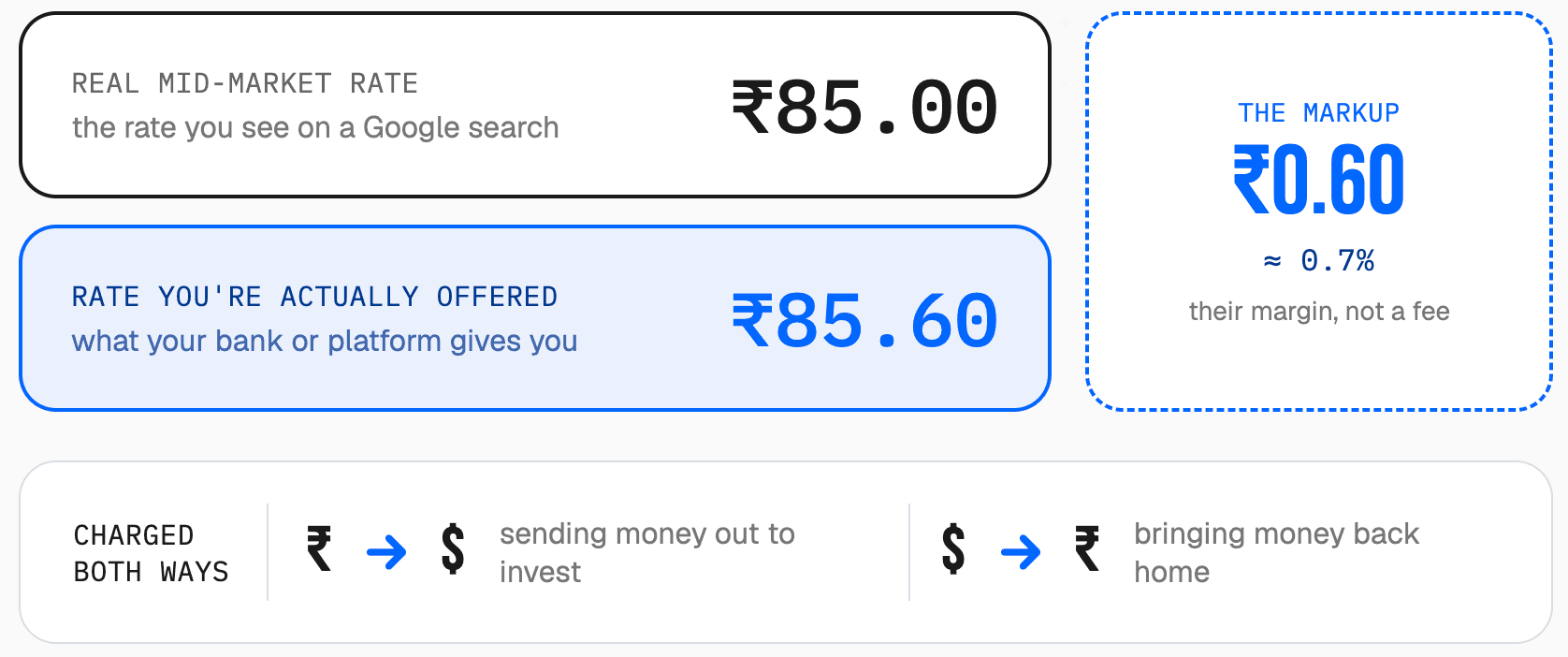
There is a real, mid-market rate at which currencies genuinely trade (the one you see when you do a Google search!), and then there is the slightly higher rate your bank or platform actually offers you, and the gap between the two is their margin. It applies both when you send money out and when you eventually bring it back. Over many transactions, a markup of even a fraction of a percent adds up, so it is worth knowing to look for the rate you are being offered, not just the fee you are being shown.
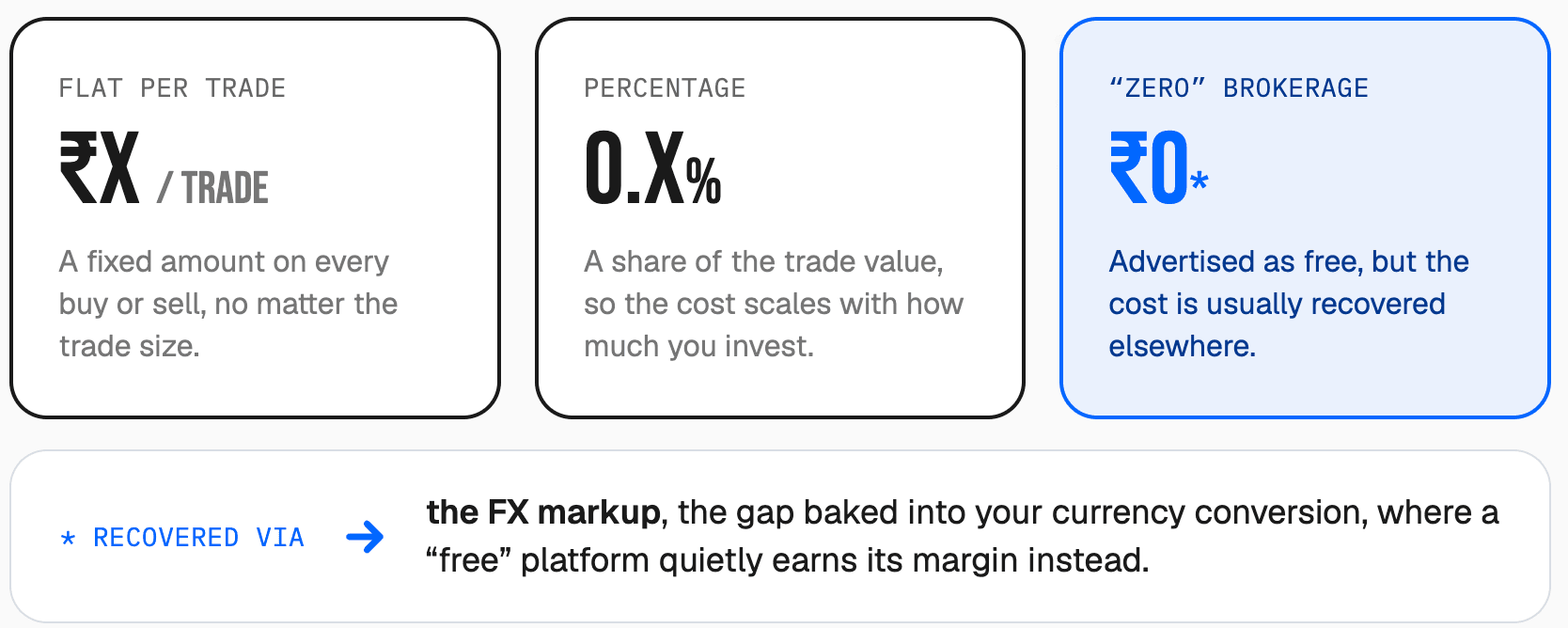
Next is brokerage, the charge for actually buying and selling. When you place a trade through a broker or platform, whether buying a foreign stock or an ETF, there may be a fee for executing that transaction. Some platforms charge a flat amount per trade, some charge a percentage, and some advertise zero brokerage while recovering their costs elsewhere, often through the FX markup just described. The important habit here is to look at the whole picture rather than a single headline number, because "zero brokerage" does not always mean the cheapest overall.
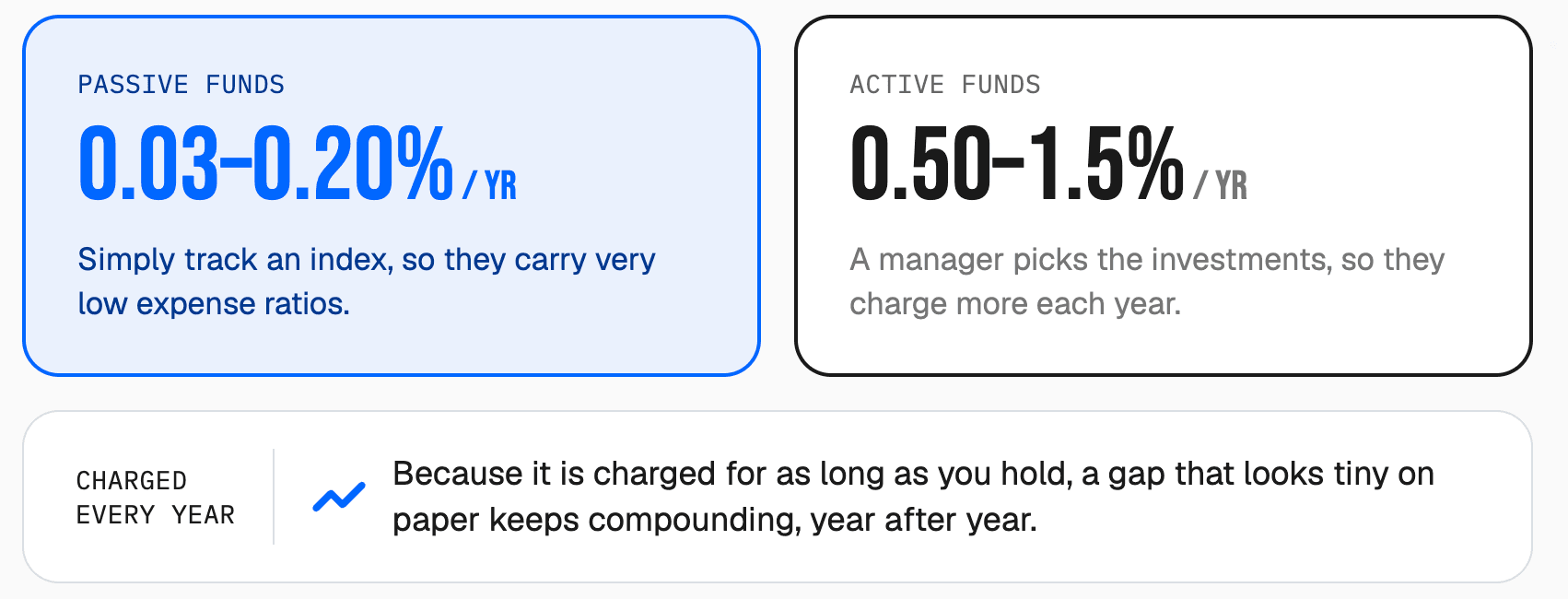
This one applies not to stocks but to funds, that is, ETFs and mutual funds. Running a fund costs money, managing the portfolio, administration, and so on, and that cost is charged as a small annual percentage of the amount you have invested. You never receive a bill for it; it is quietly deducted from the fund's value over the year. The key thing to know is that passive funds, which simply track an index, carry very low expense ratios, while active funds, where a manager is picking investments, charge more. Because the TER is charged every year for as long as you hold, a difference that looks tiny on paper compounds into a meaningful sum over a long horizon, which is a large part of why low-cost funds are so often favoured.
Some platforms charge an account maintenance fee, some charge for withdrawals or for transferring money back to India, and some are free to use but make their money through the FX markup or brokerage. There is no single standard, so the practical advice is simply to read what a given platform charges before committing, and to understand where it earns its money, because a platform that is free in one place is usually recovering the cost in another.
There is one thing that often gets mistaken for a cost but is not one, and it is worth repeating here so the picture stays clean. TCS, the Tax Collected at Source, is not a charge on your investment. It is advance tax that is adjusted against your total tax liability and refunded if excess, so it does not belong in this list of costs at all, even though it comes off your money at the moment of transfer. Keep it mentally separate: costs reduce your return, TCS does not.
One question. Less than 10 seconds.
Reinforce what you've learned before continuing to the next chapter.






Discussion