



If you hold RSU shares in a US brokerage account and your company pays dividends, the broker is required to withhold US tax on those payments before they reach you.
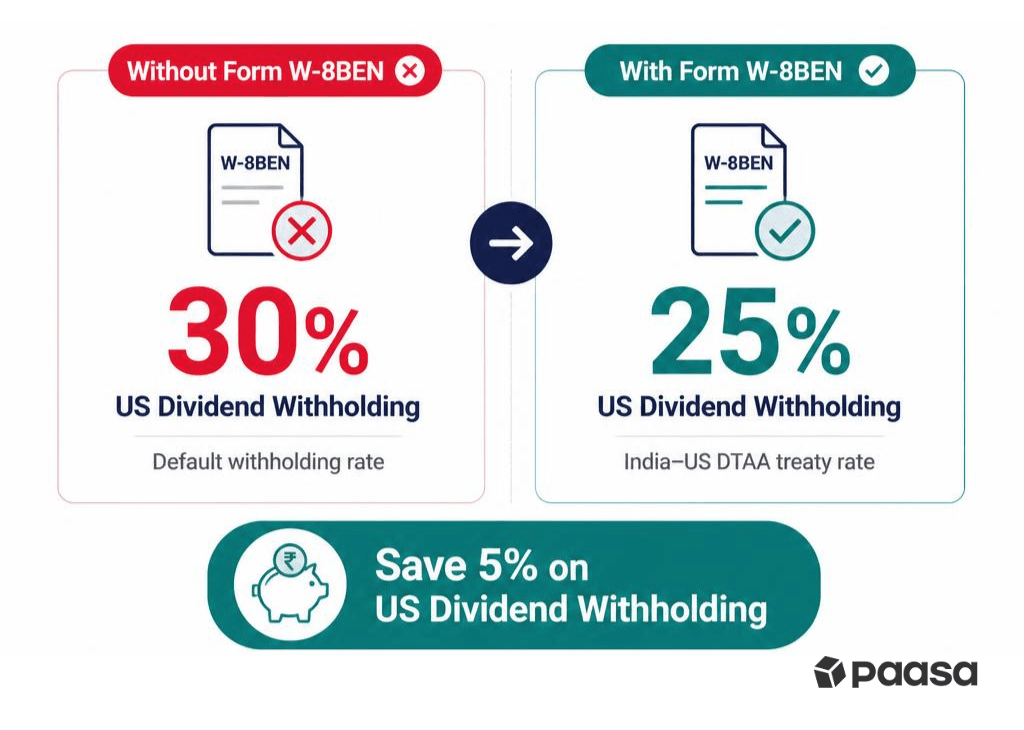
By default, that rate is 30%. Filing a W-8BEN brings it down to 25% under the India-US tax treaty.
This guide covers what the form does, how to fill it in, when it expires, and what happens if you have not filed it yet.
Table of contents
- What is W-8BEN?
- Why RSU holders need it
- What it actually changes
- No US capital gains tax when you sell
- How to file it
- How long it is valid
- What if you have not filed it yet?
- How Paasa helps
What is W-8BEN?
W-8BEN is a US tax form for non-US individuals. Its full name is Certificate of Foreign Status of Beneficial Owner for United States Tax Withholding and Reporting.
When you receive income from a US source like dividends from US-listed shares, US law requires the payer to withhold tax before paying you. The default rate for non-US persons is 30%.
W-8BEN tells the payer two things: that you are not a US tax resident, and that you are entitled to a lower rate under the tax treaty between the US and your country of residence.
For Indian residents, the relevant treaty is the India-US Double Taxation Avoidance Agreement (DTAA). How the India-US DTAA works for Indian investors
The form is not filed with the IRS. It is submitted directly to the withholding agent — in most cases, your brokerage.
Why RSU holders need it
Your RSU shares sit in a US brokerage account, typically Fidelity, Charles Schwab, E*Trade, or Interactive Brokers. Your employer handles the tax side of vesting through payroll. But once those shares are in your brokerage account, the employer is out of the picture. The broker does not automatically know you are an Indian tax resident unless you tell them.
W-8BEN is how you tell them.
Without it on file, the broker applies the default 30% withholding on any dividends from your RSU shares. With it, the broker applies the treaty rate of 25%.
What it actually changes
Dividend withholding: 30% → 25%
Under Article 10 of the India-US DTAA, dividend withholding for Indian portfolio investors (which includes RSU holders) is capped at 25%. Without W-8BEN, the broker has no basis to apply the treaty rate and defaults to 30%.
Example
Your RSU shares pay a dividend of $5000.
| Without W-8BEN | With W-8BEN | |
|---|---|---|
| Gross dividend | $5000 | $5000 |
| US withholding rate | 30% | 25% |
| US tax withheld | $1500 | $1250 |
| Amount received | $3500 | $3750 |
The $250 difference per $5000 is not large on any individual payment, but it compounds across multiple dividend payments and over multiple years of holding.
In India, the gross dividend ($5000) is taxable as income from other sources at your slab rate. The withholding tax already paid ($1250 with W-8BEN) can be claimed as a Foreign Tax Credit via Form 67, reducing your Indian tax liability by that amount.
No US capital gains tax when you sell
W-8BEN also confirms to your broker that you are a non-US person. Under US tax law, Indian residents are not liable to pay US capital gains tax when they sell shares listed in the US. This is not a DTAA benefit — it is how US tax law works for non-residents in general. But your broker needs a valid W-8BEN on file to document your foreign status. Without it, some brokers may apply backup withholding on sale proceeds.
How to file it
The form is submitted to your broker, not to the IRS. Most major brokers (Interactive Brokers, Fidelity, Schwab, E*Trade) have a W-8BEN submission process in their account settings. It takes about five minutes.
The form has two relevant sections for RSU holders:
Part I: Identification
- Your full legal name
- Country of citizenship: India
- Your permanent residential address in India
- Your PAN number in the Foreign Tax Identification Number field — this is mandatory if you are claiming treaty benefits. Without it, the broker may not apply the reduced rate.
Part II: Claim of Tax Treaty Benefits
- Country of residence for treaty purposes: India
- Article: Article 10 (Dividends) of the India-US DTAA
- Rate: 25%
Sign and date the form and submit it to your broker through their portal. You do not send it to the IRS.
Note: If you hold shares in your name through multiple brokers, you need to file W-8BEN with each broker separately.
How long it is valid
W-8BEN is valid for three calendar years from the year in which you sign it.
If you sign in March 2025, the form is valid through December 31, 2028 — the end of the third calendar year after 2025. After that, you need to renew it.
The form also needs to be renewed immediately if your circumstances change — for example, if you move abroad and your country of tax residence changes. In that case, the existing W-8BEN becomes invalid and the broker reverts to the 30% default until a new form is on file.
What if you have not filed it yet?
If your broker has been withholding at 30% on dividends because no W-8BEN was on file, the 5% excess withholding is not automatically refunded. You have two options.
Go forward: File W-8BEN now so all future dividends are withheld at 25%. The form takes effect once the broker processes it.
Claim back what was over-withheld: The excess withholding (30% minus the 25% treaty rate) can in theory be reclaimed by filing a US non-resident tax return (Form 1040-NR) with the IRS. In practice, for small amounts, the effort often exceeds the refund. For larger amounts, speak to a CA with cross-border tax experience.
In India, you can still claim the full withholding (even at 30%) as a Foreign Tax Credit via Form 67 in your ITR, up to the amount of Indian tax payable on that income.
How Paasa helps
Paasa is the platform used by global Indian investors, HNIs, and family offices to diversify their wealth across global markets like US, UK, China, Singapore, Switzerland, and beyond.
For RSU holders, Paasa makes it easier to manage your equity compensation alongside the rest of your portfolio:
- RSU diversification across global markets while preserving USD exposure
- End of year tax documents covering capital gains, dividends, and Schedule FA in INR
- Consolidated tax reports calculated for Indian tax filing
If you are an RSU holder with questions around managing your global wealth, feel free to reach out to our team.

