
Global Investing
Top UCITS Alternatives to XSD (SPDR S&P Semiconductor ETF)
The SPDR S&P Semiconductor ETF (XSD) offers broad access to the chip sector through an equal-weighted strategy, but it carries significant US Estate Tax risks for Indian investors. This guide explores the best tax-efficient UCITS alternatives to XSD that provide high-growth semiconductor exposure without the 40% tax trap.

Abhighyan Sinha

The SPDR S&P Semiconductor ETF (XSD) tracks the S&P Semiconductor Select Industry Index, utilizing a distinct equal-weighted methodology to provide broad access to the chip sector.
Unlike market-cap weighted competitors, this strategy mitigates concentration risk by preventing industry giants from dominating the portfolio, offering investors balanced exposure to small- and mid-cap companies across manufacturers, designers, and equipment providers.
However, for long-term Indian investors, XSD carries a critical structural risk: the US estate tax. If you hold US-domiciled assets like XSD and your holdings exceed $60,000, your estate faces US estate tax at progressive rates of up to 40% on your death. On a $500,000 holding, that works out to roughly 29% of the portfolio.
This blog gives you all the information you need about the top UCITS alternatives. While there are no strictly equal-weighted semiconductor UCITS ETFs available in Europe, the alternatives listed below use capped market-cap methodologies. This prevents one or two companies from dominating the fund and brings them closer to the diversified spirit of XSD without the estate tax risk.
Table of contents
- Why Indians are looking for UCITS alternatives to XSD
- Popular UCITS alternatives for XSD
- Invest in UCITS ETFs with Paasa
Why Indians are looking for UCITS alternatives to XSD
Indian investors are shifting to UCITS alternatives because they solve the tax risks and inefficiencies of US ETFs like XSD while providing similar exposure to the semiconductor industry.
- Estate Tax Protection: UCITS funds are typically domiciled in Europe (such as Ireland or Luxembourg). They are not considered "US-situs" assets, meaning they are 100% exempt from US Estate Tax.
- Tax Deferral (Accumulation): Unlike XSD, which forces taxable cash dividends on you, many UCITS funds offer "Accumulating" classes that reinvest dividends automatically. This defers your Indian tax liability until you sell the fund, and converts what would have been slab-rate dividend income into capital gains.
To learn more about UCITS ETFs and why Indian investors are choosing them, read our guide on UCITS ETFs.
Popular UCITS alternatives for XSD
Because XSD gives small and mid-cap chip companies the same weight as mega-caps like Nvidia, none of the options below is a like-for-like match, but all three are accumulating and cap their largest holdings.
Here are the top three UCITS alternatives to XSD:
1. VanEck Semiconductor UCITS ETF
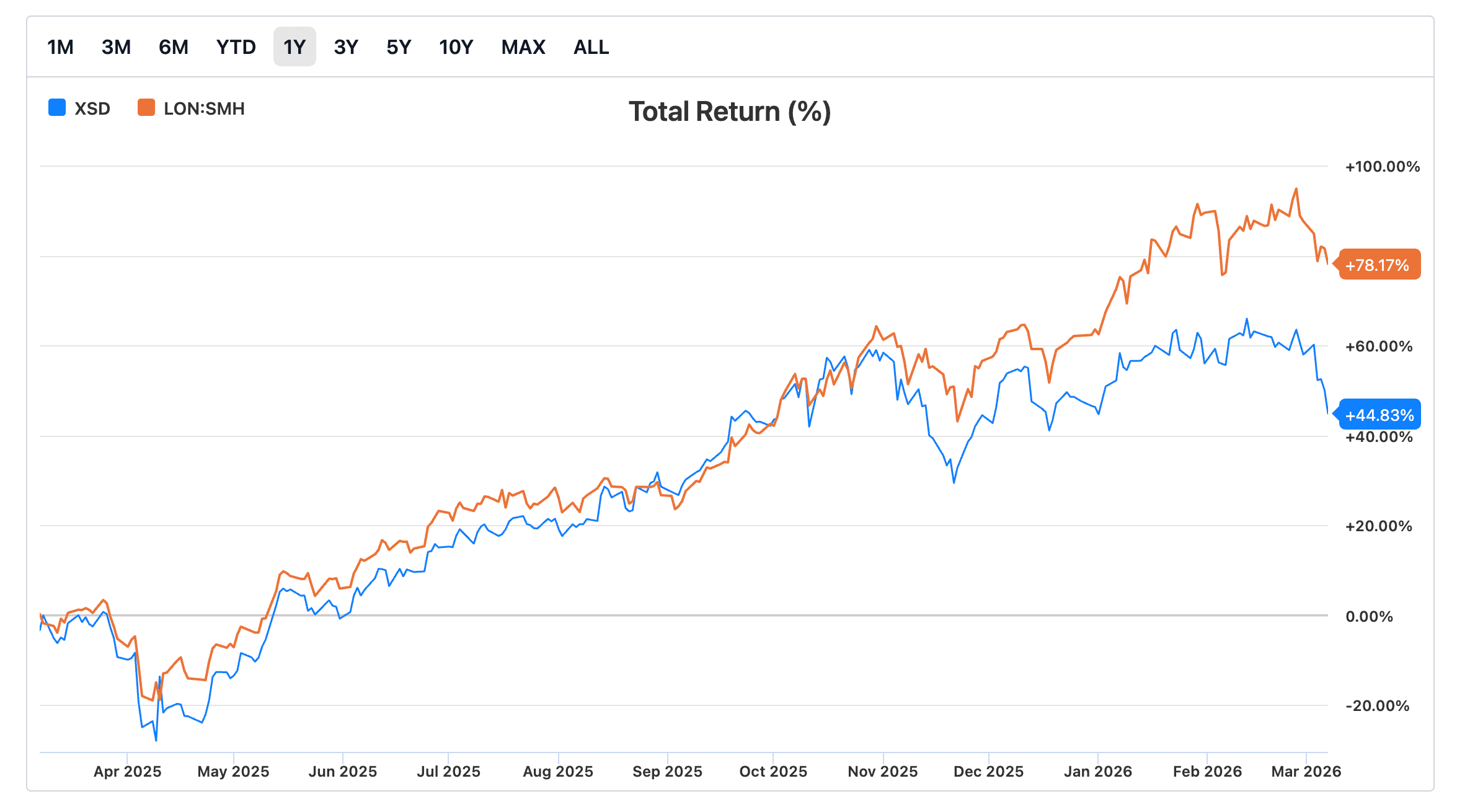
This is the largest semiconductor UCITS ETF on this list (about £6.2 billion, as of November 2026), tracking the top 25 US-listed chip companies.
Unlike the equal-weight US-only approach of XSD, this fund tracks the largest 25 US-listed semiconductor companies using a capped market-cap strategy. To prevent massive mega-caps like Nvidia from completely taking over the fund, it caps individual stock weights at 10%.
Furthermore, because it tracks US-listed companies, it includes crucial foreign giants that trade via ADRs in the United States, such as Taiwan Semiconductor and ASML. This offers a highly concentrated but globally critical portfolio.
- Ticker: SMH (LSE, USD) / VVSM (Xetra, EUR)
- Total Expense Ratio (TER): 0.35%
- Structure: Accumulating (Reinvests dividends)
- Top Holdings: Nvidia, Taiwan Semiconductor (TSMC), Broadcom, ASML, Advanced Micro Devices (AMD)
2. iShares MSCI Global Semiconductors UCITS ETF
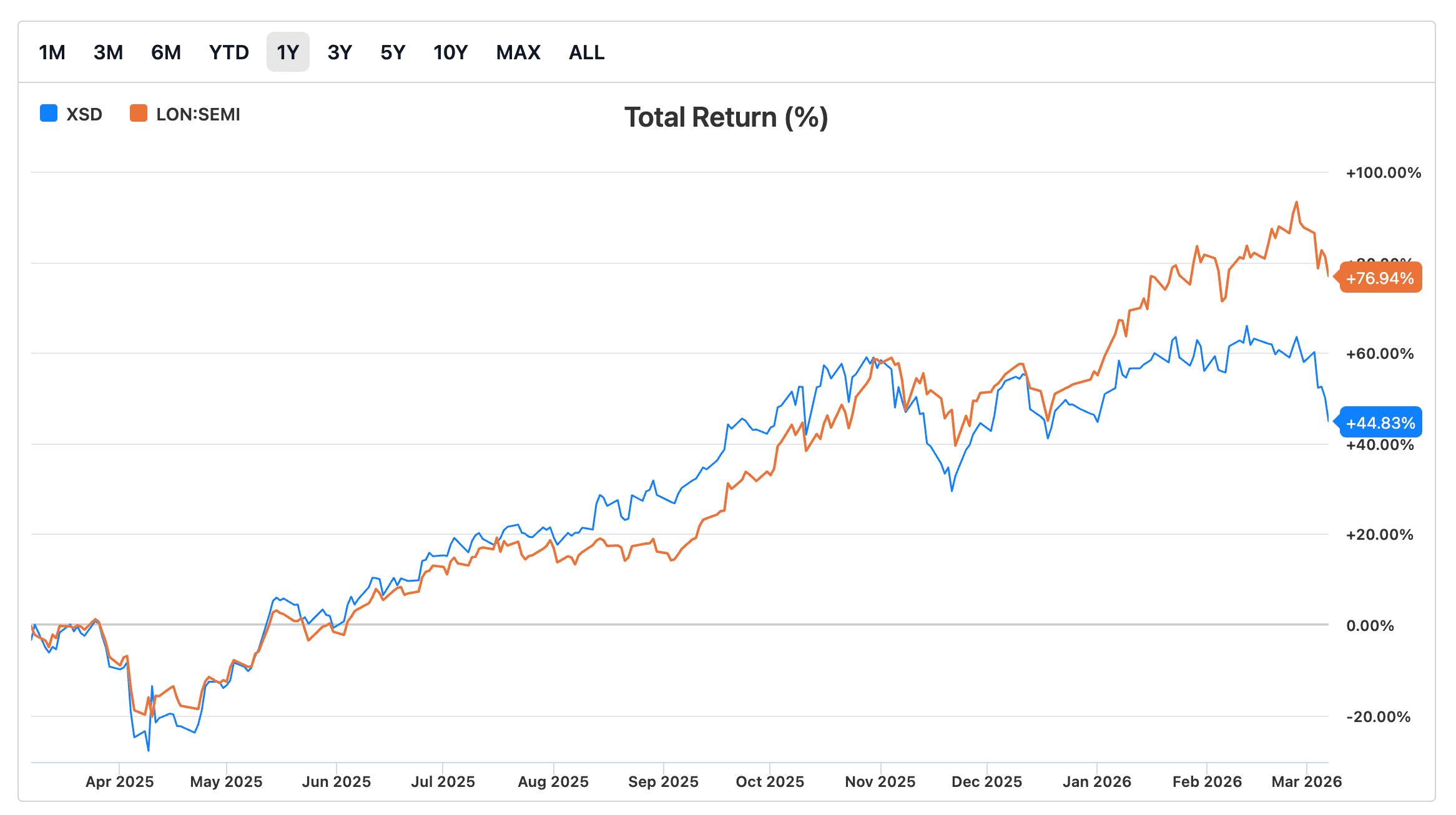
XSD restricts itself to US companies, which means it misses out on the international linchpins of the semiconductor supply chain, such as the foundries in Asia and the lithography equipment builders in Europe. This iShares ETF solves that by tracking a global index and holding about 258 semiconductor companies (as of October 2026).
While it uses a capped market-cap methodology to comply with European UCITS diversification rules rather than the equal-weight methodology of XSD, it casts a much wider net. It captures everything from US designers to the international manufacturers that actually build the chips.
- Ticker: SEMI (LSE, GBP) / SEC0 (Xetra, EUR)
- Total Expense Ratio (TER): 0.35%
- Structure: Accumulating (Reinvests dividends)
- Top Holdings: Nvidia, Taiwan Semiconductor (TSMC), ASML, Broadcom, Applied Materials
3. Amundi MSCI Semiconductors UCITS ETF Acc
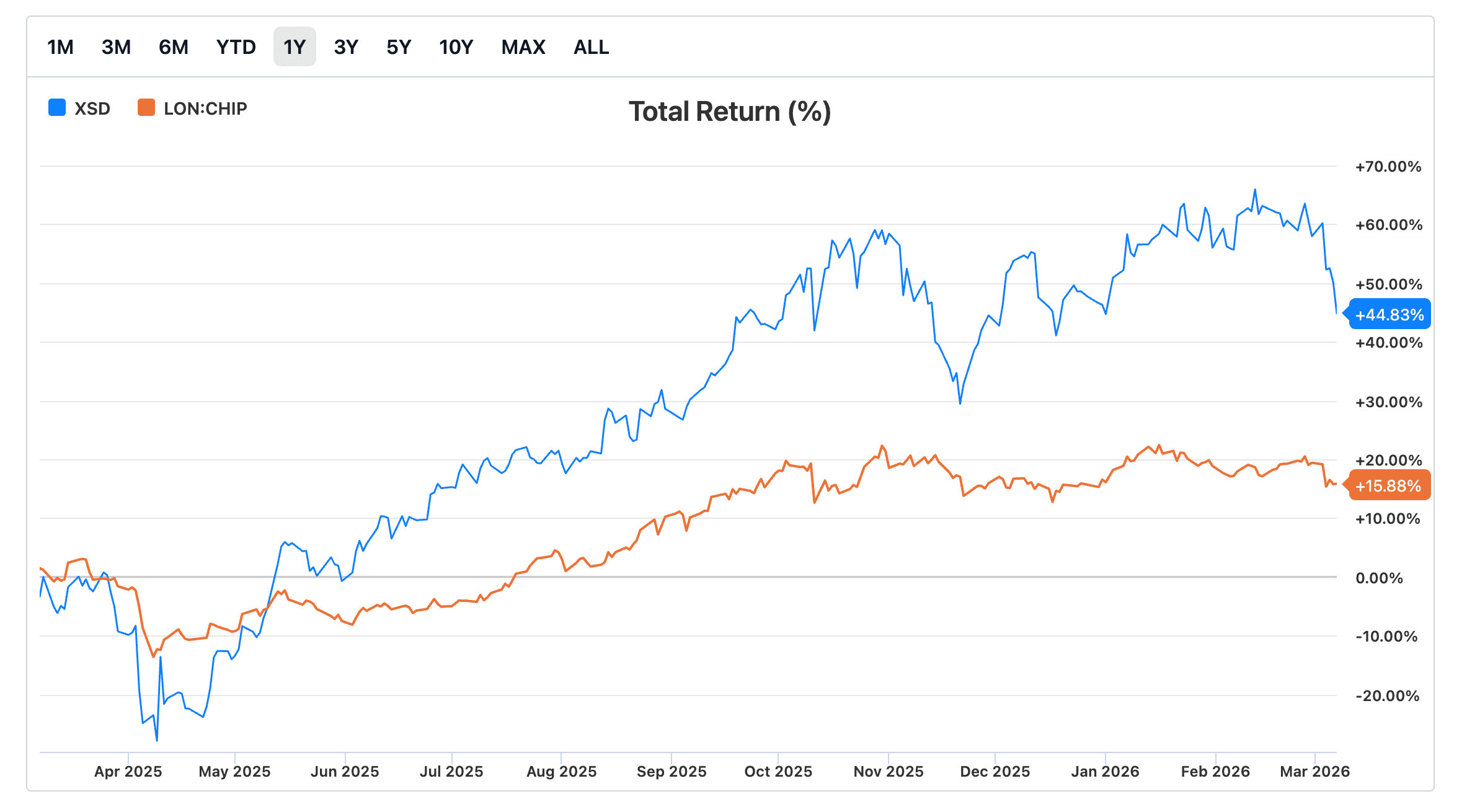
This Luxembourg-domiciled Amundi ETF tracks the MSCI ACWI Semiconductors & Semiconductor Equipment Filtered Index, which gives you a global basket of chip stocks rather than XSD's US-only focus. Like the other alternatives, it caps its largest holdings to meet UCITS diversification rules, and its index applies screening filters to the constituents.
- Ticker: SEMU (LSE, USD)
- Total Expense Ratio (TER): 0.35%
- Structure: Accumulating (Reinvests dividends)
- Top Holdings: Nvidia, Taiwan Semiconductor (TSMC), ASML, Broadcom, Texas Instruments
More UCITS alternatives: UCITS alternatives to SMH and UCITS alternatives to XLK.
Related: What are UCITS ETFs? and Should you switch from US ETFs to UCITS?
Invest in UCITS ETFs with Paasa
Paasa is a global investing platform designed for Indian residents and NRIs. We provide direct access to 11 markets: the US, Canada, the UK, Germany, France, Switzerland, the Netherlands, South Korea, Japan, Hong Kong and Singapore.
This means you are not restricted to just US ETFs like XSD; you can also buy tax-efficient UCITS equivalents using Paasa.
The compliance advantage
Paasa makes global investing easy and also removes the compliance friction with a specialized layer built for Indian residents and NRIs:
- Schedule FA reporting: Exact reports you need for your Indian tax returns, eliminating the need for manual calculations.
- FEMA & LRS guidance: Guidance on FEMA regulations and LRS limits to ensure compliance.
Whether you are buying direct US stocks or investing in UCITS ETFs listed on European exchanges, Paasa provides global access with India-specific compliance and tax support.
Frequently Asked Questions
Is there an equal-weighted semiconductor UCITS ETF like XSD?
No. None of the semiconductor UCITS ETFs listed here equal-weights its holdings the way XSD does. They use capped market-cap weighting instead, which still stops one or two companies from dominating the fund.
Which XSD alternative gives the broadest global exposure?
The iShares MSCI Global Semiconductors UCITS ETF (SEMI) does, with about 258 holdings across developed and emerging markets. The Amundi fund is also global, while the VanEck fund holds 25 US-listed companies, including ADRs such as TSMC and ASML.
Are these XSD alternatives accumulating?
Yes. SMH, SEMI and SEMU all reinvest dividends, so you pay no Indian tax on dividends until you sell. Each charges 0.35% a year.
Can I switch from XSD to a UCITS alternative without paying tax?
No. Moving from XSD to a UCITS fund means selling XSD, and that sale is a taxable event in India. Gains on units held for more than 24 months are taxed as long-term capital gains at 12.5%, and gains on units held for 24 months or less are taxed at your income-tax slab rate. As a non-resident, you generally do not owe US capital gains tax on the sale.
How can I buy the VanEck Semiconductor UCITS ETF (SMH)?
You can buy it through your Paasa account: search for SMH, which trades on the London Stock Exchange in USD, and place a buy order.
How can I buy the iShares MSCI Global Semiconductors UCITS ETF (SEMI)?
You can buy it through your Paasa account: search for SEMI, which trades on the London Stock Exchange in GBP, and place a buy order.
How can I buy the Amundi MSCI Semiconductors UCITS ETF Acc (SEMU)?
You can buy it through your Paasa account: search for SEMU, which trades on the London Stock Exchange in USD, and place a buy order.


Invest in global markets from India

Discussion
Disclaimer
The information provided in this post is for general informational purposes only. It is not intended as professional advice or to replace consultation with qualified professionals. While we strive to ensure the accuracy and reliability of the information presented, we make no representations or warranties of any kind, express or implied, about the completeness, accuracy, reliability, suitability, or availability with respect to the content contained herein. Any reliance you place on such information is therefore strictly at your own risk. We disclaim any liability for any loss or damage, including, without limitation, indirect or consequential loss or damage, or any loss or damage whatsoever arising from loss of data or profits arising out of, or in connection with, the use of this post. Always seek the advice of professionals or relevant authorities regarding your specific situation or circumstances.