
Global Investing
Top UCITS Alternatives to QUAL
Discover why switching to European-domiciled equivalents like IUQA or XUQU is the smartest move for your long-term wealth protection and quality factor exposure.

Abhighyan Sinha

The iShares MSCI USA Quality Factor ETF (QUAL) targets U.S. large and mid-cap stocks exhibiting high return on equity, stable year-over-year earnings growth, and low financial leverage. For a 0.15% expense ratio, the fund maintains broad market sector weights while providing concentrated exposure to fundamentally strong, cash-rich market leaders like Apple, Microsoft, and NVIDIA.
Investors and institutions usually choose this ETF to capture the performance of high-quality companies without unintentionally over-concentrating purely in specific sectors like tech or financials.
However, for long-term Indian investors, QUAL carries a critical structural risk: the US estate tax. If you hold US-domiciled assets like QUAL and your holdings exceed $60,000, your estate faces US estate tax at progressive rates of up to 40% on your death. On a $500,000 holding, that works out to roughly 29% of the portfolio.
This blog gives you all the information you need about the top UCITS alternatives. These alternatives solve the estate tax problem while giving you similar exposure to fundamentally strong companies.
The options listed below include a European counterpart that tracks the same MSCI USA Sector Neutral Quality Index, a global version that applies the same quality screen to developed markets worldwide, and an alternative methodology focused on dividend growth and profitability. Together, they provide high-quality equity exposure without the risk of the US estate tax.
Table of contents
- Why Indians are looking for UCITS alternatives to QUAL
- Popular UCITS alternatives for QUAL
- Invest in UCITS ETFs with Paasa
Why Indians are looking for UCITS alternatives to QUAL
Indian investors are shifting to UCITS alternatives because they solve the tax risks and inefficiencies of US ETFs like QUAL while providing very similar exposure.
- Estate Tax Protection: UCITS funds are typically domiciled in Ireland. They are not considered "US-situs" assets, meaning they are 100% exempt from US Estate Tax.
- Tax Deferral (Accumulation): Unlike QUAL, which forces taxable cash dividends on you, many UCITS funds offer "Accumulating" classes that reinvest dividends automatically. This defers your Indian tax liability until you sell the fund, and converts what would have been slab-rate dividend income into capital gains.
To learn more about UCITS ETFs and why Indian investors are choosing them, read our guide on UCITS ETFs.
Popular UCITS alternatives for QUAL
Here are the top three UCITS funds that serve as the best proxies for the US Quality Factor.
1. iShares MSCI USA Quality Factor UCITS ETF
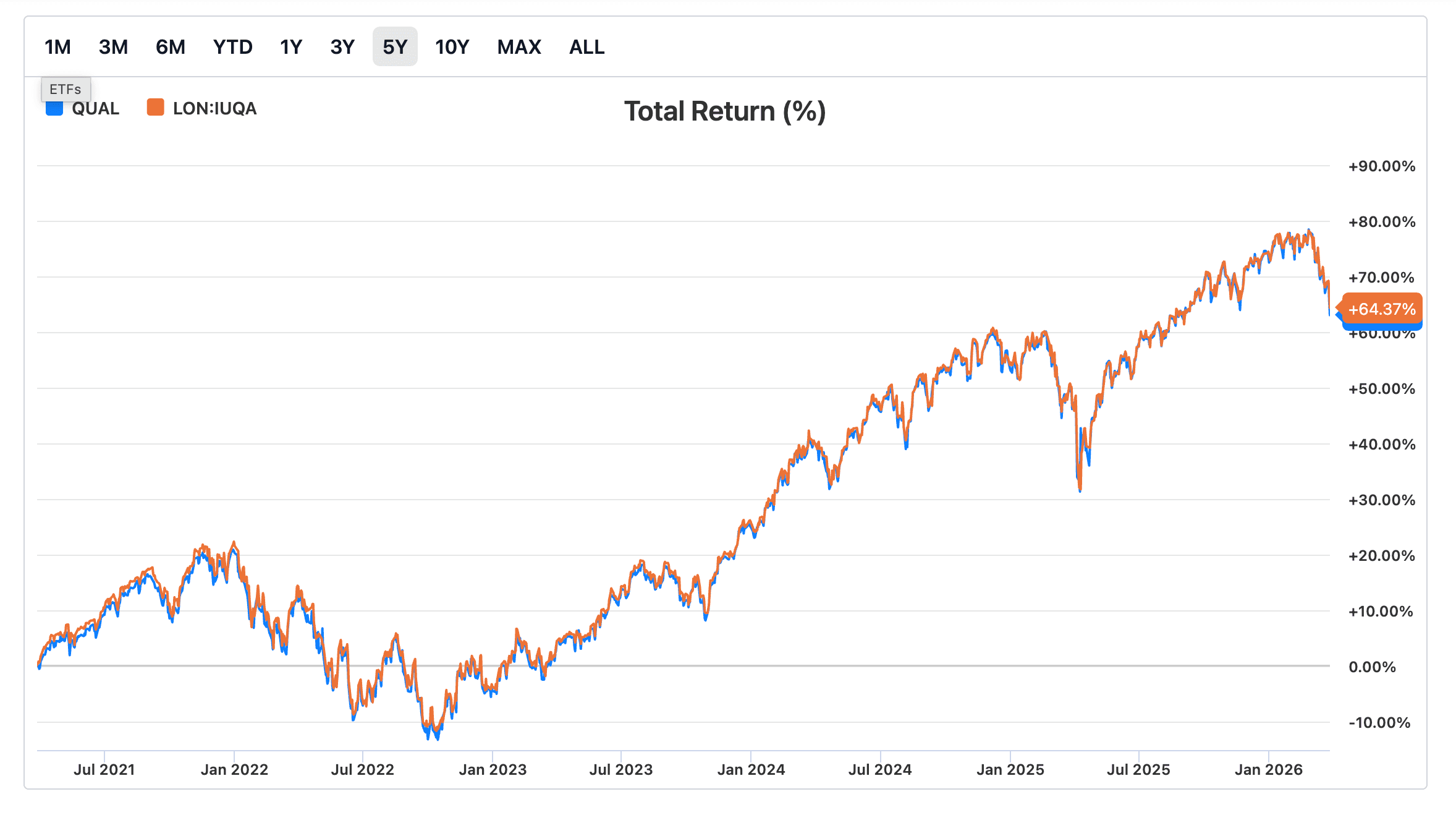
This is the European counterpart of QUAL, managed by the same provider (BlackRock/iShares). It tracks the same MSCI USA Sector Neutral Quality Index, targeting mid-to-large-cap US stocks characterized by positive fundamentals like high return on equity (ROE), stable year-over-year earnings growth, and low financial leverage.
Because it uses a "sector-neutral" approach, it matches the sector weightings of the broader US market, which prevents the fund from unintentionally over-concentrating purely in tech or financials. The accumulating structure ensures all dividends are internally reinvested, creating a tax-efficient compounding effect.
- Ticker: IUQA (LSE, USD)
- Total Expense Ratio (TER): 0.20%
- Structure: Accumulating (Reinvests dividends)
- Top Holdings: Nvidia, Microsoft, Apple, Broadcom, Eli Lilly.
2. iShares MSCI World Quality Factor UCITS ETF
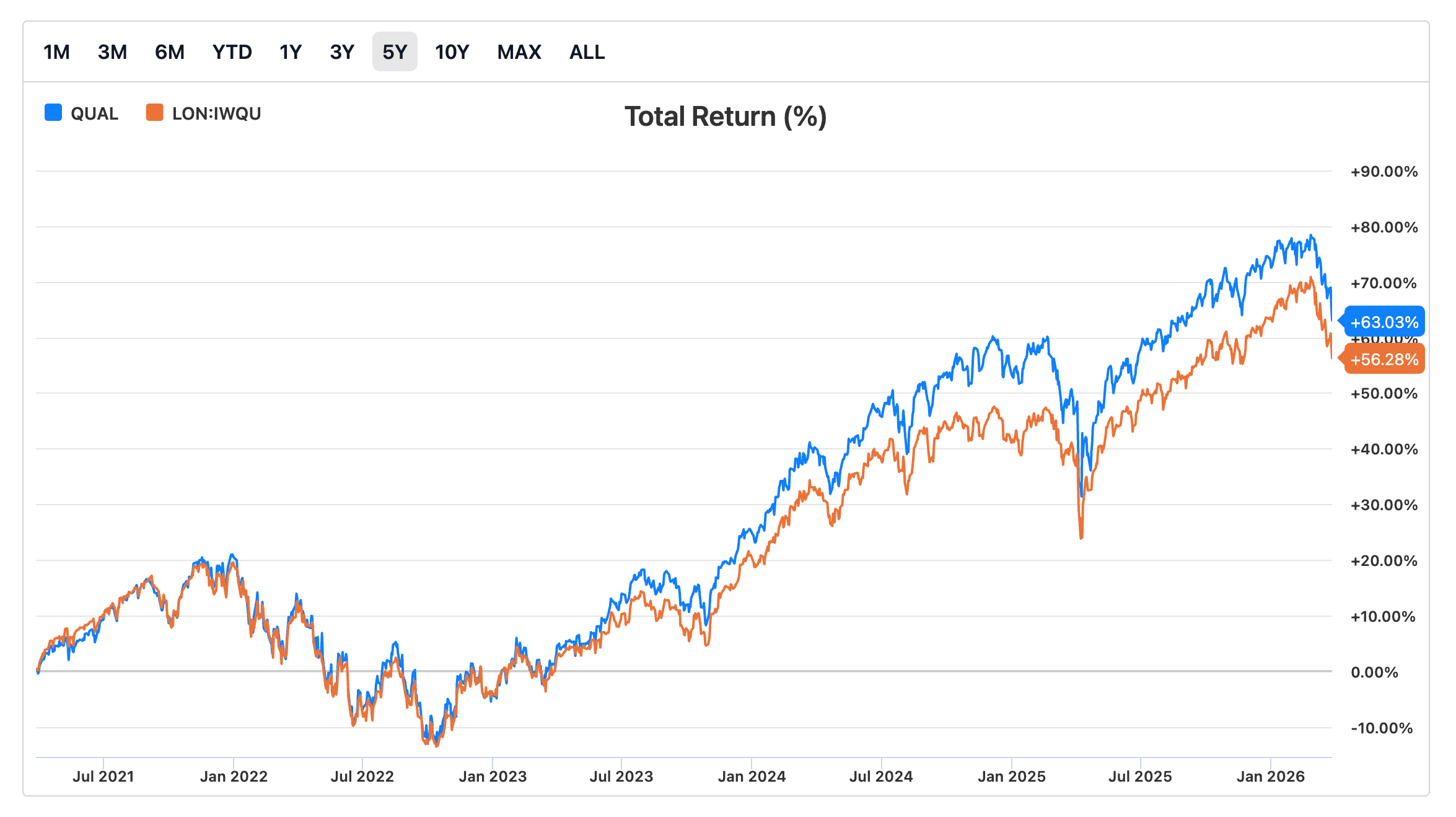
If you like QUAL's strategy but want broader geographic diversification, IWQU is the global sibling. It applies the same MSCI quality screen (high ROE, low debt, stable earnings) to the broader MSCI World index.
US companies still make up most of the fund, but it diversifies your exposure by including top-tier, high-quality international champions from Europe and Asia-Pacific, such as ASML and Novo Nordisk. Because US mega-caps rank so highly in global market cap and quality scores, the absolute top 5 overlap heavily with the US version.
- Ticker: IWQU (LSE, USD)
- Total Expense Ratio (TER): 0.25%
- Structure: Accumulating (Reinvests dividends)
- Top Holdings: Nvidia, Microsoft, Apple, Broadcom, Eli Lilly.
3. WisdomTree US Quality Dividend Growth UCITS ETF
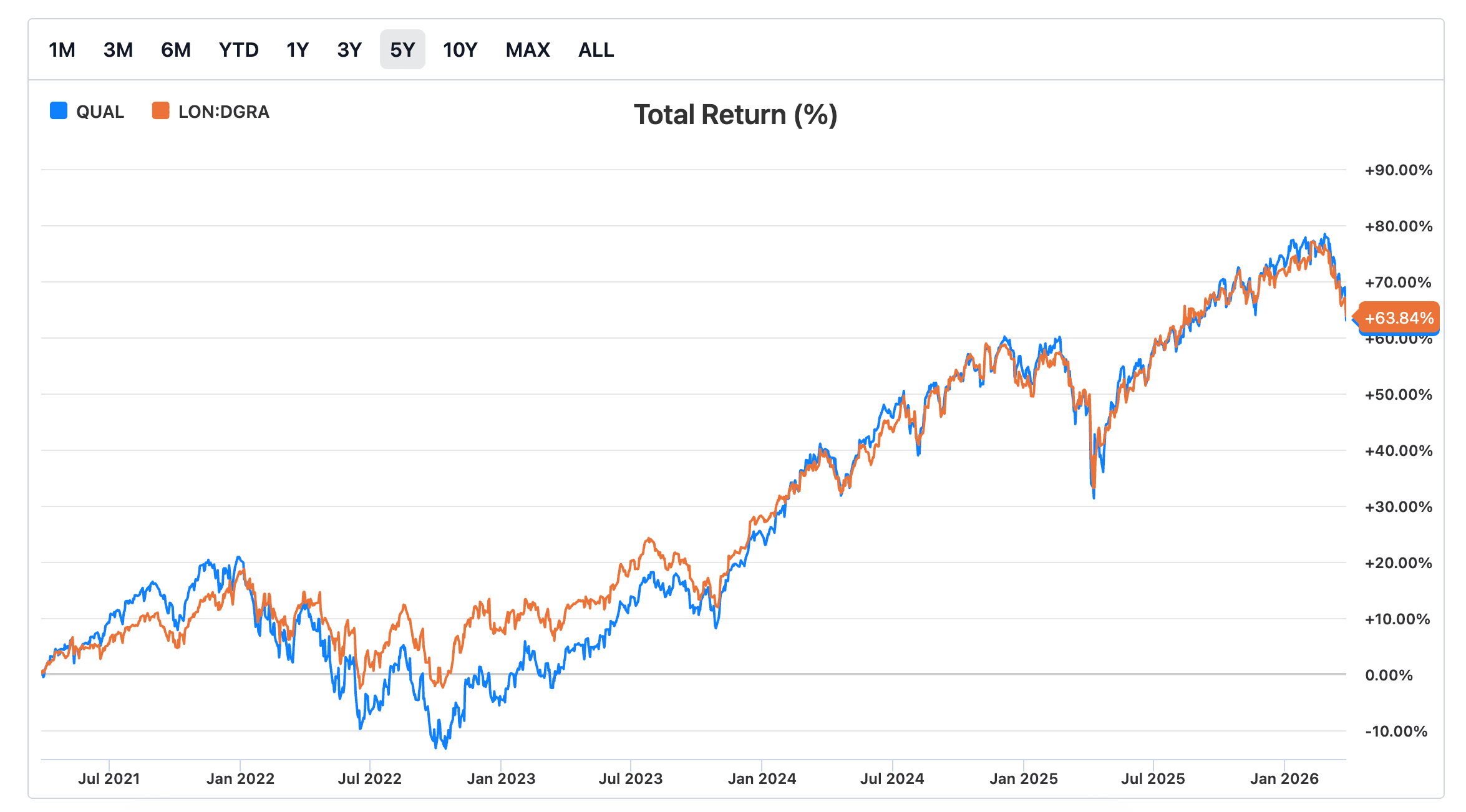
This fund offers a different methodology for capturing quality US companies. Although "Dividend" is in the name, it works as a quality fund: instead of MSCI's sector-neutral formula, its WisdomTree index screens US companies for long-term earnings growth expectations and historical return on equity (ROE) and return on assets (ROA).
This inherently filters out highly leveraged or fundamentally unstable companies. Even though it selects dividend-paying companies, this specific share class is Accumulating (Acc), meaning all cash flow is reinvested internally to maximize your tax-deferred growth.
- Ticker: DGRA (LSE, USD)
- Total Expense Ratio (TER): 0.33%
- Structure: Accumulating (Reinvests dividends)
- Top Holdings: Microsoft, Broadcom, Apple, Home Depot, Johnson & Johnson.
More UCITS alternatives: UCITS alternatives to MTUM and UCITS alternatives to AVUV.
Related: What are UCITS ETFs? and Should you switch from US ETFs to UCITS?
Invest in UCITS ETFs with Paasa
Paasa is a global investing platform designed for Indian residents and NRIs. We provide direct access to 11 markets: the US, Canada, the UK, Germany, France, Switzerland, the Netherlands, South Korea, Japan, Hong Kong and Singapore.
This means you are not restricted to just US ETFs like QUAL; you can also buy tax-efficient UCITS equivalents using Paasa.
The compliance advantage
Paasa makes global investing easy and also removes the compliance friction with a specialized layer built for Indian residents and NRIs:
- Schedule FA reporting: Exact reports you need for your Indian tax returns, eliminating the need for manual calculations.
- FEMA & LRS guidance: Guidance on FEMA regulations and LRS limits to ensure compliance.
Whether you are buying direct US stocks or investing in UCITS ETFs listed on European exchanges, Paasa provides global access with India-specific compliance and tax support.
Frequently Asked Questions
Does a UCITS version of the quality factor ETF track the same index as QUAL?
Yes. The iShares Edge MSCI USA Quality Factor UCITS ETF (IUQA) tracks the same MSCI USA Sector Neutral Quality Index as QUAL, so it holds a similar basket of US large and mid-cap stocks selected for high return on equity, stable earnings growth and low leverage.
Which QUAL alternative is cheapest?
IUQA is, at 0.20% a year. The global IWQU costs 0.25% and the WisdomTree US Quality Dividend Growth fund (DGRA) 0.33%.
Are these QUAL alternatives accumulating?
Yes. IUQA, IWQU and DGRA all reinvest dividends, so you pay no Indian tax on dividends until you sell.
Can I switch from QUAL to a UCITS alternative without paying tax?
No. Moving from QUAL to a UCITS fund means selling QUAL, and that sale is a taxable event in India. Gains on units held for more than 24 months are taxed as long-term capital gains at 12.5%, and gains on units held for 24 months or less are taxed at your income-tax slab rate. As a non-resident, you generally do not owe US capital gains tax on the sale.
How can I buy the iShares Edge MSCI USA Quality Factor UCITS ETF (IUQA)?
You can buy it through your Paasa account: search for IUQA, which trades on the London Stock Exchange in USD, and place a buy order.
How can I buy the iShares Edge MSCI World Quality Factor UCITS ETF (IWQU)?
You can buy it through your Paasa account: search for IWQU, which trades on the London Stock Exchange in USD, and place a buy order.
How can I buy the WisdomTree US Quality Dividend Growth UCITS ETF (DGRA)?
You can buy it through your Paasa account: search for DGRA, which trades on the London Stock Exchange in USD, and place a buy order.


Invest in global markets from India

Discussion
Disclaimer
The information provided in this post is for general informational purposes only. It is not intended as professional advice or to replace consultation with qualified professionals. While we strive to ensure the accuracy and reliability of the information presented, we make no representations or warranties of any kind, express or implied, about the completeness, accuracy, reliability, suitability, or availability with respect to the content contained herein. Any reliance you place on such information is therefore strictly at your own risk. We disclaim any liability for any loss or damage, including, without limitation, indirect or consequential loss or damage, or any loss or damage whatsoever arising from loss of data or profits arising out of, or in connection with, the use of this post. Always seek the advice of professionals or relevant authorities regarding your specific situation or circumstances.