


The FEMA 180-day rule says that any foreign currency that lands in your overseas account as realized income or proceeds must be either reinvested, spent on a legitimate purpose abroad, or repatriated to India within 180 days. Leave it sitting idle on Day 181, and you are in violation of the Foreign Exchange Management Act, 1999.
This guide explains exactly what triggers the rule, what counts as compliant use of the funds, what happens if you miss the deadline, and how the rule applies differently to NRIs and returning NRIs (RNORs).
Table of content
- What is the FEMA 180-day rule?
- What triggers the 180-day clock?
- What counts as using the money within 180 days?
- What happens if you violate the rule?
- Does the FEMA 180-day rule apply to NRIs?
- Does the FEMA 180-day rule apply to RNORs?
- FAQs
What is the FEMA 180-day rule?
The FEMA 180-day rule is a repatriation obligation under Indian foreign exchange law. It states that if you are a person resident in India and you receive foreign currency in an overseas account, you must dispose of that currency within 180 days by reinvesting it, spending it abroad on a permitted purpose, or bringing it back to India.

The rule applies to any form of realized foreign currency: sale proceeds from selling stocks, dividend income, interest income, salary from a foreign employer, or LRS funds you sent abroad but have not yet put to use.
The legal basis is Section 8 of the Foreign Exchange Management Act, 1999, read with Regulation 4 of the Foreign Exchange Management (Realisation, Repatriation and Surrender of Foreign Exchange) Regulations, 2015 (Notification No. FEMA 9(R)/2015-RB).
Example
You are a software professional in Bengaluru with a global brokerage account. On January 1, you receive a $1,000 dividend from your US stock holdings.
| Date | What happens | Status |
|---|---|---|
| January 1 | $1,000 dividend credited to your brokerage account | Clock starts |
| January 1 to June 29 | Cash sits idle in the account | Safe |
| June 30 (Day 180) | Option A: You buy $1,000 worth of Microsoft stock | Compliant. Clock stops. |
| June 30 (Day 180) | Option B: You wire $1,000 to your HDFC account in India | Compliant. Clock stops. |
| June 30 (Day 180) | Option C: You pay a $1,000 hotel bill while travelling in the US | Compliant. Clock stops. |
| July 1 (Day 181) | Cash is still sitting idle in the brokerage wallet | FEMA violation |
What triggers the 180-day clock?
The clock only starts when cash actually lands in your account. The key distinction is between realized and unrealized.
If your stock price goes up, that is an unrealized gain. No cash has entered your account and you can hold indefinitely.
The moment you have actual currency in your account from any of the events below, the clock starts.
| Event | Type | Clock |
|---|---|---|
| Stock price goes up | Unrealized gain | Not triggered. Hold indefinitely. |
| You sell a stock or ETF | Realized cash | Triggered from the date of settlement |
| Dividend credited to your account | Realized income | Triggered from the date of credit |
| Interest on idle cash balance | Realized income | Triggered from the date of credit |
| Salary from a foreign employer | Realized income | Triggered from the date of credit |
| LRS funds sent abroad that have not been invested or used | Remitted funds sitting idle | Triggered from the date of remittance |
Note: Each income or receipt event starts its own independent 180-day clock. If you receive a dividend in January and sell a stock in March, both clocks run simultaneously.
What counts as using the money within 180 days?
Three actions stop the clock and keep you compliant.
(A) Reinvest it. Buying any security (stocks, ETFs, bonds) with the idle cash converts it from realized cash into an investment holding. Once invested, it is no longer subject to the 180-day obligation because you no longer hold idle foreign currency.
(B) Repatriate it. Wire the funds back to your Indian bank account. This is a standard banking process and requires no prior RBI approval for legitimate earnings. For a detailed walkthrough of how repatriation works and what documentation you need, see our guide on tax on repatriation of foreign income to India.
(C) Spend it on a legitimate purpose abroad. Paying for hotel stays, travel, education fees, or medical expenses outside India counts as utilizing the funds. The money has been put to a permitted use and is no longer sitting idle.
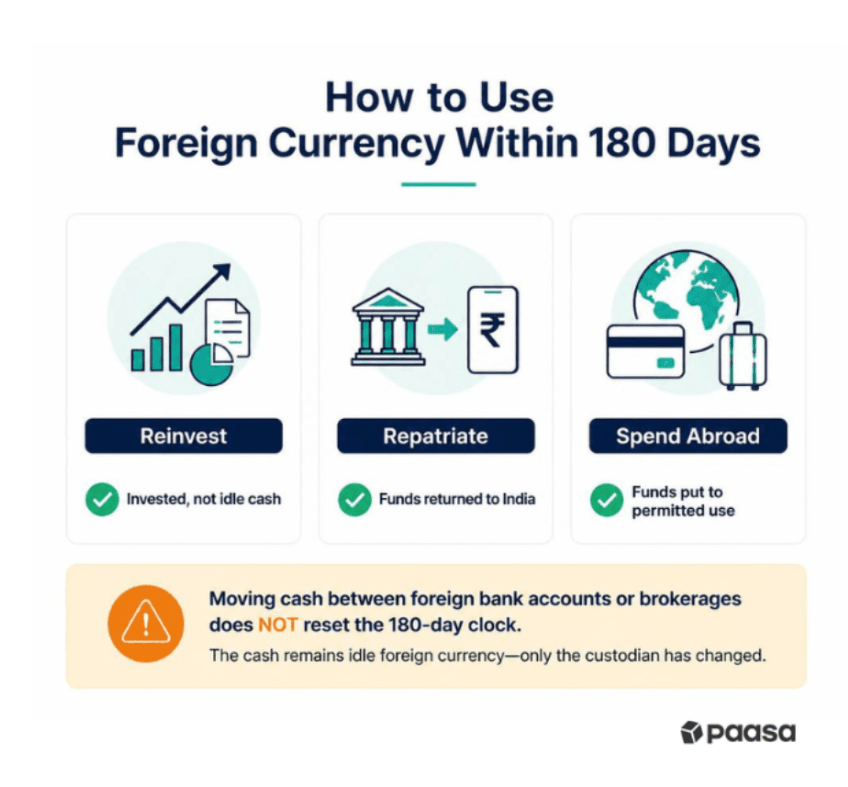
Note: Moving the cash to a different foreign bank account or a different brokerage does not stop the clock. The currency is still idle foreign exchange in your possession. Only the custodian has changed.
What happens if you violate the rule?
Holding foreign exchange beyond the permitted period is a contravention under FEMA.
Under Section 13 of FEMA 1999, the penalty for a violation can be up to three times the amount involved. If the amount cannot be quantified, the penalty can be up to ₹2 lakh. Where the violation continues beyond the initial penalty order, an additional penalty of up to ₹5,000 per day applies for each day the contravention continues.
Enforcement is carried out by the Enforcement Directorate (ED). In practice, violations are typically detected through banking data, FEMA audit trails at authorized dealer banks, and cross-referencing of brokerage account information.
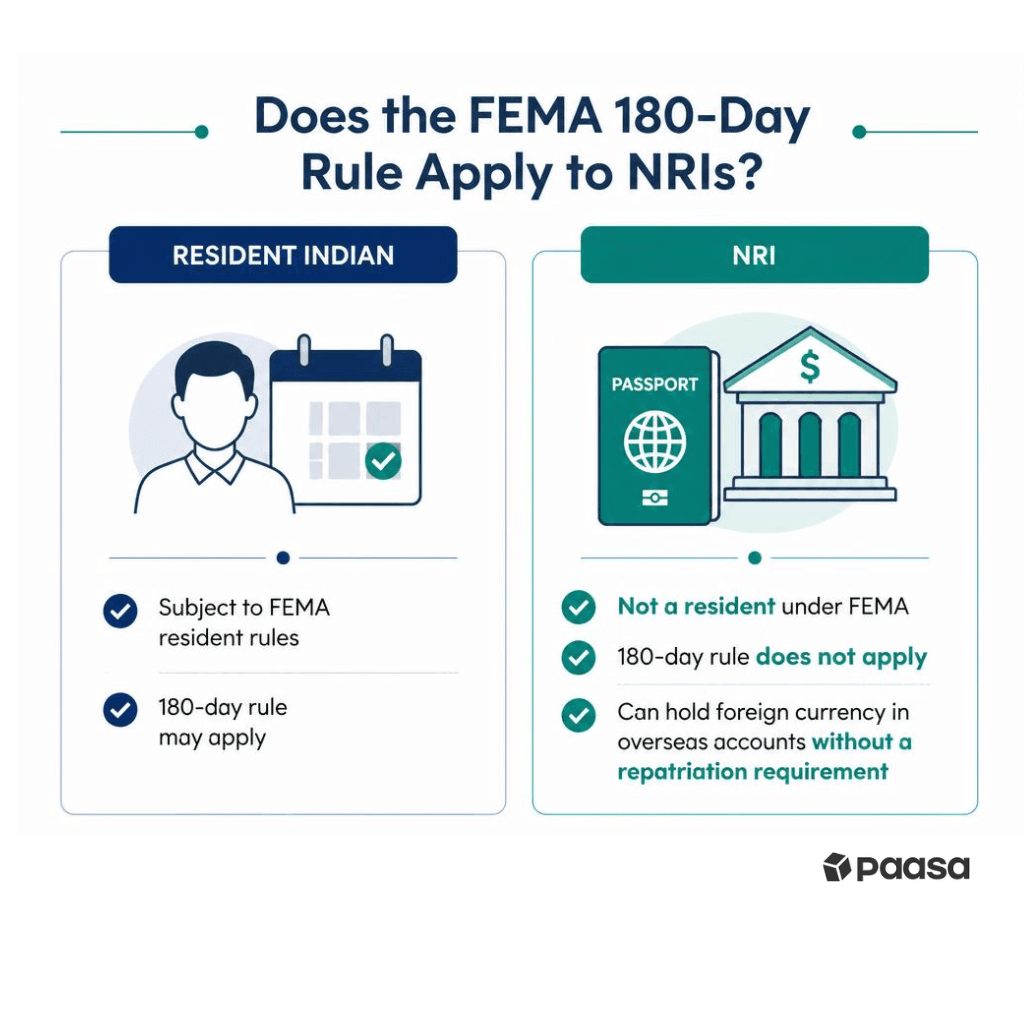
What does the FEMA 180-day rule apply to NRIs?
No. The FEMA 180-day rule applies to persons resident in India as defined under FEMA 1999. NRIs are non-residents under FEMA and are not subject to the same repatriation obligations.
As a non-resident, you can hold foreign currency in your overseas accounts for as long as you like without triggering any obligation to repatriate.
What does the FEMA 180-day rule apply to RNORs?
Yes. The moment you return to India and become a tax resident, FEMA's obligations apply to you, including the 180-day repatriation rule.
FEMA applies to all persons resident in India, and RNOR is a tax residency classification under the Income Tax Act.
For a full explanation of who qualifies as RNOR and what tax benefits the status carries, see our RNOR guide.
How Paasa helps
Paasa is the platform used by global Indian investors, HNIs, and family offices to diversify their wealth across markets in the US, UK, Europe, Japan, Singapore, and beyond.
On the compliance side, Paasa provides:
- Dedicated relationship manager for ongoing FEMA and remittance advisory
- Year-end tax documents including capital gains reports, dividend and interest statements, and a Schedule FA report calculated at SBI TT rates
- Tax loss harvesting and portfolio rebalancing support
- Guidance on in-kind transfers for investors moving holdings from another broker without triggering a sale
If you are an Indian resident with a global portfolio and want clarity on how the FEMA 180-day rule applies to your specific situation, speak to our team.

