


You have RSU shares sitting in your brokerage account and you are thinking about selling. Before you do, one number matters more than anything else: how long you have held the shares since they vested.
Depending on whether you are above or below the 24-month threshold, the tax on your gain can be your slab rate or a flat 12.5%. For someone in the 30% bracket, that difference is significant.
This guide explains how capital gains tax works on RSU shares, how to calculate what you owe, and what changes depending on when you sell.
Table of contents
- RSU shares are just foreign equity after vesting
- The 24-month rule
- What is your cost of acquisition?
- How to calculate your gain
- What if you have shares from multiple tranches?
- Sell-to-cover at vest
- How losses work
- How Paasa helps
RSU shares are just foreign equity after vesting
Once your RSUs vest and the shares land in your brokerage account, they are treated exactly like any other foreign-listed stock for capital gains purposes.
The fact that they came from RSUs, that your employer deducted TDS at vest, or that you paid nothing for them does not change how capital gains are calculated. The rules that apply are the same rules that apply to any Indian resident holding US or foreign equity, same holding period thresholds, same rates, same Schedule CG reporting in ITR.
The RSU-specific part ends at vest. Everything after that is standard foreign equity taxation.
The 24-month rule
For foreign-listed shares, the holding period that separates long-term from short-term is 24 months from the date of acquisition. For RSU shares, the date of acquisition is the vest date.
| Holding period from vest date | Classification | Tax rate |
|---|---|---|
| Up to 24 months | Short-term capital gains (STCG) | At your income slab rate |
| More than 24 months | Long-term capital gains (LTCG) | 12.5%, without indexation |
Note that this is different from Indian-listed shares, where the threshold is 12 months. RSU shares from companies listed on foreign exchanges follow the 24-month rule.
What is your cost of acquisition?
When your RSUs vest, the vest-day FMV is taxed as salary income (the perquisite). That same FMV in INR becomes your cost of acquisition for capital gains purposes. So when you sell, you are only taxed on the gain above the vest-day value, not on the full sale price.
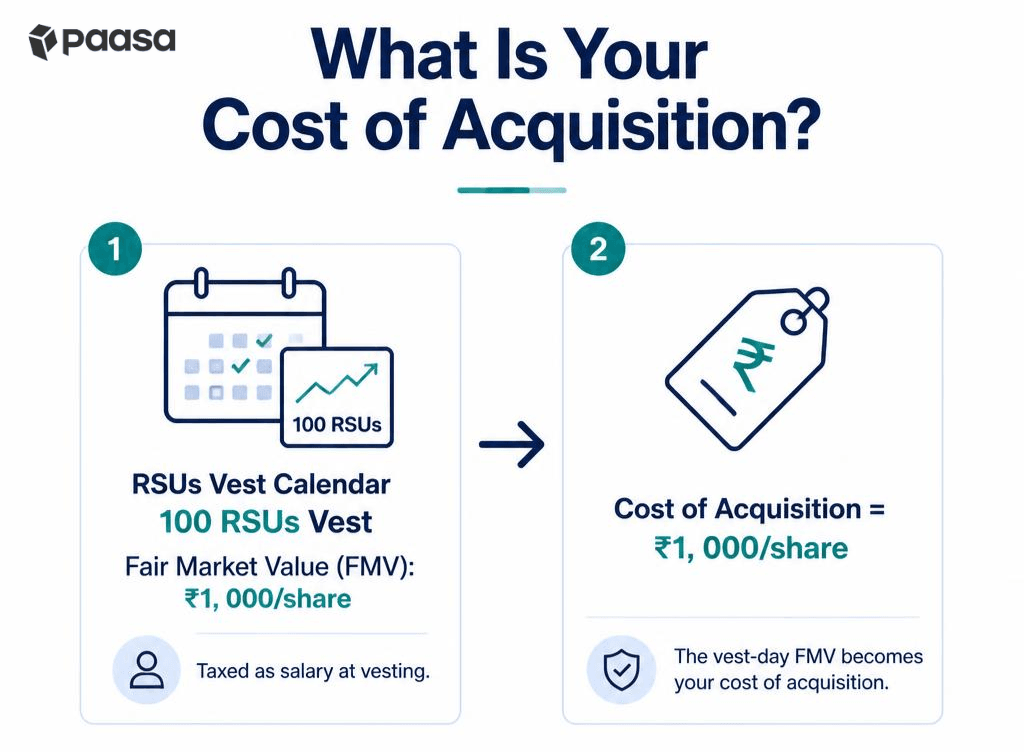
You are not taxed twice on the same amount. The perquisite income and the capital gain are two separate events with two separate starting points.
How the perquisite value is calculated and where it appears in your Form 16
How to calculate your gain
Sale proceeds are the sale price converted to INR using the SBI TTBR on the last day of the month preceding the month of sale.
Cost of acquisition is the vest-day FMV converted to INR using the SBI TTBR on the last day of the month preceding the month of vesting. This matches the perquisite figure in your Form 16.
Capital gain is sale proceeds minus cost of acquisition.
Why the SBI TTBR is used and how to find it
STCG Example
50 Google shares vest on September 10, 2025, at $212 per share. You sell all 50 on January 15, 2026, at $310 per share.
| Amount | Note | |
|---|---|---|
| Cost of acquisition (B) | ₹8,95,700 | 50 shares × $212 × ₹84.50, vest-day FMV already taxed as salary |
| Total sale proceeds | $15,500 | 50 shares × $310 |
| SBI TTBR on December 31, 2025 | ₹86.00 per dollar | Last day of month preceding January |
| Sale proceeds in INR (A) | ₹13,33,000 | |
| Capital gain (A minus B) | ₹4,37,300 | |
| Holding period | 4 months | September 10, 2025 to January 15, 2026 |
| Classification | STCG | Under 24 months |
| Tax at 30% slab rate | ₹1,31,190 | |
| Surcharge at 10% | ₹13,119 | Applicable if total income is ₹50L–₹1Cr |
| Health and education cess at 4% | ₹5,772 | On tax + surcharge |
| Total tax | ₹1,50,081 |
LTCG Example
25 Google shares vest on June 10, 2023, at $126 per share. You sell all 25 on September 15, 2025, at $218 per share.
| Amount | Note | |
|---|---|---|
| Cost of acquisition (B) | ₹2,60,100 | 25 shares × $126 × ₹82.50, SBI TTBR on May 31, 2023 |
| Total sale proceeds | $5,450 | 25 shares × $218 |
| SBI TTBR on August 31, 2025 | ₹84.50 per dollar | Last day of month preceding September |
| Sale proceeds in INR (A) | ₹4,60,525 | |
| Capital gain (A minus B) | ₹2,00,425 | |
| Holding period | 27 months | June 10, 2023 to September 15, 2025 |
| Classification | LTCG | Over 24 months |
| Tax at 12.5% | ₹25,053 | |
| Surcharge at 10% | ₹2,505 | |
| Health and education cess at 4% | ₹1,102 | On tax + surcharge |
| Total tax | ₹28,660 |
What if you have shares from multiple tranches?
Each tranche has its own vest date and its own 24-month clock. They are treated completely independently.
If you have 25 shares from June 2023 and 50 shares from September 2025 in the same brokerage account, selling in January 2026 means:
- The June 2023 tranche has been held for 31 months — LTCG at 12.5%
- The September 2025 tranche has been held for 4 months — STCG at your slab rate
When you sell, you need to know which tranche's shares you are selling. Most brokers follow FIFO (first in, first out) by default, meaning the oldest shares are sold first. Check your broker's default and confirm before placing a sell order if you want to control which tranche you are selling from.
In ITR-2, each tranche is reported as a separate line under Schedule CG with its own cost of acquisition, sale price, and classification.
Sell-to-cover at vest
Many employers automatically sell a portion of your vested shares on vest day to cover the TDS liability. These shares are sold on the same day they vest, so the holding period is effectively zero.
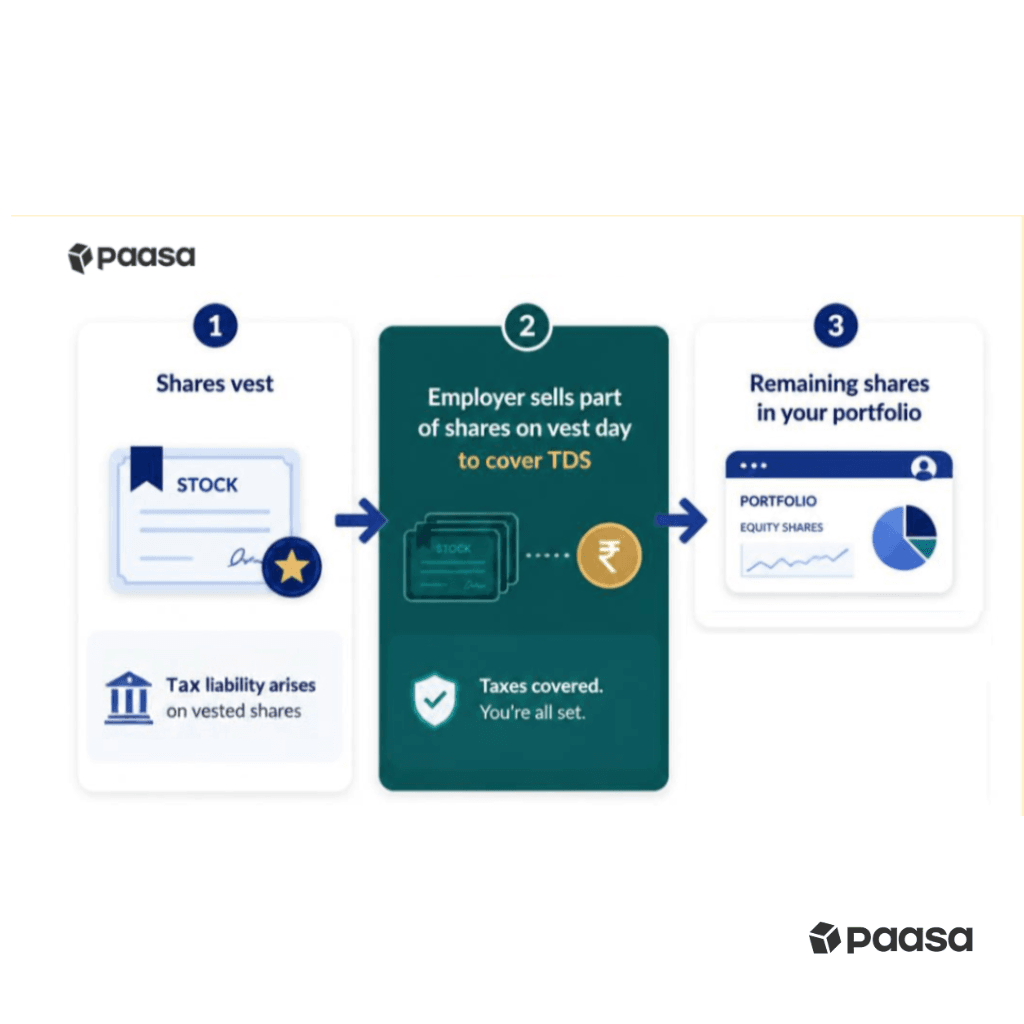
Any difference between the sale price and the perquisite value (which is calculated using the same day's FMV) will typically be very small, usually a few rupees per share due to intraday price movement. This difference is technically STCG but in practice is negligible. Your employer handles this and it will be reflected in your Form 16.
The shares that remain in your account after sell-to-cover are the ones whose 24-month clock starts from vest date.
How losses work
If you sell RSU shares at a loss, the loss can be set off against other capital gains in the same year.
If your total capital losses exceed your total capital gains for the year, the remaining loss can be carried forward for up to eight assessment years and set off against future capital gains of the same or lower classification.
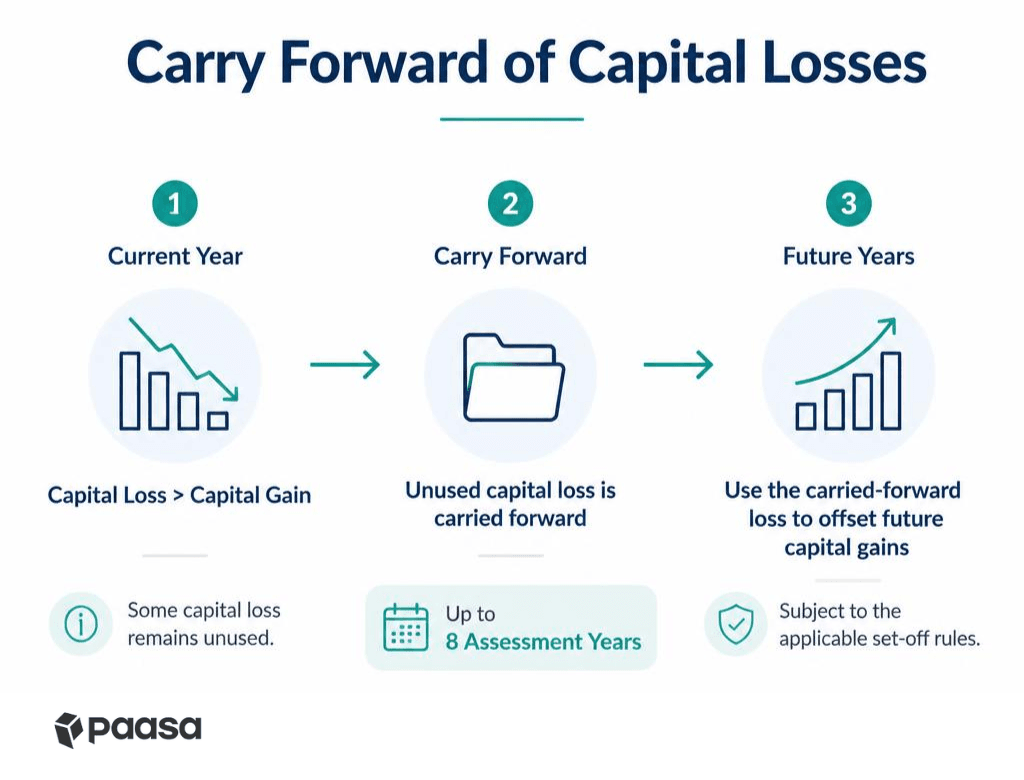
The only restriction is that global long-term loss cannot be adjusted against Indian short-term gains.
Important Notes:
- Same Head Only: You cannot set off these capital losses against your Salary or Business Income.
- Carry Forward: If your total losses exceed your total gains for the year, you can carry the remaining loss forward for 8 years to offset future gains.
- Mandatory Reporting: To claim this set-off and carry forward, you must file your Income Tax Return (ITR-2/3) on or before the due date (usually July 31). If you file a "Belated Return," you lose the right to carry forward losses.
How Paasa helps
Paasa records every vest date, tranche, and conversion rate as it happens. When you sell, your cost of acquisition, holding period, and gain classification are already calculated; across all tranches, in INR, ready for Schedule CG. You do not need to reconstruct months of broker statements to file correctly.

