
If part of your pay comes as company shares, you're already a global investor, whether you meant to be one or not. This module is built specifically for RSU holders. It walks through the full lifecycle of an RSU from grant to sale, how it is taxed, and the problems unique to them.
RSU stands for Restricted Stock Unit. It is a promise from your employer to give you a certain number of company shares in the future, provided you stay and meet certain conditions. You are promised the shares, but you cannot have them yet; they are restricted until you have earned them over time.
Two features distinguish RSUs from other kinds of equity pay. First, you pay nothing for them. Unlike stock options (ESOPs), where you must pay a price to buy the shares, RSUs are simply given to you as part of your compensation, at no cost. Second, until they convert into real shares, an RSU is only a bookkeeping entry, a unit, not a share. It has no market value you can access, you cannot sell it, and you do not receive dividends or votes on it.
An RSU's life has three distinct moments.
All of the steps above have significance for your portfolio and taxation considerations, which we'll unpack in this chapter and the ones that follow.
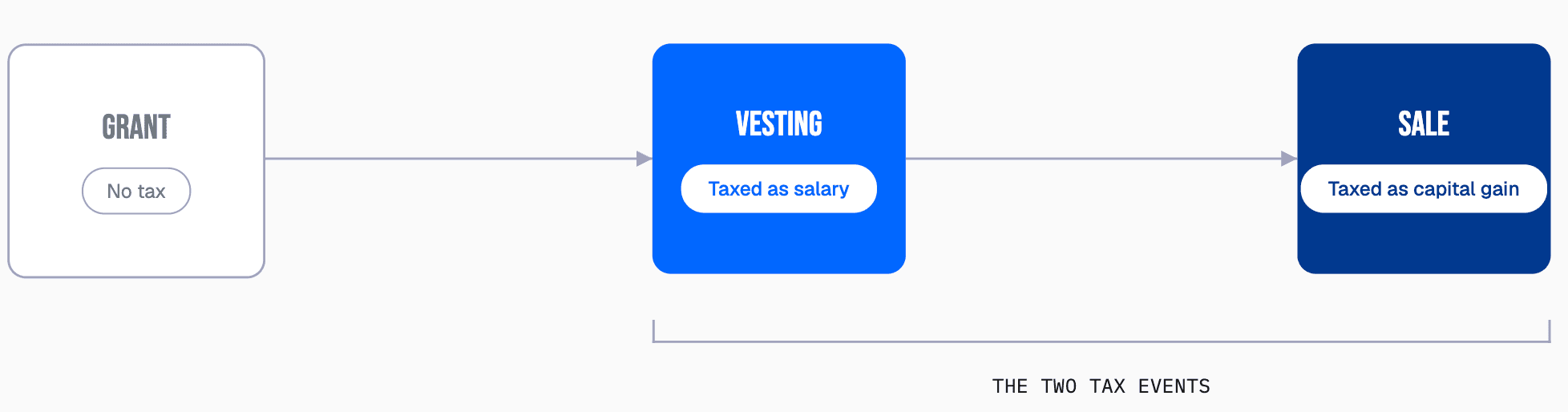
Here is the single most useful thing to fix in your mind before anything else. An RSU passes through three stages, but it is taxed at only two of them.
At grant, nothing is taxed, since the income is not yet generated. It is a tax non-event. At vesting, the first tax hits: the moment your units convert to shares you own, the value of those shares is treated as income, essentially as part of your salary, and taxed accordingly. This happens whether or not you sell anything.
At sale, the second tax hits: any gain in value since vesting is taxed as a capital gain, a separate tax from the first, on a different thing, the growth after vesting rather than the value at vesting.
Between grant and vesting sits the vesting schedule, the timetable that decides when your units convert to shares. The most common arrangement at large tech companies is a four-year schedule with a one-year cliff.
A cliff means that for the first year, nothing vests at all. If you leave before your one-year anniversary, you walk away with nothing from the grant. But on that first anniversary, a large chunk vests all at once, typically a quarter of the whole grant. Each company treats the vesting schedule differently based on internal policies and priorities which is why the grant is worth reading carefully the day you receive it: how many units, on what schedule, with what conditions.
The flip side of the vesting schedule is forfeiture. Because you earn RSUs by staying, leaving early means giving up what you have not yet earned. Shares that have already vested are yours to keep. But any units that have not yet vested are generally lost the moment you leave the company. They simply return to the employer.
Vesting in practice: becoming an owner, and sell-to-cover
Vesting is where the lifecycle becomes active, because a tax bill is triggered immediately, on the value of those shares, and it usually has to be paid straight away. This creates a practical problem: you have just received shares, not cash, but you owe tax. Where does the money come from?
The common answer is a mechanism called sell-to-cover. Under sell-to-cover, your employer sells a portion of the shares, right at vesting, and uses the proceeds to pay the tax on your behalf. A slice is sold off the top to cover the tax, and the rest lands in your account.
With the lifecycle now clear, we turn next to the mechanics of taxation for RSU holders.
One question. Less than 10 seconds.
Reinforce what you've learned before continuing to the next chapter.






Discussion