
If part of your pay comes as company shares, you're already a global investor, whether you meant to be one or not. This module is built specifically for RSU holders. It walks through the full lifecycle of an RSU from grant to sale, how it is taxed, and the problems unique to them.
We learnt that the RSU lifecycle involves two taxation stages: first, at vesting and second, at sale. The first time at vesting is the one most misunderstood, because it taxes you on money you have not received in cash and may not have sold.
When your RSUs vest, the value of the shares you receive is treated as salary income. Therefore it is taxed the same way your salary is: added to your total income for the year and taxed at your applicable income tax slab rate. The technical name for this is a perquisite, a benefit provided by your employer that counts as part of your salary income.
The amount taxed at vesting is the fair market value, the FMV, of the shares on the vesting date. So the tax is based on what the shares were worth the moment you received them, not what they were worth when granted. If 100 shares vest on a given day and each is worth a certain price that day, the full value of those 100 shares at that day's price is your perquisite income.
Because your shares are in a foreign company, priced in a foreign currency, that FMV has to be converted into rupees to be taxed in India. The conversion uses a defined rate, the SBI TT buying rate on the vesting date, so the foreign value becomes a rupee value, and it is that rupee figure that is added to your salary income.
The tax at vesting is usually collected at the moment of vesting, and this makes the sell-to-cover mechanism critical to know about.
Because vested RSUs are salary, your employer is responsible for deducting tax on them, through TDS (tax deducted at source), under Section 192. In practice, the employer typically arranges for a portion of the vesting shares to be sold immediately, and uses the proceeds to deposit this TDS with the tax authorities on your behalf. You can see the deducted amount reflected in your Form 16, the same salary tax document that shows TDS on your regular pay.
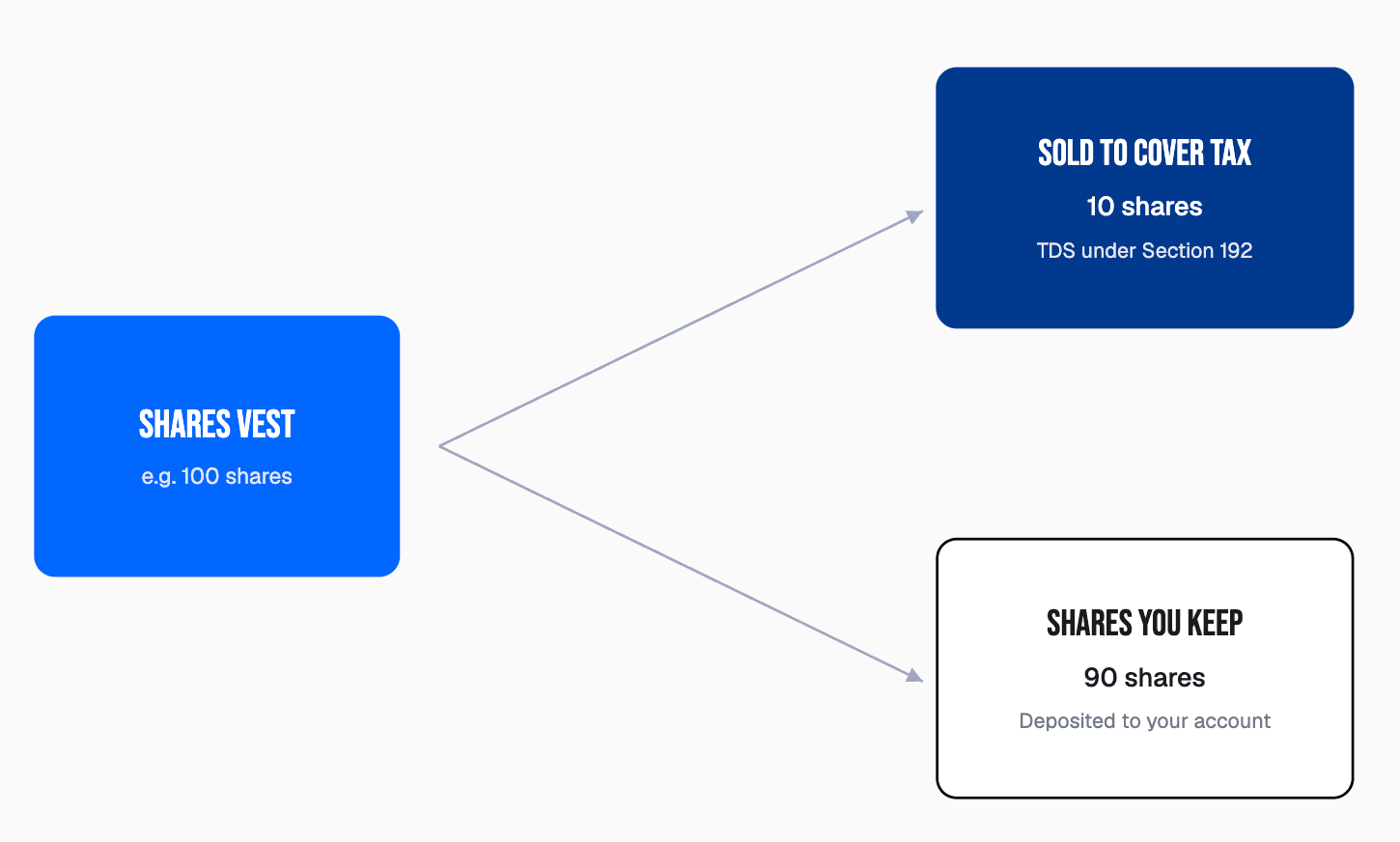
If RSUs vested under two employers in the same year, say you switched jobs mid-year, the perquisite figures from both Form 16s are combined when you file, in Schedule S of your return. And if your employer gets the perquisite figure wrong, they can issue a revised Form 16, but this has to be sorted out before you file, not after.
You are taxed at vesting even if you do not sell a single share and hold all of them. If you decide to hold, believing in the company's future, you still owe the vesting tax now, in cash, on shares you have not turned into cash.
Because the tax is locked to the vesting-date value, a later fall in the share price does not reduce it. If your shares vest at a high price, you are taxed on that high value, and if the stock then drops before you sell, you can end up having paid tax on value that no longer exists.
The TDS deducted at vesting is an estimate, and it may not equal your actual tax liability. Your true tax on the perquisite depends on your total income for the year and your exact slab, surcharge, and cess, and the employer's withholding may fall short of that. So even after sell-to-cover has taken its slice, you may still owe additional tax on your vested RSUs when you file, which you would settle through advance tax or at filing.
One question. Less than 10 seconds.
Reinforce what you've learned before continuing to the next chapter.






Discussion