
If part of your pay comes as company shares, you're already a global investor, whether you meant to be one or not. This module is built specifically for RSU holders. It walks through the full lifecycle of an RSU from grant to sale, how it is taxed, and the problems unique to them.
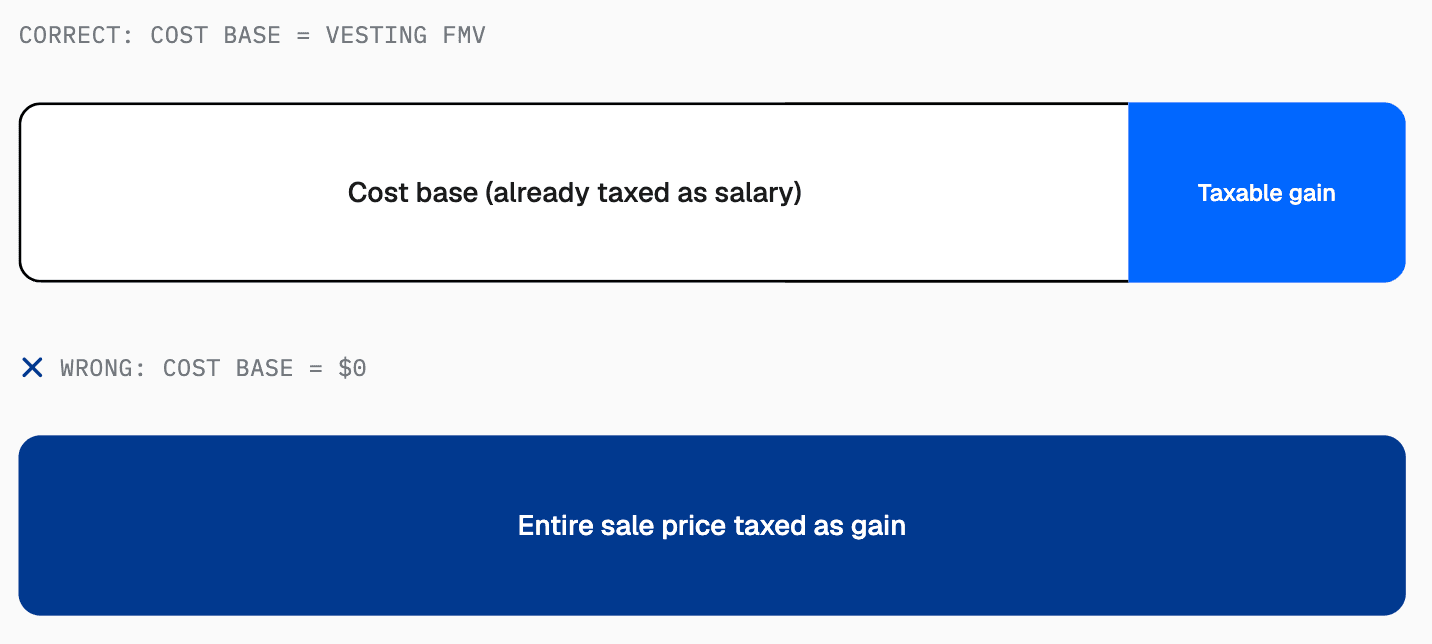
At vesting, you were taxed on the full value of the shares as salary. At sale, you are taxed only on the growth in value since vesting, not on the wholesale price again. The only new thing that has happened between vesting and sale is that the shares may have risen or fallen in price. That change in value is the capital gain (or loss) and it is the only amount taxed at this second event.
Your cost of acquisition for RSU shares is the fair market value on the vesting date, the same figure that was taxed as salary, before any shares were sold to cover tax. Because the full vesting-date value was already taxed as your salary, the law treats that value as what you effectively "paid," so your cost base is the vesting-date FMV, not zero. Your capital gain is the sale price minus that vesting-date value, and nothing more.
Example: Say your shares vest when the price is $100 each. That $100 was already taxed as salary, so it becomes your cost base. If you later sell at $130, your taxable gain is $30 per share, the growth since vesting, not the full $130. And if the price instead falls to $70 by the time you sell, you don't owe tax at all on that sale, you have a capital loss of $30 per share instead, since you sold for less than your cost base. Either way, the $100 you were already taxed on at vesting is never taxed again. Only the movement from that point forward matters, up or down.
Unlike vesting, where your employer withholds tax before you see the shares, the sale itself carries no TDS at all in India. Nobody deducts anything at the point of sale. The gain simply becomes part of your income for the year which is exactly why it turns into an advance tax obligation rather than something already handled.
How much tax you pay on that gain depends, as with any foreign share, on how long you held the shares after vesting. And the holding clock starts at vesting, the day you became the owner, not at grant. The dividing line for foreign shares is 24 months. If you sell within 24 months of vesting, your gain is short-term, added to your income and taxed at your slab rate, which for a high earner is the least favourable outcome. If you hold for more than 24 months after vesting before selling, your gain is long-term, taxed at the flat 12.5%, with no indexation.
If you have vested shares from more than one date, which is the normal case once you have been at a company for a couple of years, and you sell only part of your holding, you need to know which shares are being sold. By default, brokers treat the earliest-vested shares as sold first, a method called FIFO, first in, first out. This matters because your oldest tranche is the one most likely to have crossed the 24-month line into long-term treatment, so a FIFO sale often works in your favour. Some brokers allow you to choose specific lots instead, which is worth knowing if you would rather sell a short-term tranche and hold onto a long-term one, or vice versa.
Because the shares and their prices are in a foreign currency, the gain must be worked out in rupees, using defined conversion rates for both the vesting-date value and the sale-date proceeds. If the rupee weakens between vesting and sale, that currency effect is captured inside the rupee gain automatically, and it is the rupee figure that is taxed. So a modest gain in dollar terms can be a larger gain in rupee terms, or even a dollar loss can show up as a rupee gain, purely because of currency movement over the holding period.
If a sale results in a loss rather than a gain, that loss is not wasted. A short-term loss on your RSU shares can be set off against short-term or long-term capital gains, and this is not limited to your foreign holdings, it can offset gains from your ordinary Indian stock portfolio too. A long-term RSU loss is more restricted and can only be set off against long-term gains. So a bad year for one part of your portfolio can genuinely reduce the tax bill on a good year elsewhere.
If you sell your shares immediately at vesting, or very soon after, there is little or no capital gain to tax, because the price has barely moved since vesting. In that case, the vesting tax as salary is effectively the only tax you pay.
One question. Less than 10 seconds.
Reinforce what you've learned before continuing to the next chapter.






Discussion