
If part of your pay comes as company shares, you're already a global investor, whether you meant to be one or not. This module is built specifically for RSU holders. It walks through the full lifecycle of an RSU from grant to sale, how it is taxed, and the problems unique to them.
Holding RSUs exposes you to two critical risks: Concentration and US Estate Tax. This chapter is about concentration, and recognising it is the beginning of managing your RSUs wisely rather than just passively accumulating them.
The RSU holder has a deeper problem: their savings and their salary are tied to the same company. Your monthly income comes from your employer. And your RSUs, which over years can grow into a large part of your net worth, are shares in that same employer. If that company hits a rough patch, two things can go wrong at once: the stock falls, shrinking your savings, and the company may cut pay, freeze hiring, or lay people off, threatening your income.
This is a fundamentally different and worse kind of risk than an ordinary investor carries. Someone who simply owns shares in a company they do not work for risks only their investment if that company stumbles. Your human capital and your financial capital are correlated when they should be independent. That correlation is the heart of the concentration problem.
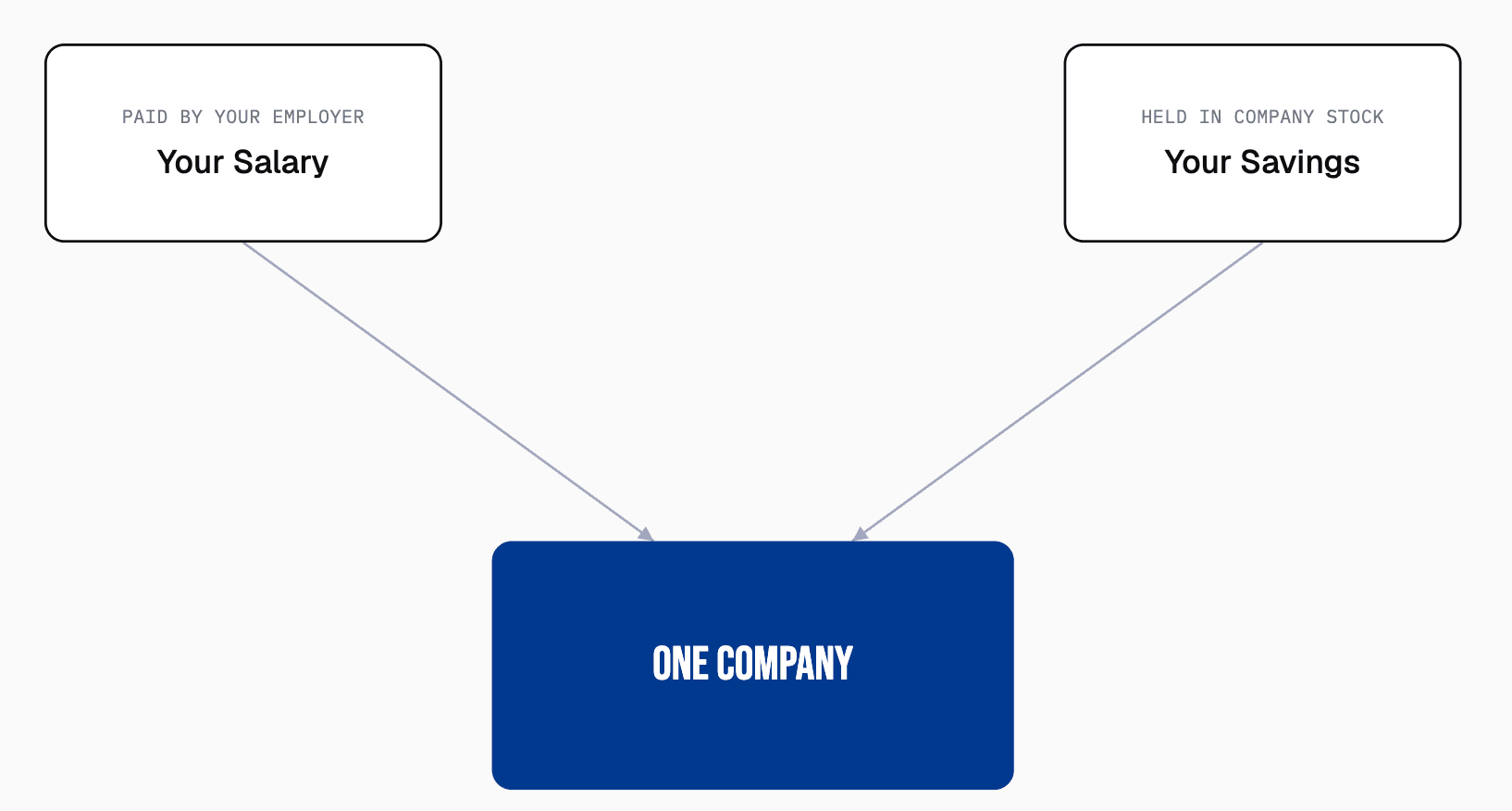
You do not choose to become concentrated; you simply keep working, and each vesting date quietly adds more of your own company's stock to your holdings. Several forces push you to hold rather than sell. There is loyalty and belief in the company you work for. There is the feeling that selling your own company's stock is somehow disloyal or pessimistic. There is inertia, holding requires no action, selling requires a decision. So the default path, doing nothing, leads straight into deeper and deeper concentration, which is exactly the wrong direction.
A common rule of thumb is that no single stock should make up more than 25 to 30% of your net worth. Beyond that, your financial fate is too tightly bound to one company's fortunes. For an RSU holder, this line is easy to cross without noticing, because vesting keeps adding to the position while you are not looking.
The issue is not that you hold your company's stock. The issue is that you hold too much of it, undiversified. The solution follows directly: reduce the concentration, without necessarily abandoning global equity altogether. The wise move is usually to sell some of the concentrated position and redeploy that money into a diversified holding, a broad index fund or ETF, so that you remain invested in equities, and remain invested globally, but spread across hundreds of companies instead of anchored to one.
One question. Less than 10 seconds.
Reinforce what you've learned before continuing to the next chapter.






Discussion