
If part of your pay comes as company shares, you're already a global investor, whether you meant to be one or not. This module is built specifically for RSU holders. It walks through the full lifecycle of an RSU from grant to sale, how it is taxed, and the problems unique to them.
Imagine your employer had paid you a cash bonus today instead of shares. Would you take that cash and use it to buy shares of your own company? If the answer is no, then holding your vested RSUs is the same decision and you have just decided you would not do that.
The simplest and, for most people, most effective strategy is to sell your shares as they vest and reinvest the proceeds into a diversified portfolio.
Recall from earlier chapters that at vesting you are taxed on the full value as salary, and that value becomes your cost base. So if you sell immediately at vesting, the sale price is almost identical to your cost base, which means there is little or no capital gain, and therefore almost no second tax. You convert the shares to cash cleanly and efficiently, then reinvest that cash into a broad, diversified holding, an index fund or ETF spread across hundreds of companies. You remain fully invested, still in equities and dollars.
Because it happens at each vesting, it prevents concentration from ever building up in the first place.
What if you already have a large, concentrated position that has built up over years, with substantial gains? Selling all of it at once would work, but it could trigger a large capital gains tax bill in a single year, and it exposes you to the bad luck of selling everything on one possibly poor day.
The answer is phased selling, sometimes called systematic diversification. Instead of selling everything at once, you sell down the position gradually, a set portion at a time, over a period of months or across tax years. This does two useful things. It spreads the capital gains across more than one year, which can soften the tax impact, and it averages out your selling price, so you are not betting everything on the level of the stock on a single day.
Selling is not the only way to act on a concentrated position. If your goal is simply to get your RSUs out of your employer's equity plan and into a brokerage where you can manage them properly, you can often transfer the shares across in-kind, without triggering a sale at all, through the ACATS process covered here earlier. This works from the major employer plans and brokers RSU holders typically deal with, think Fidelity, Schwab, Morgan Stanley, and similar platforms, and it means the shares arrive intact rather than being liquidated and re-bought.
The proceeds of your RSU sales should be reinvested into broad, diversified holdings, the kind covered elsewhere in this course: low-cost index funds or ETFs that spread your money across hundreds of companies. It is also a natural opportunity to build the globally diversified portfolio you actually want to and choose products like UCITS ETFs that also address the estate exposure from the last chapter.
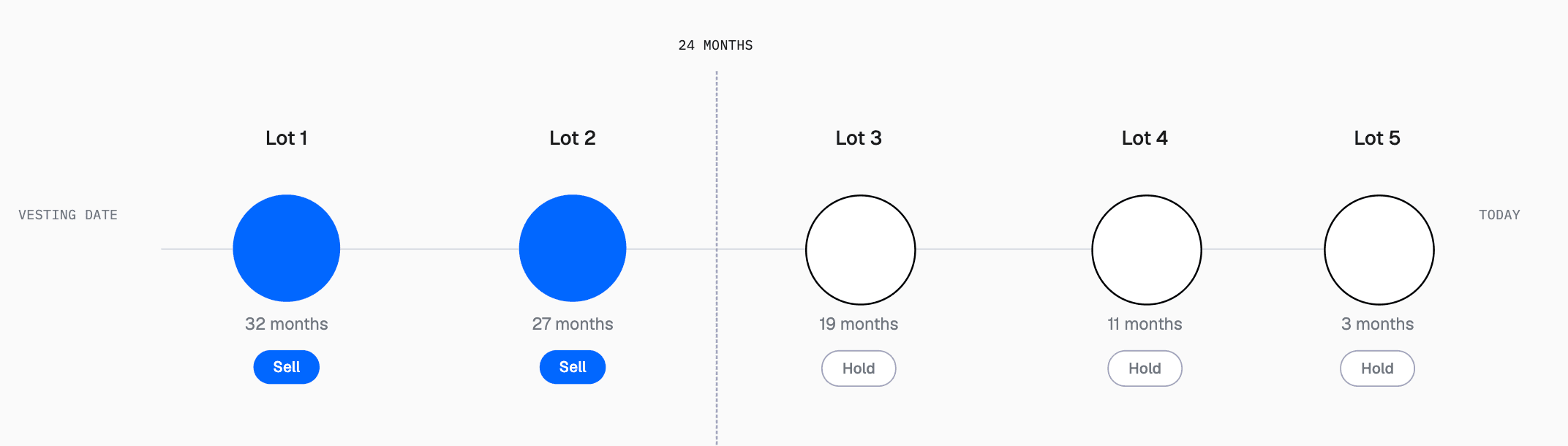
The first is holding winners. When the stock has risen, selling feels like leaving money on the table, so people hold. The second is refusing to sell at a loss. When the stock has fallen, selling feels like admitting defeat, so people wait for it to "come back." From a tax view, a loss can even be useful, since it can offset other gains. The third is over-optimising for tax. Some people hold shares purely to reach the long-term holding period and the lower rate, even when the concentration risk of waiting outweighs the tax saved.
The common thread is that all three traps push you toward holding, which is the direction of greater risk. Recognising that your instincts will usually argue for holding, and that a pre-set rule exists precisely to overrule those instincts, is the essence of managing RSUs well.
One question. Less than 10 seconds.
Reinforce what you've learned before continuing to the next chapter.






Discussion