
If part of your pay comes as company shares, you're already a global investor, whether you meant to be one or not. This module is built specifically for RSU holders. It walks through the full lifecycle of an RSU from grant to sale, how it is taxed, and the problems unique to them.
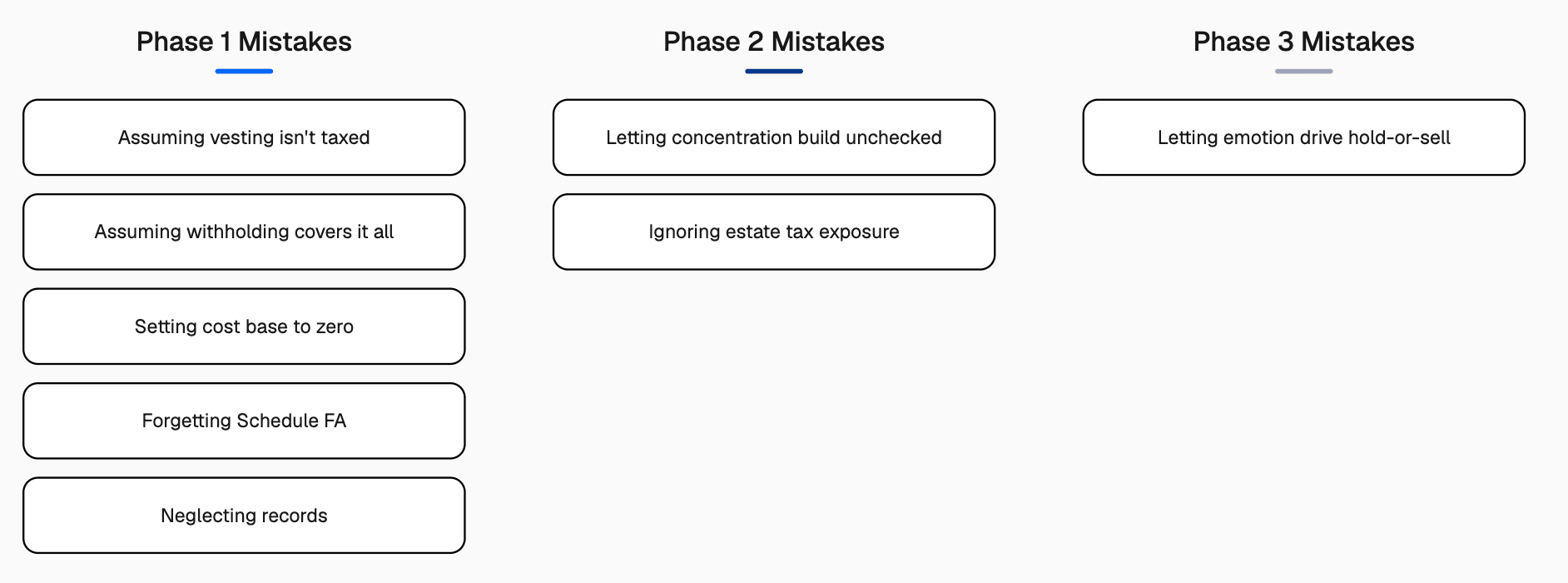
We will close the RSU journey by gathering the mistakes RSU holders most commonly make, organized the same way we understood everything about RSUs: mechanics and taxation, risks, and de-risking.
1. Assuming vesting is not taxable until you sell. The most common misconception of all is thinking RSUs are taxed only when you sell them. They are not. Vesting itself is a taxable event, taxed as salary on the full value of the shares, whether or not you sell a single one. People who believe otherwise fail to set aside money for the vesting tax and are blindsided when the bill, or the sell-to-cover, arrives. Remember the two tax events: salary at vesting, capital gain at sale.
2. Assuming the employer's withholding covers your full tax. Because your employer deducts tax at vesting through sell-to-cover, it is tempting to assume the tax is fully handled. It often is not. That withholding is an estimate, and if your actual slab, surcharge, and total income push your liability higher, you will owe more at filing. Treating the employer's deduction as the final word leads to a shortfall you have to scramble to cover. Set aside a buffer, and check that what was withheld matches what you actually owe.
3. Setting your cost base to zero. Because RSUs were given to you free, some assume their cost base is zero, which would make the entire sale price a taxable gain. It is not. Your cost base is the vesting-date value that was already taxed as salary, so only the growth since vesting is a capital gain. Remember: the value taxed at vesting becomes your cost, and the sale is taxed only on what came after.
4. Forgetting Schedule FA entirely. The moment your shares vest, you hold a foreign asset, and you must disclose it in Schedule FA every year, on ITR-2 or ITR-3, whether or not you sold or earned anything. Filing the simple ITR-1, or omitting the disclosure, counts as non-disclosure and can attract a flat penalty of 10 lakh rupees per year under the Black Money Act.
5. Neglecting records and vesting dates. Without a record of each vesting date, the FMV on that date, and the tax withheld, you cannot correctly compute your cost base, your capital gains, or your Schedule FA values later. Keep your grant letters, vesting statements, and sale records, or use a platform that assembles them for you.
6. Letting concentration build unchecked. Because vesting keeps adding company stock and holding requires no action, an RSU holder can drift into having a dangerous share of their net worth in one stock, without ever deciding to take that bet. Check your concentration periodically, and diversify down when it climbs too high.
7. Ignoring the estate tax exposure. A large, directly held position in a US company carries US estate tax exposure above a low $60,000 threshold, at rates up to 40%, with no relief from the India-US income tax treaty. RSU holders are the most exposed of anyone and the least aware, because the asset was handed to them rather than chosen. Diversify down the direct position, and consider non-US-domiciled wrappers like UCITS ETFs for ongoing US exposure as the holding grows.
8. Letting emotion drive the hold-or-sell decision. Holding winners because selling feels like missing out, clinging to losers waiting for a recovery that is not owed, or holding purely to reach the long-term tax rate even when the concentration risk outweighs the saving, all of these push you toward holding, which is the direction of greater risk. A pre-set selling rule is the single most reliable defence against your own instincts.
One question. Less than 10 seconds.
Reinforce what you've learned before continuing to the next chapter.






Discussion