
When you invest abroad, a second country often taxes you too, before India ever gets involved. This module explains that foreign layer, dividend withholding, the treaty and foreign tax credit that stop you being taxed twice, and US estate tax, and ends by comparing the routes on their full, two-sided tax picture.
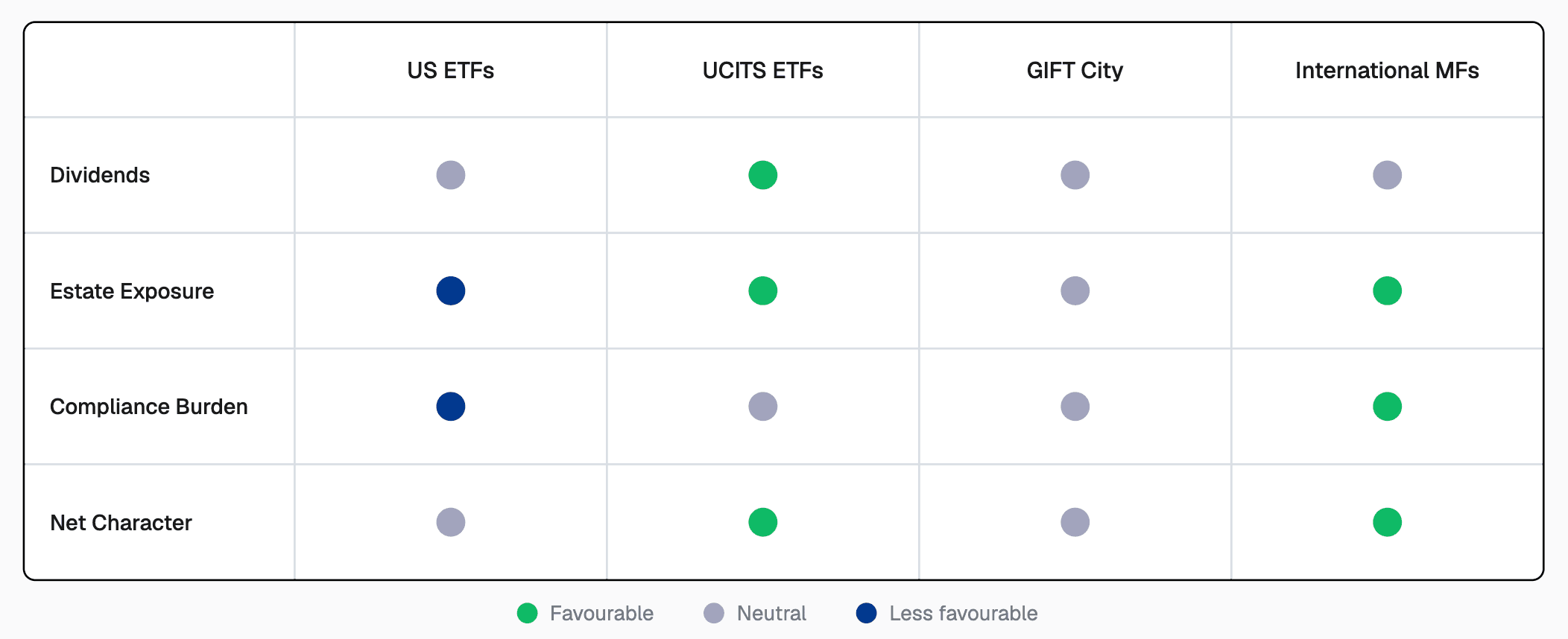
Every route can be judged on four tax questions, and it helps to hold all four together rather than fixating on any one.
The first is how capital gains are taxed. The structure of the holding can shift the timing of when that gain is realised, which matters more than it first appears.
The second is how dividends are taxed, and this is where routes genuinely diverge. A route that pays dividends into your hands creates a taxable dividend event. A route that reinvests dividends inside a fund.
The third is estate exposure. A route that leaves you holding US-situs assets directly carries the 40% estate tax exposure above the low threshold, with no treaty relief.
The fourth is the reporting and compliance burden, which is not a tax but is a real cost in effort and risk. An offshore route holding foreign-listed assets brings Schedule FA, Schedule FSI, Form 67, and the calendar-year reporting.
Route | Dividends | Estate exposure | Compliance burden | Net tax character |
Direct US stocks & ETFs | Full cycle: US withholding at treaty rate, India-side tax, foreign tax credit via Form 67 to reconcile | Highest. Directly held US-situs assets, squarely in the 40% net, no treaty relief | Full offshore reporting burden (FA, FSI, Form 67) | Deepest market and most control, but the least efficient wrapper for the same exposure |
UCITS ETFs (Irish, accumulating) | No personal dividend event; reinvested inside the fund, and Ireland's treaty reduces withholding on US holdings inside the fund | Generally none. Non-US-situated, so outside US estate tax | Still offshore reporting, but lighter on the dividend side (no personal dividend or annual FTC) | Same companies as a US ETF, answering three of four tax questions more favourably |
GIFT City funds | Shaped by IFSC's favourable fund-level treatment; varies by product | Differs from direct US holdings, since you hold through an IFSC structure, not US-situs assets | Varies by product; framework still evolving | Built to be tax-competitive, but check the specific product rather than the route |
International mutual funds (onshore) | Fund handles the cross-border side internally; no personal FTC machinery | None personally. You hold an Indian instrument, not US-situs assets | Lightest by far. Indian mutual fund, not a foreign asset, so minimal foreign-asset reporting | Quiet strength on tax and compliance; gives ground on internal cost and the domestic overseas cap |
One question. Less than 10 seconds.
Reinforce what you've learned before continuing to the next chapter.






Discussion