
There are several distinct ways an Indian can actually invest abroad, and they differ far more than they first appear. This module walks through each route, US ETFs, UCITS ETFs, GIFT City funds, and international mutual funds and then compares them across the dimensions that matter, so you can find the one that genuinely fits who you are.
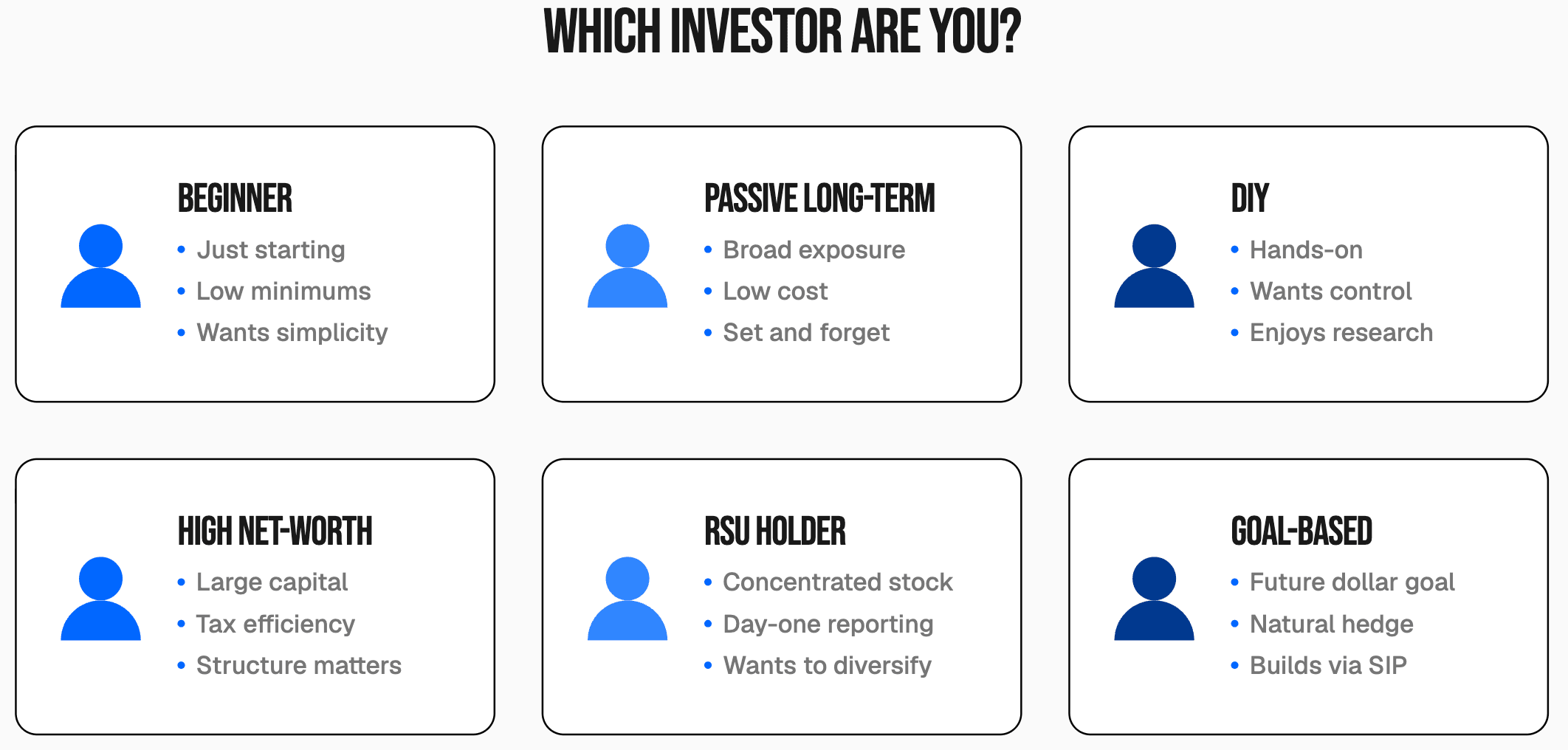
This is someone taking their first steps into global investing. They are not yet sure of the jargon, they want to start small, and above all they want simplicity and reassurance over control or optimisation. For a beginner, the worst outcome is feeling overwhelmed and giving up, so the priorities are an easy start, low minimums, and a route that does not demand foreign accounts or heavy paperwork.
This investor does not want to pick stocks. They want broad, diversified exposure, ideally through low-cost index funds or ETFs, set up once and largely left alone. Their priorities are low ongoing cost and simplicity of maintenance, and passive approach.
The do-it-yourself investor is the opposite of passive. They want to research, choose, and manage their own portfolio, and they value control and breadth of choice above convenience. This is the investor most likely to want individual stocks or a wide menu of ETFs. What they want above all is access to the widest possible universe and the freedom to build their own portfolio.
This investor has substantial capital to deploy, and that single fact changes their priorities. Costs that look tiny in percentage terms become large in absolute money. How a holding is structured for tax and estate purposes become genuinely important at scale. Their priorities are tax and structural efficiency, and they are usually willing to accept more complexity to achieve it.
This is an Indian who works for a multinational or a foreign-listed company and receives part of their pay as shares in that company, often US-listed. They already own foreign stock and often have concentrated exposure to a single foreign company. They have foreign holdings to report in taxation from day one, and they may want to diversify out of that concentration over time. Their priorities are understanding what they already hold, managing the concentration, and handling the reporting that comes with owning foreign shares.
This investor is not investing globally for a specific future need denominated in a foreign currency. The classic case is a parent saving for a child's overseas education, but it could equally be planning to travel, work, or retire abroad. Their liability is already in dollars, so holding dollar assets is not just diversification, it is a natural hedge: their savings and their future expenses move in the same currency. Their priorities are shaped by the goal's timeline and currency.
One important boundary. So far, the chapters are written for the resident Indian investor, and the rules that apply to them. Non-Resident Indians operate under different rules for remittance, taxation, and access, and several of the constraints in this course simply do not apply to them in the same way.
You have probably recognised yourself in one, or in a blend of two. To get from "this sounds like me" to "so this is what I should do," we need to compare the routes along the dimensions that actually separate them. Those comparisons come in next chapters, and the final chapter of this brings the profiles and the dimensions together into a single decision.
One question. Less than 10 seconds.
Reinforce what you've learned before continuing to the next chapter.






Discussion