
There are several distinct ways an Indian can actually invest abroad, and they differ far more than they first appear. This module walks through each route, US ETFs, UCITS ETFs, GIFT City funds, and international mutual funds and then compares them across the dimensions that matter, so you can find the one that genuinely fits who you are.
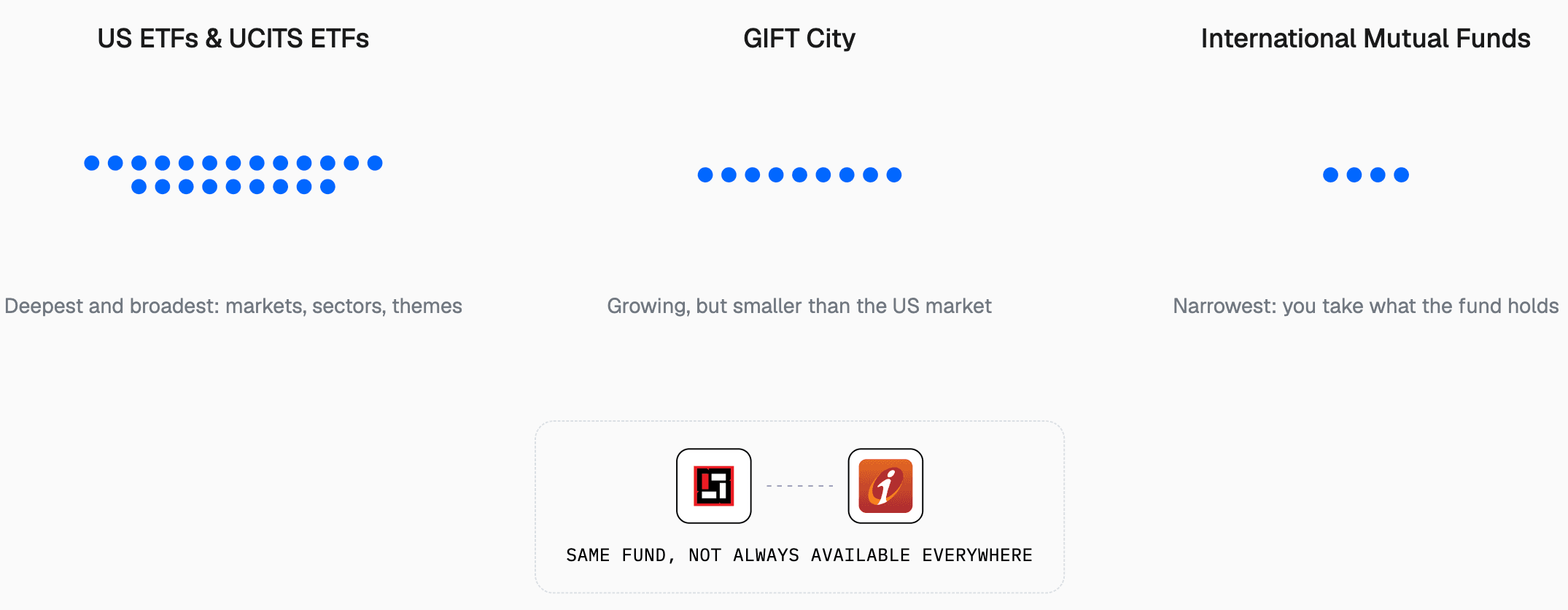
The offshore ETF routes offer the most. US and UCITS ETFs, in particular, open onto the deepest and broadest market anywhere, almost any exposure you could want, across markets, sectors, and themes, usually in several competing versions.
The onshore route is the most constrained. With international mutual funds, you take whatever the fund holds. You are choosing a fund and the range of foreign exposures available through Indian fund houses is far narrower than the US market.
GIFT City’s range of global funds and stock access is growing quickly but is still smaller than the vast US market. It also faces the same problem as mutual funds: products are not universally accessible across all platforms. This means a particular fund offering exposure to US defence stocks on HDFC might not be available on ICICI.
You met a breakdown of costs in Module 1 relevant for this discussion. We are looking only at pre-tax costs here; taxation has its own modules.
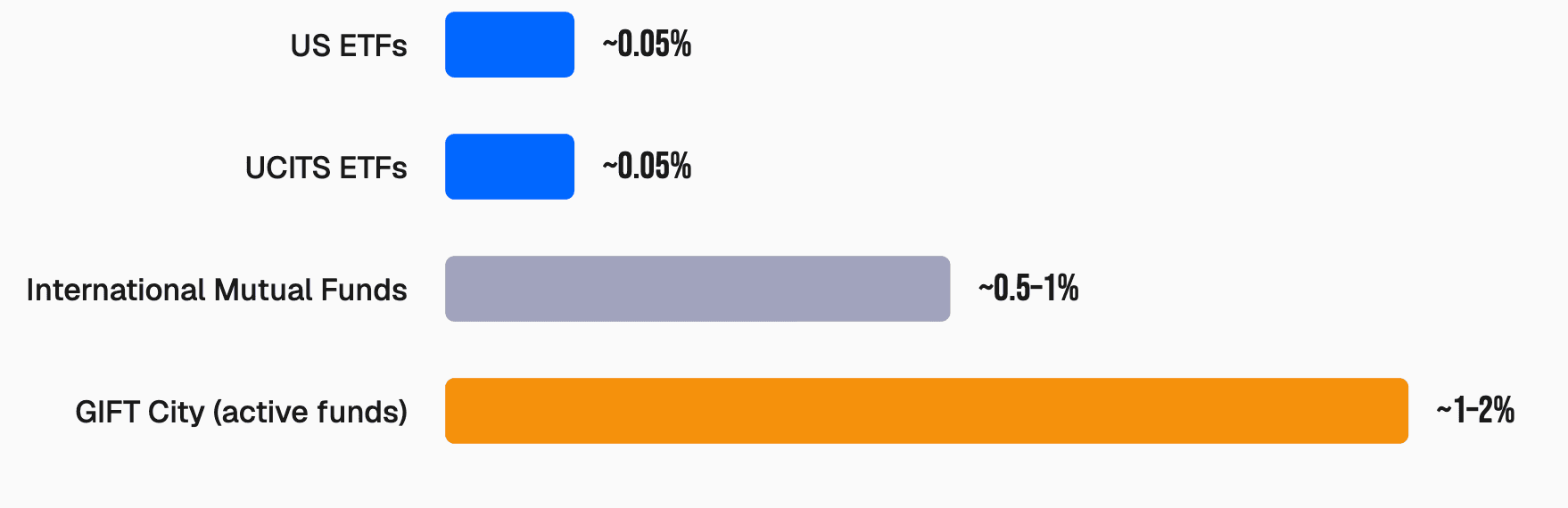
US ETFs tend to offer some of the lowest costs anywhere, with broad index funds charging expense ratios as low as around 0.05% a year, alongside the widest range of low-cost products available globally. UCITS ETFs are comparably affordable, giving up very little on cost in exchange for their structural advantages.
GIFT City costs vary significantly by product and by provider platform, driven mostly by management expenses. An actively managed GIFT City fund, for instance, may charge in the region of 1 to 2% a year on your investment, considerably more than a plain index ETF.
International mutual funds usually involve additional layers of expense, because you are typically reaching overseas markets through an intermediary fund structure. Expense ratios, management fees, and exit loads can inflate the costs, though this route generally still works out cheaper than an actively managed GIFT City fund, often landing somewhere around 0.5 to 1% of your investment.
One question. Less than 10 seconds.
Reinforce what you've learned before continuing to the next chapter.






Discussion