
If you're moving back to India after years abroad and qualify for the RNOR status, this module is for you and everything that becomes important due to this move. Your foreign brokerage account, your retirement savings, your RSUs, the property you may own abroad; each piece has its own rules and its own timeline that becomes critical for the future of these entities.
Under Section 6(4) of FEMA, you're legally entitled to continue holding foreign stocks and ETFs you acquired while you were a resident outside India, indefinitely. Moving back doesn't force a sale. Whatever you built abroad, you're allowed to simply keep.
The law permitting you to hold isn't the same as your broker permitting it. Some foreign brokerage platforms, particularly retail-focused fintechs, don't support non-resident accounts at all.
Once you update your address to India, they may restrict your account to sell-only, or force a closure outright. Others allow you to convert to an international account, but often with new-fund restrictions, weaker FX rates, and higher fees than what you had as a resident there.
If your broker is pushing you toward liquidating, selling isn't the only option, and it's rarely the best one, since it triggers an actual taxable event you don't need to create.
The better route is an in-kind transfer, moving your holdings exactly as they are to a new platform, without selling and rebuying. In the US this runs through ACATS; in Canada, the equivalent mechanism is called AON; most developed markets have some version of the same process.
The specifics vary by country and broker, but the principle holds everywhere: your shares move intact, preserving both your original cost basis and your holding period, to a platform built to work with Indian residency rather than fight it.
Capital gains on your foreign stocks and ETFs only become taxable in India once you're a full Ordinary Resident. During RNOR, and while you were still an NRI, those gains fall outside India's tax net entirely, governed by the same master rule from earlier in this module: exempt, provided the proceeds are received into your foreign account rather than sent directly to India.
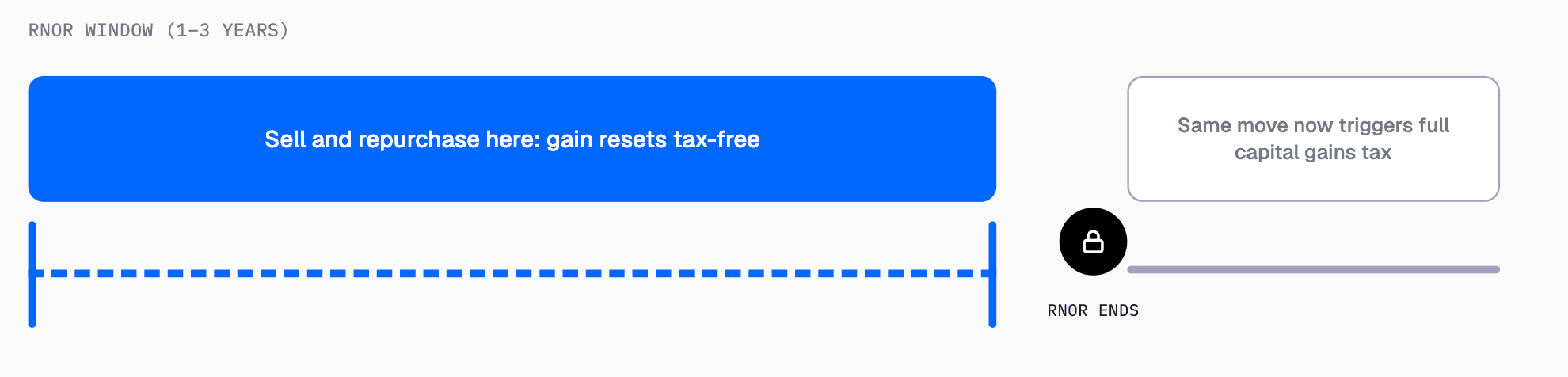
This creates a time-limited opportunity. If you're holding foreign stocks with substantial embedded gains, built up over years, selling and immediately repurchasing the same position while you're still RNOR resets your cost basis to today's market value, tax-free. Once you cross into full residency, that same sale would trigger Indian capital gains tax on the entire embedded gain. Do it while RNOR still holds, and that gain simply never enters India's tax calculation at all.
You're under no obligation to sell your foreign holdings just because you've moved, and if your broker forces the issue, an in-kind transfer avoids an unnecessary tax event entirely. The next chapter turns to a different kind of foreign asset: your retirement accounts.



Discussion