
If you're moving back to India after years abroad and qualify for the RNOR status, this module is for you and everything that becomes important due to this move. Your foreign brokerage account, your retirement savings, your RSUs, the property you may own abroad; each piece has its own rules and its own timeline that becomes critical for the future of these entities.
Once you're a resident under FEMA, continuing to hold NRO or NRE accounts is a violation. You're required to inform your bank and convert them. This is worth doing promptly rather than treating it as paperwork to handle whenever convenient, since it's a legal obligation that starts the moment you land with the intention to stay, not once your tax residency is confirmed.
Your NRE and NRO accounts, the two you relied on throughout your time as an NRI, need to be converted. Broadly, they become either an ordinary resident savings account or the new account type built for exactly this transition, the RFC account, which we'll come to in the next chapter in depth.
Your foreign bank accounts are a different story. Under Section 6(4) of FEMA, you're allowed to continue holding and operating foreign bank accounts, along with foreign stocks and property, if they were acquired while you were genuinely a resident outside India. There's no requirement to close them. In fact, keeping your foreign bank account open is often the single most important step in actually being able to use your RNOR exemptions, since without a foreign account to receive income into, the foreign-account-first rule has nothing to work with.
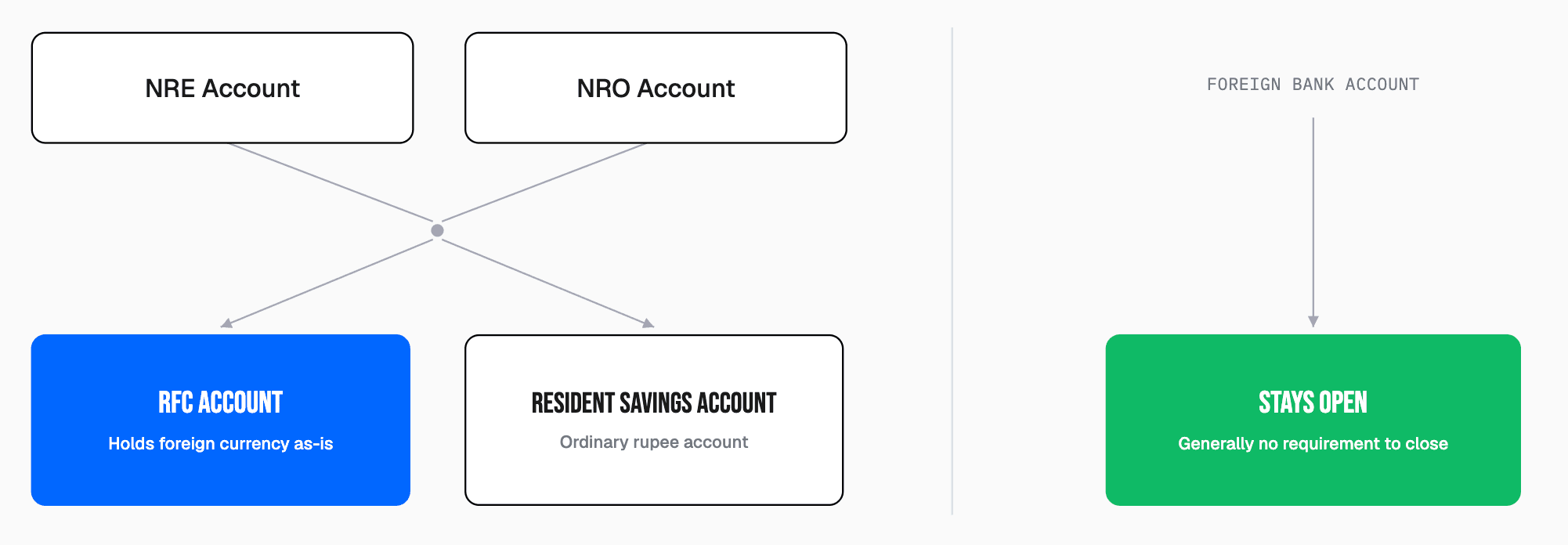
Alongside converting your NRE and NRO accounts, you gain access to a new option: the Resident Foreign Currency account, or RFC. This lets you hold foreign currency earnings in foreign currency form, without converting them into rupees.
For anyone expecting ongoing foreign income during their transition, rent from property still held abroad, a pension, retirement account withdrawals, dividends, this avoids repeatedly converting currency back and forth, and it preserves your exposure to foreign currency rather than locking it into rupees the moment it arrives.
The moment you return, your NRE and NRO accounts must be converted, your foreign accounts can stay open and generally should, and the RFC account gives you a purpose-built home for foreign currency income without forcing an immediate conversion to rupees. With the account structure settled, the next chapter turns to the RFC account specifically, and the practical mechanics of what it can and can't be used for



Discussion