
If you're moving back to India after years abroad and qualify for the RNOR status, this module is for you and everything that becomes important due to this move. Your foreign brokerage account, your retirement savings, your RSUs, the property you may own abroad; each piece has its own rules and its own timeline that becomes critical for the future of these entities.
Recall the master rule that's run through this entire module: while you're RNOR, your foreign-sourced income stays exempt from Indian tax, provided it's received into a foreign account first.
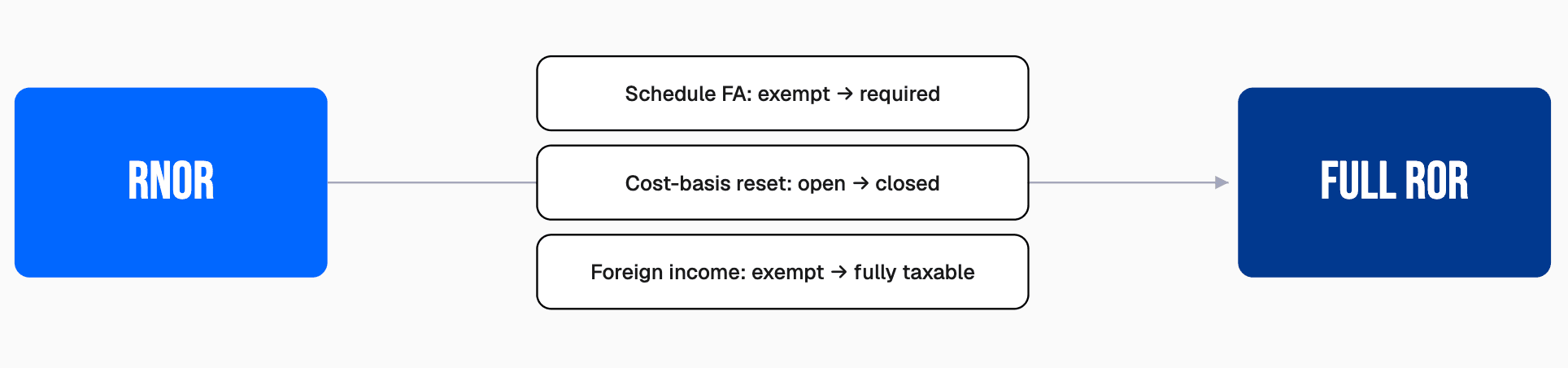
The moment you become a full Ordinarily Resident, ROR, that rule simply stops applying. From that point forward, your worldwide income is taxable in India, in full, regardless of which account it lands in or where it was earned. This is the same principle the rest of this course has assumed all along for a resident Indian investor, it's simply arriving for you a little later, once your RNOR window has run out.
Once you're a full ROR, you're no longer a special case with a transitional rulebook. You're a resident Indian investor, in exactly the sense the rest of this course has been built around, remittance rules, route comparisons, capital gains treatment, everything covered in the modules on taxation arising in India and abroad now applies to you directly, without any RNOR exemption softening the picture.
If you're holding onto foreign stocks, retirement accounts, or property beyond this point, the taxation modules elsewhere in this course become your ongoing reference, not this one.
One specific, important consequence deserves its own mention. Throughout your time as an NRI and through your RNOR window, you were exempt from Schedule FA, the foreign asset disclosure requirement.
That exemption ends with RNOR. Once you're a full ROR, any foreign asset you hold, a brokerage account, a retirement account, property, has to be disclosed annually, with the same peak-value and closing-value detail, and the same steep non-disclosure penalties, that apply to every other resident Indian investor. If you've been carrying foreign holdings through your transition, this is the point at which they need to start appearing on your return.
RNOR isn't a fixed, universal duration, it depends on your own residency history, and it ends the moment you meet the tests for full ROR status: broadly, having been a resident in India for at least 2 of the preceding 10 years, and at least 730 days across the preceding 7 years. Because this is based on a rolling count rather than a flat "three years and you're done" rule, it's worth tracking your own numbers each year rather than assuming the window is still open by default.
Several of the opportunities covered earlier in this module exist only while RNOR holds, and it's worth treating this chapter as a final checklist rather than just an ending.
The cost-basis reset on foreign stocks and RSU shares, selling and repurchasing tax-free in India, only works while you're RNOR. Large withdrawals from foreign retirement accounts are shielded from Indian tax only during this window.
Selling foreign property tax-free in India depends on the sale falling inside RNOR, not after it. None of these opportunities carry over once you cross into full residency, they simply close, and whatever gains have accumulated by that point become taxable the next time you act on them.
If any of these apply to your situation, this is the point in the module to go back and actually act, not simply to have read about them.
RNOR ends quietly, determined by your own day count rather than a fixed date, and the moment it does, the exemptions this entire module has been built around stop applying.
You become, from that point forward, the resident Indian investor the rest of this course was written for, with Schedule FA now a live obligation and worldwide income fully in India's tax net.
The final chapter of this module gathers the mistakes returning Indians make most often, across every stage of the journey this module has covered.



Discussion