
If you're moving back to India after years abroad and qualify for the RNOR status, this module is for you and everything that becomes important due to this move. Your foreign brokerage account, your retirement savings, your RSUs, the property you may own abroad; each piece has its own rules and its own timeline that becomes critical for the future of these entities.
If your RSUs finish vesting before you move, the answer is simple: that income was earned entirely abroad, taxed there in full, and India has no claim on it. If they vest after you've already moved, the answer gets more specific.
The income isn't simply "foreign" or "Indian" based on where you happen to be sitting on the vesting date.
It's split, based on the actual number of workdays you spent in each country across the entire vesting period, from grant to vest.
Say you had a four-year RSU grant. You worked abroad for three of those years, then returned to India roughly a year before the grant finished vesting. At vesting, the shares are worth ₹40 lakh in total.
The split follows your actual workday count across all four years, not just the final year. If three-quarters of your workdays across the full vesting period were abroad, roughly ₹30 lakh of that value is foreign-source income. The remaining quarter, spent working in India, makes roughly ₹10 lakh India-source.
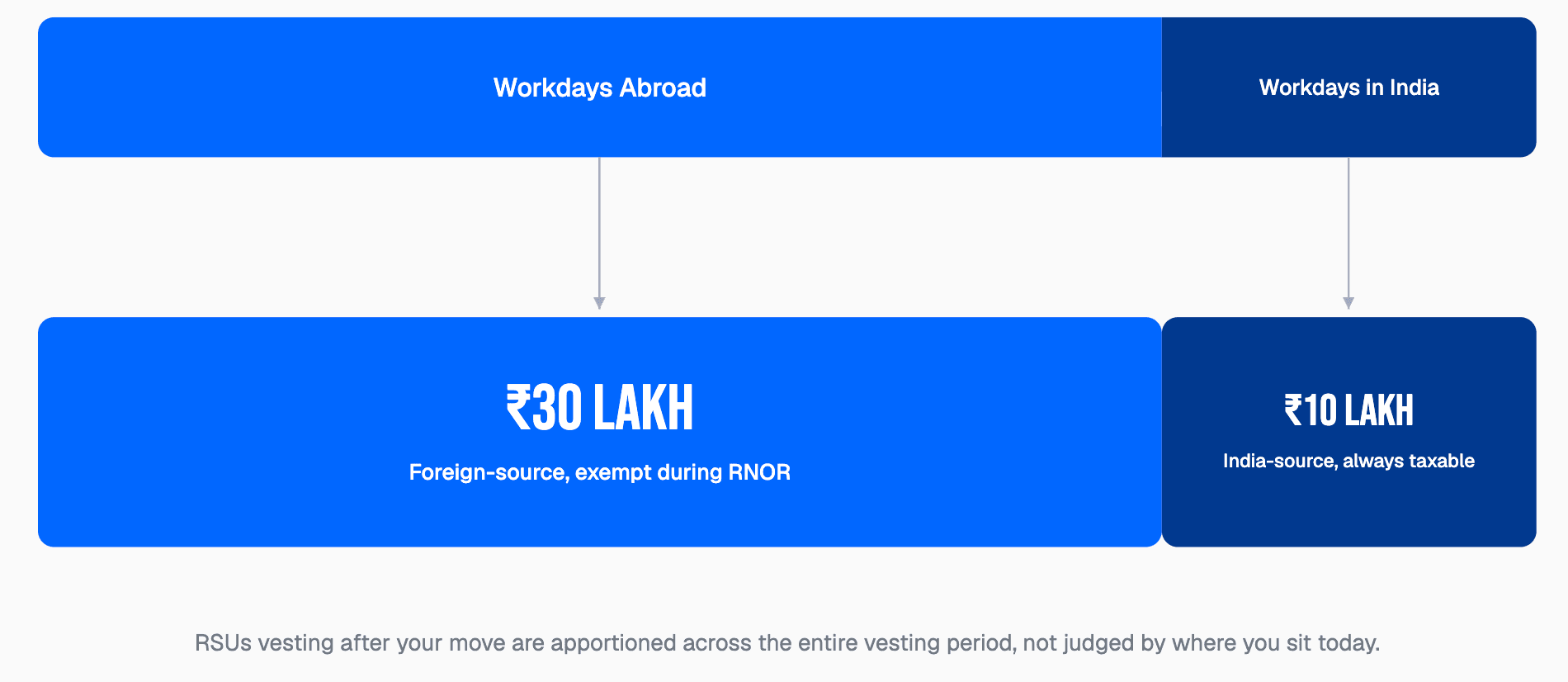
The foreign-source ₹30 lakh is exempt from Indian tax while you're RNOR, sheltered by the same master rule that's run through this entire module. The India-source ₹10 lakh is not. It's taxed in India as ordinary salary income, at your slab rate, regardless of your RNOR status. RNOR shelters foreign-sourced income; it was never going to shelter income you earned by physically working in India, no matter how the rest of the grant is treated.
Once your RSUs vest and become shares you hold, they behave like any other foreign equity from here. Your cost basis is the fair market value at vesting, and any gain from selling later is calculated from that point forward. If you sell while you're still RNOR, that gain is exempt in India too, and it closes the same way, the moment your RNOR window ends.
For shares not listed on an Indian exchange, which is most foreign RSUs, the fair market value used for Indian tax purposes has to come from a valuation by a SEBI-registered Category 1 Merchant Banker, not simply the number on your US brokerage statement.
Relying only on the brokerage figure, without this formal valuation, has led to real compliance problems for people who assumed one number was as good as another.
Because the apportionment depends on a full workday count across the entire vesting period, sometimes four years or more, the practical advice is simple: keep a workday log from the grant date onward.
Your employer's payroll team may track something similar, but verifying the apportionment is legally your own responsibility, and reconstructing years of travel history after the fact is far harder than logging it as you go.
RSUs that straddle your move are split by workday, not by a single date, with the India-sourced portion always taxable and the foreign-sourced portion sheltered only while RNOR holds. The next chapter turns to a different asset entirely, one that often comes with its own country-specific complications: property you still own abroad.



Discussion