
If you're moving back to India after years abroad and qualify for the RNOR status, this module is for you and everything that becomes important due to this move. Your foreign brokerage account, your retirement savings, your RSUs, the property you may own abroad; each piece has its own rules and its own timeline that becomes critical for the future of these entities.
Resident but Not Ordinarily Resident is a transitional tax status. It applies for a window of one to three years after you return, and while it holds, your foreign income is treated in a way that's much closer to how it was treated when you were an NRI than to how a full resident is taxed.
You qualify for RNOR if you meet any one of a few conditions.
There's also a specific case worth knowing: an Indian citizen with Indian income above ₹15 lakh who isn't liable to tax in any other country is automatically classified as a "Deemed Resident," and deemed residents are always treated as RNOR.
The precise combination that applies to you depends on your own travel history, but the shape is consistent: RNOR isn't something you apply for, it's a status you land in based on how gradually or abruptly your residency shifted.
Recall that FEMA residency and tax residency run on different clocks. Here's what that actually means in practice.
The moment you land in India intending to stay, your bank accounts are already required to convert under FEMA, regardless of what your tax status will eventually turn out to be for that financial year. Your RNOR classification, by contrast, gets determined only once the year's day count is complete.
So you can be mid-transition on the banking side well before your tax status has caught up, which is exactly why the next chapter treats account redesignation as its own distinct, immediate task.
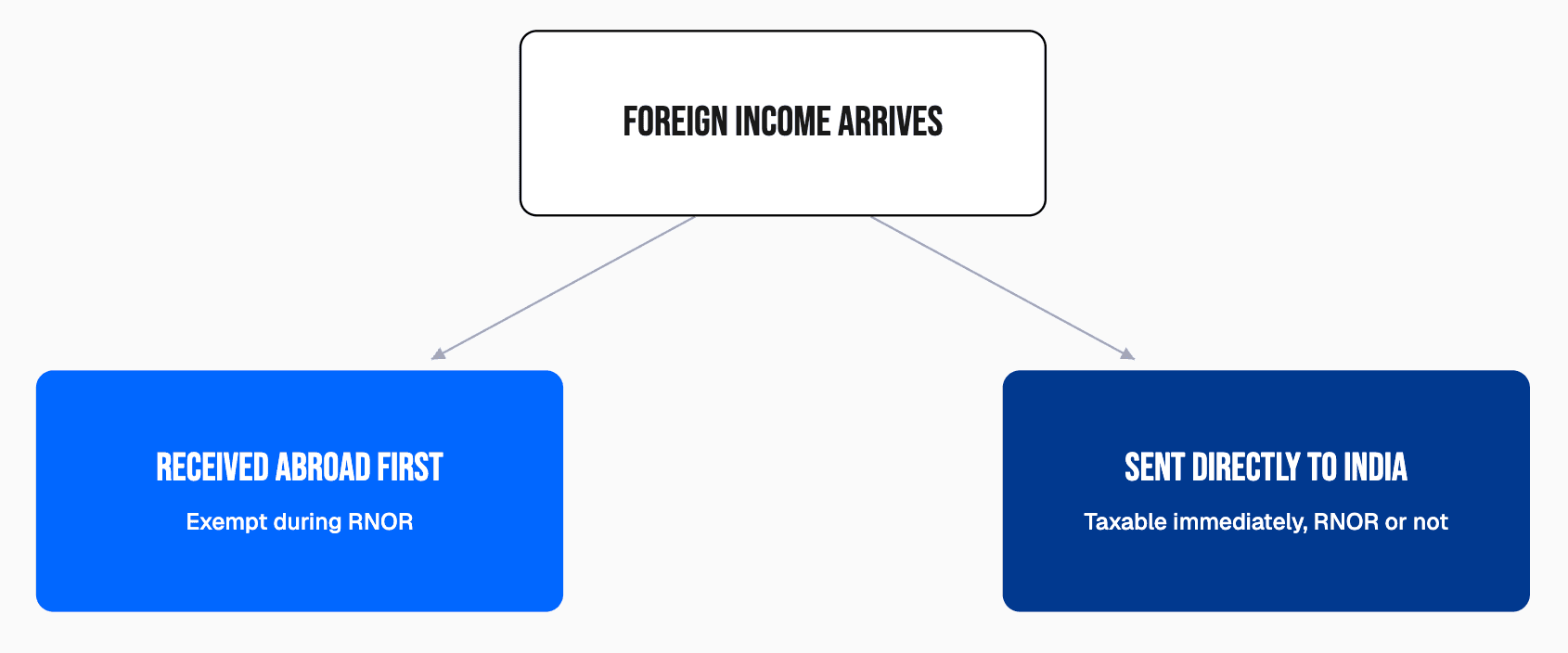
While you're RNOR, your foreign income is exempt from Indian tax, but only if it's received into a foreign bank account first. If that same income is instead sent directly into an Indian account, it becomes taxable in India immediately, RNOR status notwithstanding.
This one rule is what underlies nearly every benefit RNOR offers. It's why keeping a foreign bank account open through your transition matters more than almost any other single decision.
Capital gains from selling foreign stocks and ETFs are tax-free in India during RNOR, which also opens a genuine window to reset your cost basis by selling and repurchasing without an Indian tax cost.
Foreign bank interest and dividends are tax-free. Withdrawals from foreign retirement accounts, often the single most valuable RNOR benefit given how heavily some of these accounts are taxed elsewhere, are not taxed by India during this window.
Foreign rental income is tax-free, provided the tenant pays into your foreign account rather than directly to India. And gains from selling foreign property are exempt in India entirely during RNOR.
RNOR exempts foreign-sourced income. If you work remotely for a foreign employer while physically located in India, that salary is still treated as accruing in India, because the work itself happens here. It's India-sourced income, fully taxable, regardless of RNOR status, regardless of which country's bank account the salary lands in.
Schedule FA, the foreign asset disclosure requirement, does not apply to RNOR, and neither does Schedule FSI. That obligation switches on only once you become a full Ordinary Resident.
RNOR is a genuine window, one to three years, built around a single rule: foreign income stays exempt only if it's received abroad first.
Everything from here, your bank accounts, your investments, your retirement savings, your RSUs, your property, is really an application of that one rule to a different piece of your financial life.
The next chapter starts with the most immediate of them: what has to happen to your bank accounts the moment you land.



Discussion