
If you're moving back to India after years abroad and qualify for the RNOR status, this module is for you and everything that becomes important due to this move. Your foreign brokerage account, your retirement savings, your RSUs, the property you may own abroad; each piece has its own rules and its own timeline that becomes critical for the future of these entities.
If you're moving back to India after years abroad, this module is for you and everything that becomes important due to this move.
Your foreign brokerage account, your retirement savings, your RSUs, the property you may own abroad, none of it simply follows you home automatically. Each piece has its own rules and its own timeline that becomes critical for the future of these entities.
We assume here that you've read, or are at least familiar with, how NRI status works, since returning to India is fundamentally a transition out of that status. If not, we encourage you to go through the module designed for NRIs. Where it matters, we'll recap the relevant piece briefly.
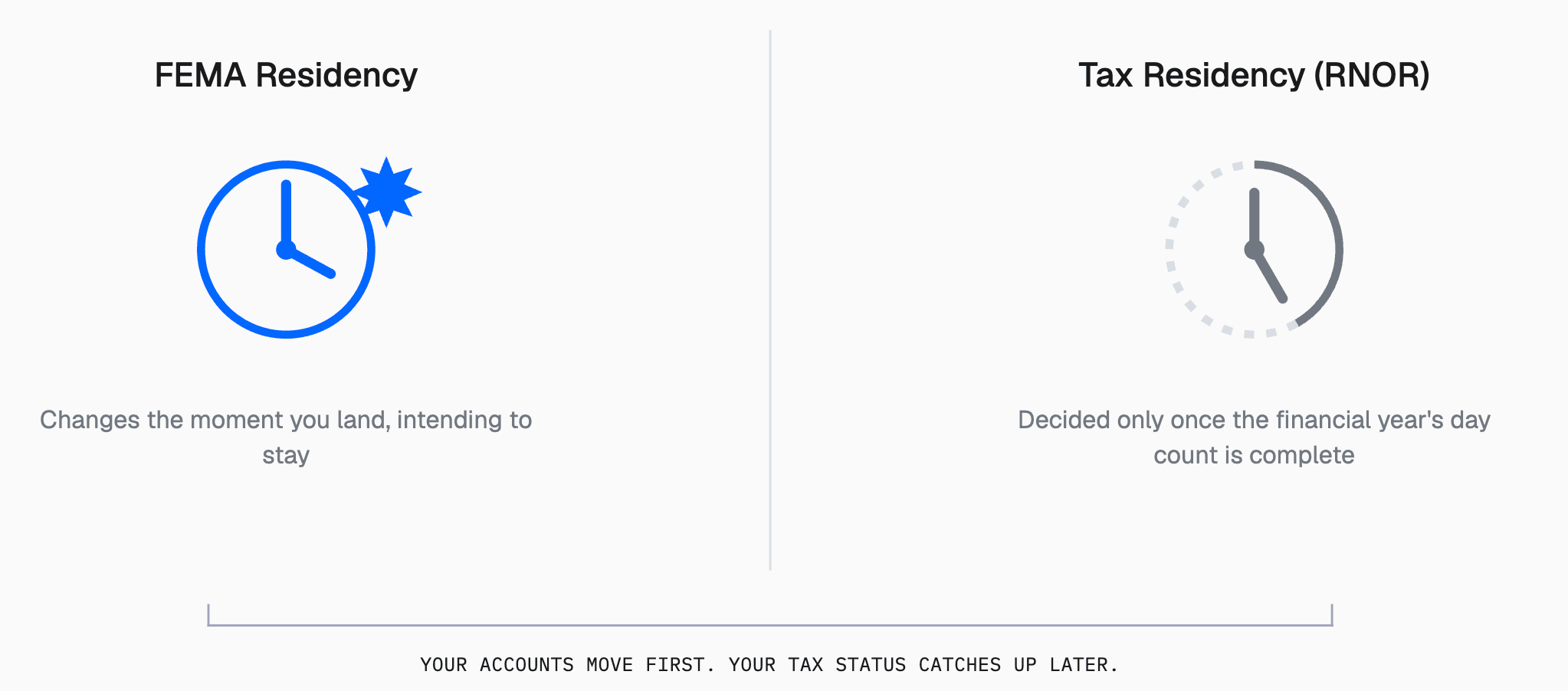
Moving back is a bit complex. Two different clocks start running the moment you return, and they don't run at the same speed.
Your FEMA residency, which governs your bank accounts, changes the moment you land with the intention of staying. Your tax residency, which governs how your income is taxed, is decided by counting days across the financial year, the same day-count logic from the NRI module. This means your accounts can be legally required to convert before your tax status has actually shifted.
Bridging the two is a transitional tax status called RNOR, Resident but Not Ordinarily Resident, which holds for up to three years and treats your foreign income in a way that's much closer to your NRI days than to a full resident's. Understanding RNOR properly, therefore, becomes uniquely critical.
We start with RNOR itself: what qualifies you for it, how long it lasts, and the rules that determine whether you actually get its benefits or accidentally forfeit them.
From there, we work through the pieces of your financial life in the order you're likely to actually deal with them.
Your bank accounts, which have to be redesignated the moment you return.
Your foreign investments, and how to move them without triggering a tax event you didn't need to trigger.
Retirement accounts, which follow a different logic depending on the country and the type.
RSUs that are still vesting when you move, which get split between your old country and India in a way most people never expect.
Foreign property you may still own, both the rental income and an eventual sale.
And a risk that actually belongs to the other end of your journey, the exit tax some countries charge on the way out, before you've even landed in India.
We close with what changes once RNOR ends and you become a full resident, and the mistakes returning Indians make most often across all of it.



Discussion